A recent Government Accountability Office report reveals what’s been obvious to broadband deployment experts for years now: the federal government’s multi-agency approach to closing the digital divide is undermined by a lack of coordination and data-management among agencies.
Researchers say they’re concerned that a massive influx of new federal grant money being redirected to Elon Musk’s Starlink satellite broadband company in Ohio will be thwarted by the simple fact that many targeted locations don’t have a clear, unobstructed view of the sky.
Researchers tells Pennsylvania House Communications & Technology Committee that persistent attacks by the federal government on Internet affordability protections and social safety nets are directly resulting in a drop in overall broadband adoption, with large numbers of low-income Americans unable to afford modern connectivity — and the vast benefits it provides.
As Digital Inclusion Week 2026 kicks off October 4-10, the Building for Digital Equity webinar series — co-hosted by the Institute for Local Self Reliance’s (ILSR) Community Broadband Networks Initiative and the National Digital Inclusion Alliance (NDIA) — returns on October 8th.
Chris and Doug Dawson break down new Ookla FWA data, critique the FCC’s flawed mapping challenges, examine the final BEAD funding numbers, and tackle the wild economics of artificial intelligence.
The New Hampshire Electric Cooperative (NHEC) has been awarded a $5.58 million federal broadband grant to help expand affordable fiber access to the rural and underserved parts of its service territory in The Granite State.
Paulding Putnam Electric Cooperative (PPEC) was awarded $13.2 million in federal broadband grant support to help fund a major fiber-to-the-home expansion to rural unserved segments of northeast Indiana.
The Texas Broadband Development Office (BDO) says that it has placed Broadband, Equity, Access, and Deployment (BEAD) broadband grant money on hold to address continued claims that the program has been unfairly tilted to the direct benefit of billionaire Elon Musk.
ILSR publishes new piece in The American Prospect on how the "One Big Beautiful Bill Act" cuts food assistance benefits to households that pay for internet access.
The FCC’s Universal Service Fund has survived a Supreme Court challenge by a right wing activist nonprofit, but the program – which for decades has helped extend broadband to underserved rural homes and schools – still faces a precarious immediate future. It is a peculiar political story, given that the rural regions that overwhelmingly vote for Republicans are now seeing Republicans try to dismantle a program that has been crucial for rural investment and development.
If you missed our Building for Digital Equity “Wired for Freedom” Livestream, you can watch it in its entirety here. The second UTOPIA Fiber-sponsored event of the year, hosted in partnership with the National Digital Inclusion Alliance (NDIA), brought together community-based digital inclusion practitioners and policy experts to talk about the road ahead for expanding broadband access amid a rapidly shifting political landscape.
California lawmakers’ efforts to pass a new law mandating affordable broadband access is at risk of being destroyed by industry lobbying. California insiders say the changes are so dramatic they may wind up making broadband affordability in the state worse – undermining years of digital equity activism and discarding a rare opportunity to bridge the digital divide.
On Tuesday, July 1, the Institute for Local Self-Reliance and National Digital Inclusion Alliance will present the next Building For Digital Equity event - Wired For Freedom: Digital Access and the American Dream. It will run from 3:00 - 4:15 ET.
Empower Broadband, a wholly-owned subsidiary of Virginia-based Mecklenburg Electrical Cooperative, says it has successfully deployed affordable fiber access to more than 7,500 subscribers across long-neglected and underserved portions of the Old Dominion state. Like many cooperatives, Mecklenburg and Empower are leveraging generations-old experiences at rural electrification to migrate into the broadband business.
Maine Connectivity Authority President Andrew Butcher leads five-day “Driving Connections” tour to highlight broadband infrastructure investments the state has made to bring high-speed Internet access to 86,000 homes and businesses over the past several years and rally support for future work. The first stop on the tour is today, at the Woodstock Library, where Butcher and his team will meet with the town’s librarian, the town manager, and a digital navigator to hear how the state broadband office can continue to support community-based digital inclusion work in western Maine.
Baltimore city leaders have issued a request for proposals (RFP) for a partner willing to help the city’s ongoing efforts to expand affordable broadband access to marginalized city residents. According to the RFP, the city’s latest efforts would help bring affordable, high-speed Internet to over 4,100 new housing units spread across eight different public housing communities.
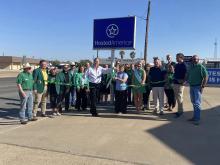
The remote West Texas city of Monahans has spent the last decade taking matters into their own hands and now the city’s 7,500 residents are headed for the right side of the digital divide. The city’s network build is in partnership with Hosted America, which is acting as the first last mile ISP serving residents.
Clallam County, Washington and Astound Broadband have begun construction on a major new joint partnership that will bring affordable fiber access to more than 1,500 homes across the largely rural Northwestern part of The Evergreen State. The deployment is a joint collaboration between The Public Utility District (PUD) No. 1 of Clallam County, Astound Broadband, and the Northwest Open Access Network (NOANet), a nonprofit coalition developed by regional Washington Communications Utility Districts (CUD) to bring more reliable, affordable fiber access to neglected rural Washington communities.
Trump administration changes to the $42.5 billion Broadband Equity, Access, and Deployment (BEAD) grant program are poised to introduce years of potential new delays to the already slow-moving program, potentially undermining the program’s goal of bringing universal broadband access to mostly rural communities. Worse, the looming changes would eliminate efforts to ensure taxpayer-funded broadband is affordable for low-income Americans, while driving billions in new subsidies to the world’s richest man and Trump mega donor Elon Musk.