


The Texas Broadband Development Office (BDO) says that it has placed Broadband, Equity, Access, and Deployment (BEAD) broadband grant money on hold to address continued claims that the program has been unfairly tilted to the direct benefit of billionaire Elon Musk.
In July, the office faced widespread accusations that Trump administration changes made to the BEAD program deprioritized faster fiber technologies and gave an unfair advantage to Elon Musk, Jeff Bezos, and their slower, more congested low-Earth-orbit (LEO) satellite technologies.
The changes were part of the Trump administration’s misleadingly-named “benefit of the bargain” modifications, which eliminated requirements that taxpayer-funded broadband be affordable to the public, removed efforts to ensure equitable broadband delivery, and doled out billions to Musk and Bezos for satellite service they’d already planned to deploy.
An email obtained by the Texas Tribune sent from the state broadband office to subgrantees says that a hold is being placed on all BEAD disbursements “until further notice.”
“No further action is required from subgrantees at this time,” the office said in the email. “The BDO will provide additional guidance and updates as they become available.”
The email does not provide a reason for the hold, and the Texas Broadband Office did not respond to a request for comment. But the hold comes just a week after Texas Comptroller Don Huffines announced a comprehensive internal review of his office, including the state broadband office, in part to address complaints of Musk favoritism.
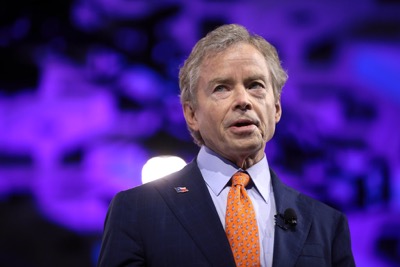
“As chief financial officer of the state, it is my obligation to ensure that taxpayers have a strong advocate and an alert watchdog looking out for their interests,” Huffines said.
Broad Accusations Of Cronyism
As we’ve noted for months, dramatic, unpopular, and at times unlawful changes to BEAD by the National Telecommunication and Information Administration (NTIA) have resulted in infighting and delays, after the Trump administration steered billions in taxpayer funds to slower and more congested satellite broadband networks owned by the President’s biggest donors.
The broadly-criticized shift was sold as a new “benefit of the bargain” program necessary to “cut costs.” The change required that all 56 BEAD eligible states and territories complete a “benefit of the bargain” round of subgrantee selection and completely retool their broadband deployment plans – often at significant cost to states.
As part of that retooling, the Trump administration demanded that states prioritize the cheapest – but not necessarily the best, most future proof, or reliable – broadband options, a direct nod to lobbying pressure from LEO satellite providers like Elon Musk’s SpaceX and Starlink, and Jeff Bezos’ Leo (previously project Kuiper).
But shifting funding priority from affordable fiber to congested and expensive satellite broadband service actually risks driving up monthly costs for Americans, and dramatically undermines a once-in-a-lifetime opportunity to bridge the digital divide.
In part because Musk and Bezos already planned to deploy these networks without taxpayer subsidization, but also because research has continued to show that Starlink struggles with congestion when it attempts to scale, making it an unsuitable – and often expensive – option for Americans stuck without affordable, fast Internet access.

The Trump administration has claimed, without evidence, that shifting so much taxpayer money to Bezos and Musk “saved” taxpayers roughly $21.5 billion of the BEAD program’s original $42.5 billion slated for Internet access.
But Congressional law required the full $42.5 billion be spent on broadband, and the Trump administration has refused to clarify what’s to become of the missing “non deployment funds.”
Bipartisan Annoyance In The Lonestar State
In states like Texas, the complaints about the changes are becoming increasingly bipartisan as public backlash grows. During a recent Texas Senate committee hearing, Texas Republican Sen. Charles Schwertner said his office has been fielding complaints from taxpayers regarding the redirection of infrastructure bill money.
“I have my eye on y’all regarding the way y’all are conducting your business,” Schwertner told BDO Director Bryant Clayton. “I don’t care who’s messing with your business, but we, as an oversight committee, are going to oversee it regarding fairness and transparency.”

Texas Sen. Nathan Johnson, a Dallas Democrat running for Texas Attorney General, has also leveraged the accusations of Musk favoritism in campaign messaging.
“Without drawing conclusions for the moment, the whole process may have involved coordinated corruption among the Trump administration, the illegally empowered DOGE czar Musk, private entities (Starlink), the governor’s office and the broadband development office,” Johnson said in a statement.
Texas Lieutenant Governor Dan Patrick and House Speaker Dustin Burrows also issued a joint statement calling for an audit of the state’s broadband office due to concerns being raised about the BEAD award process.
“The Office’s grant award process should be open to the public, accountable to the stakeholders, informed by the most accurate mapping and data available, and focused on the responsible use of taxpayer dollars,” the duo wrote.
While an audit of the Texas State Broadband Deployment Office is underway, there has been no announcement of an expected completion date. Any reforms made to the process wouldn’t be implemented until the next legislative session, starting next January.
Texas is poised to get the most BEAD funding of any state ($3.3 billion) despite Texas Senators Ted Cruz and John Cornyn both voting against the 2021 infrastructure bill that made the funding possible in the first place.
Header image of Texas flag courtesy of Kimberly Vardeman on Flickr, CC BY 2.0
Inline image of Texas Comptroller Don Huffines courtesy of Gage Skidmore on Flickr, CC BY-SA 2.0
Inline image of Elon Musk surveying crashed rocket courtesy of Wikimedia Commons, CC BY 2.0, Attribution 2.0 Generic