

Los Alamos County, New Mexico is inching closer to the launch of its Atomic Fiber county-wide open access fiber network, which aims to dramatically improve affordable Internet access to the county’s 19,400 heavily-rural residents.
Network construction formally began in May, and county officials say they’re hopeful the first customers will come online by the end of the year.
“We have been delayed a bit with getting our Phase 1 construction done, so first customers will likely be December,” Los Alamos County broadband manager Jerry Smith tells ILSR.
The project was first conceived back in 2024, after locals expressed continued aggravation at the high prices, spotty coverage, and slow speeds of regional telecom monopolies. Officials settled on an open access network that will allow private ISPs to compete in layers on top of the county’s publicly-owned infrastructure.
“Although a need for Internet upgrades in Los Alamos County has long been clear, the private sector was unwilling to take the project,” county officials wrote. “In response, the Los Alamos County Council awarded contracts to Bonfire Fiber to design and build a fiber-to-the-premise (FTTP) network for $35 million at the November 19, 2024 Council Meeting.”
The $35 million network price tag is being financed via $40 million in New Mexico Gross Receipts Tax (GRT) revenue bonds. County leaders have stated that the 20-year maintenance and operations cost of the network will be around $15.9 million and paid off via subscription revenues.
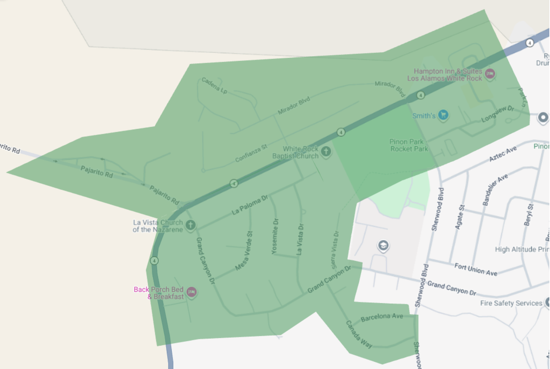
Once completed, every last rural county resident will have access to next-generation fiber at speeds and prices much better than what’s available in many dense urban markets.
Open Access Brings Open Competition
Data historically indicates that the open access model results in faster, cheaper broadband access as ISPs compete over a shared infrastructure. But because it challenges the monopoly dominance of large private telecom monopolies, the model has historically been under-utilized here in the United States.
At the same time, studies have also consistently found that locally-owned municipal broadband operations – usually built and staffed by local residents – tend to be more directly accountable to the public.
When we last checked in with Los Alamos county leaders last March, they’d just struck agreements with the partner ISPs that will be the competitive backbone of the county’s ambitious open access fiber network (XMission, Anthem Broadband, Intellipop, and LANet, a local WISP that started operations in 1998).
The Atomic Fiber website indicates that the open access network will offer locals five tiers of service: symmetrical 250 megabit per second (Mbps); symmetrical 1 gigabit per second (Gbps); symmetrical 2 Gbps; symmetrical 5 Gbps, and a symmetrical 8 Gbps option, with slight pricing and package variation between ISPs.

“The pricing listed there is preliminary,” Smith said. “The 4 ISPs will be finalizing initial pricing soon, and it will be available on a customer signup dashboard between now and December.”
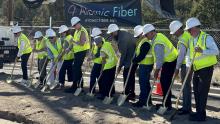
In May, the county conducted a groundbreaking ceremony and began network construction, which will be conducted across eight phases and 47 distribution zones starting with locals in White Rock. The county has issued consistent updates via its website.
In addition to the open access fiber network, the county has cemented a $4.4 million middle-mile backhaul partnership with the Pueblo of San Ildefonso – connecting through Pojoaque – to ensure fiber optic route redundancy off the plateau.
LANet – which will be transitioning many of its fixed wireless customers to fiber – recently announced that it will be hosting a joint public briefing with Atomic Fiber officials on October 22 to give an update on construction progress.
Smith said Los Alamos officials have also planned two public events featuring its four partner ISPs later this week aimed at updating the public and drumming up interest in the project.
Bridging the Digital Divide
With the federal government all but abandoning telecom oversight and affordability concerns, states have been attempting to fill the void with varying degrees of success.
New Mexico has emerged as a particularly dedicated leader in the space, passing legislation earlier this year empowering the New Mexico Public Regulation Commission (PRC) to offer $30 per month discounted broadband access to low-income homes that qualify. It’s a decision that’s expected to improve affordable access for 173,000 New Mexico households.
The law is providing meaningful relief for low-income households that previously received assistance through the FCC’s now-defunct Affordable Connectivity Program, which was dismantled by Congressional Republicans. Federal lawmakers claimed they axed the program to save money, but follow-up studies indicated it provided significantly more public benefit than it cost.
While the federal government has abandoned any concern for Internet affordability and equitable deployment – even going so far as to try and illegally dismantle the Digital Equity Act – Los Alamos officials say they’re preparing to participate in Digital Inclusion Week during the first week of October to drum up public awareness about the public benefits of affordable fiber.
Header image of Atomic Fiber groundbreaking ceremony courtesy of Los Alamos County Facebook page
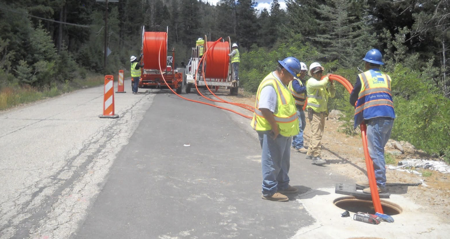
Inline image of workers deploying conduit under street courtesy of Los Alamos County Facebook page