
Willmar, Minnesota officials say they’re making steady progress on construction of the city’s planned $24.5 million open access fiber network, with the first residential and business customers slated to come online sometime later this year.
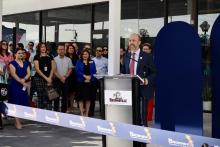
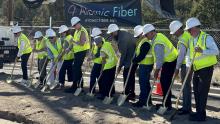
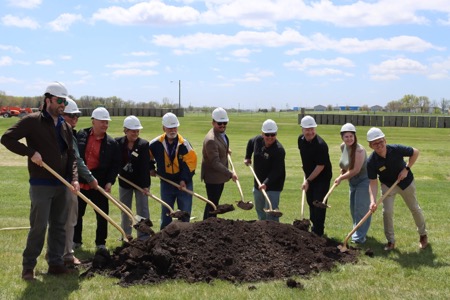
Dubbed Willmar Connect, construction of the city-owned fiber-to-the-home (FTTH) network broke ground in May 2026, marking a pivotal turn from years of feasibility studies and council debates to actual directional boring, conduit placement, and fiber splicing.
When we last checked in on Willmar back in March, the city council had just voted 4-3 to sign off on the $24.5 million open access project. After a summer of steady construction the city says it’s making meaningful progress toward a full commercial launch.
“We expect to light up our first users on the network this year,” Willmar City Administrator Kyle Box tells ILSR.
Phased Construction Starting From GO (Bond)
Construction of the network is occurring in three phases.
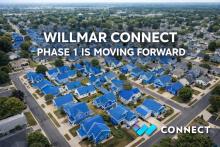
Phase one of the project, focused on Southwest Willmar, is budgeted for between $7.6 million to $9.2 million. This phase of the project will focus on backbone construction, neighborhood conduit boring, lateral connections, and converting a former municipal wastewater facility into the network operations center (NOC).
Phase one neighborhoods on the city’s southwest side are expected to see service go live at the tail end of 2026. The city maintains a construction schedule map and FAQ, and is already taking pre-orders for when service becomes available. While the city owns the open access network, retail operations are being managed by Hometown Fiber.
Phase one is being primarily funded via $8.79 million in General Obligation (GO) Tax-Abatement Bonds approved by the Willmar city council during a meeting back in January.
“This paid for construction, construction administration, bond fees, and one year of capitalized interest,” Box said.
Phases two and three of the network’s deployment – focusing on Southeast and North Willmar – will be tied to take rates and funded by subscriber and network leasing revenue from Phase one.

Financial models presented to the Willmar City Council by Hometown Fiber and municipal financial advisors indicate the network's self-sustainability hinges on reaching a baseline residential take rate of approximately 30 to 35 percent.
Willmar officials say the ultimate goal is bringing affordable fiber to the entire city of 21,000. The city was able to reduce upfront capital expenses by repurposing city-owned property for network facilities (like the former municipal wastewater facility), while targeting federal and state broadband infrastructure funds to cushion subsequent expansion phases.
“The City Council will consider Phase 2 in the fall of 2026, with construction tentatively beginning in spring 2027,” Bond told ILSR. “Phase three will follow the same cadence but with a 2028 construction schedule.”
Grass Roots Response To Market Failure And Limited Competition
Like countless communities nationwide, Willmar spent years waiting for regional monopoly and duopoly telecom providers to deliver affordable, future-proof broadband. And like so many underserved communities, local leaders eventually realized that if you want critical 21st-century infrastructure built correctly, you often have to take matters into your own hands.
So Willmar officials first decided to create a Willmar broadband committee in September of 2022. By December of 2022 city officials had mapped out available local broadband access, and found that most broadband access in the city consists of either spotty, slower coaxial cable broadband access through Charter Communications (Spectrum), or aging DSL provided by long-criticized regional telco Frontier Communications.
Willmar’s interest in building its own open access fiber network prodded Charter to offer the city a last-minute promise to expand its hybrid coaxial fiber network out to the city’s industrial park in exchange for cancelling the planned citywide network.
But four of the city’s council members realized a partial build out of Charter’s network likely wouldn’t match the regional impact of a city-owned network, particularly when it comes to affordability and overall reach. Charter also has a history of not living up to its promises to regulators in other states, such as New York.

Open access networks generally involve a municipality owning their own local infrastructure, then leasing access to multiple providers who compete in layers. Data from around the world historically indicates that the open access fiber model results in greater competition, lower prices, faster speeds, and better overall customer service.
“Currently, three providers have signed agreements with the City to provide service on the network,” Box says. Those providers are Zuma Internet, Broadband MN, and Intellipop.
According to the Willmar website, residential customers in Willmar will have the option of three tiers of fiber service at various price points from each ISP: a symmetrical 500 megabit per second (Mbps) option; a symmetrical 1 gigabit per second (Gbps) tier; and a symmetrical 2 Gbps option. There are no usage caps or long-term contracts.
All participating providers are expected to provide access to discounted tiers for as little as $30 a month; helping shore up the assistance provided by the Republican lawmakers' decision to defund the FCC’s Affordable Connectivity Program (ACP).
Pre-registration drives launched via the Willmar Connect portal have offered free drop-line installations to early sign-ups, saving homeowners up to $500 in connection fees and giving city engineers precise demand-density data to steer lateral fiber drops.
Header and inline images courtesy of City of Willmar, Minnesota Facebook page