

A crushing near-miss at the ballot box last year hasn’t stopped the town of Southwick, Massachusetts from chipping away at Comcast’s local monopoly.
The town is now making progress on a scaled-down pilot project aimed at helping sell locals on the benefits of community-owned-and-operated affordable fiber optics.
After falling just 14 votes shy of the two-thirds majority required to authorize a full $16 million municipal fiber build at Town Meeting (353-204) last year, local officials refused to shelve the project.
Instead, the Select Board approved a municipal agreement with Westfield Gas & Electric’s Whip City Fiber to construct a targeted pilot network funded entirely by existing money.
The smaller phased deployment aims to prove out subscriber demand, connect vital anchor institutions, and demonstrate that a publicly owned fiber-to-the-home (FTTH) network can pay for itself without leaving general taxpayers on the hook.
According to local news outlet The Reminder, this scaled-back pilot project will target three of the original 19 fiberhoods targeted under the original plan to deploy fiber to the entire town of 9,346.
Pilot Cleared for Takeoff
Rather than wait around to convince hesitant voters at another contentious town meeting, Southwick leadership pivoted to what was already sitting in the town’s war chest.
To fund the pilot, Southwick officials say they are leaning on a three-part funding patchwork: $900,000 from the town's American Rescue Plan Act (ARPA) allocation, a $250,000 state grant from the Massachusetts Broadband Institute (MBI) earmarked strictly for outside-plant construction, and a $3 million bonding authorization previously approved by voters in 2023.
The Southwick Select Board formally approved a municipal agreement with Whip City Fiber during its meeting on July 20. In early September, Whip City Fiber and the town officially opened pre-registration and sign-ups for the Phase 1 pilot footprint via Whip City’s Southwick portal and the town's municipal website.
Officials anticipate that the physical pilot build will take about a year to complete once pole make-ready work is finished, with residential connections going live sometime by the summer or fall of 2027.
Select Board member Doug Moglin — who has spearheaded Southwick’s municipal broadband ambitions for more than half a decade — recently pushed back on the notion that the narrow ballot loss last year meant residents were happy with their existing monopoly options.
“To be fair, it was 20 [short] for the borrowing authorization for all the money,” Moglin noted during a Select Board discussion. “The correlation was that the majority of the town was in favor of the project. Just not two-thirds that you needed to borrow that much money.”
In nearby Westfield, Whip City Fiber offers locals symmetrical 1 gigabit per second (Gbps) fiber for $70/month — pricing and speeds that are significantly better than regional telecom monopolies like Comcast. Moglin has indicated that an $89 per month price point for gigabit fiber was being considered for Southwick, though formal pricing has not yet been set.

Targeting 'The Woods' and Anchor Institutions
The Southwick fiber footprint targets high-density residential pockets officials colloquially refer to as "the woods" — specifically neighborhoods lining Pineywood, Fernwood, Birchwood, and Thurgood roads. It also sweeps in utility pole runs along Powder Mill Road, South Longyard Road, and Depot Street, passing a planned 100-unit condominium development.
To keep initial capital expenditures manageable, Southwick is exploiting existing conduit installed years ago beneath the local rail trail where it crosses Depot Street. Furthermore, Whip City Fiber agreed to host the network’s central routing equipment on its own infrastructure across the town border in Westfield), sparing Southwick the upfront six-figure expense of erecting a dedicated central office hut on town property until Phase 1 delivers hard subscriber numbers.
In addition to residential drops, the scaled-back Phase 1 pilot will still bring high-speed fiber drops directly into anchor civic facilities, including the Southwick Public Library, Department of Public Works, and the Southwick-Tolland-Granville Regional School District.
As is often the case, the success of the pilot hinges largely on the participation or take rate. Financial modeling developed by WG&E indicates the network requires a take rate between 40 and 45 percent to comfortably service operational debt without tapping municipal coffers.
Whip City Fiber currently operates turnkey municipal fiber networks for more than 20 hilltowns and municipal light plants (MLPs) across the region, routinely notching take rates hovering north of 60 percent as locals abandon pricey cable bundles from the likes of Comcast and dated copper DSL connections from companies like Frontier/Verizon.
The challenge, however, will be cost containment. Supply chain pressures and escalating labor expenses have driven up per-mile pole make-ready and fiber installation rates across New England over the past three years. As Moglin warned the board, waiting to build the rest of the town will only get more expensive with time.
For now, Southwick’s piecemeal launch serves as a practical playbook for mid-sized towns stuck in procedural limbo: when the big-ticket bond measure hits a political wall, use unspent pandemic relief and state middle-mile hooks to build the high-density low-hanging fruit, and let the take rates speak for themselves to generate momentum for future deployment phases.
Read our in-depth report published earlier this year about how western Massachusetts and its small hill towns became a hotbed of community-owned networks and are now offering the most reliable and affordable Internet service in the state below:
Header image of Southwick Rail Trail tunnel in Southwick MA courtesy of Wikimedia Commons, Creative Commons Attribution-Share Alike 4.0 International
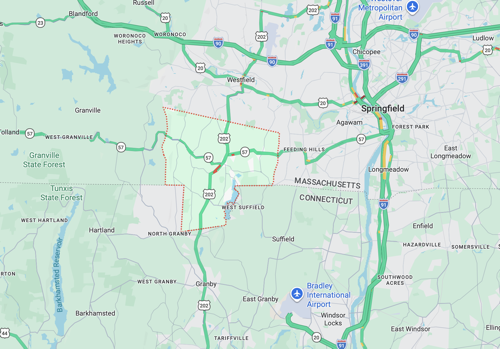
Inline screenshot of Southwick on Google maps
Inline image of Blossoming Acres sign courtesy of Town of Southwick Facebook page