

Construction on the regional expansion of Sherburne’s municipal open-access fiber network is advancing across neighboring Chenango County borders, backed by a $6.9 million state grant intended to turn a local pilot project into a regional community-owned utility model.
The project, branded Sherburne Connect, originated as an early municipal fiber deployment operated in coordination with the village’s century-old public electric utility, Sherburne Electric, after being designated in 2022 as one of four initial municipalities (alongside Nichols, Diana, and Pitcairn) to participate in New York State’s $1 billion ConnectALL initiative.
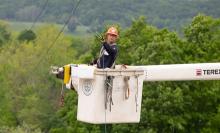
Partnering with the New York Power Authority (NYPA) and Empire State Development, the village shared an initial $10 million state pilot allocation to engineer a publicly owned open-access fiber network utilizing Sherburne Electric’s existing poles, bucket trucks, and municipal rights-of-way.
This project initially passed roughly 1,800 to 2,000 premises inside the village of Sherburne and immediate electric territory. Village of Sherburne Board of Trustees meeting minutes from last June indicate that the core network in Sherburne now has more than 1,000 active subscribers.
Those same meeting minutes indicate that Sherburne officials had requested a deadline extension but were denied it by Albany. “Superintendent [Travis] DuBois said Sherburne is furthest ahead with this fiber project than the other 13 systems and Albany want to show at least one project closed out by year end,” the minutes indicate.
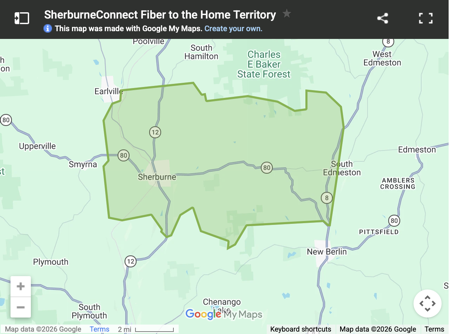
In 2024, Sherburne and neighboring Columbus also received a $6.9 million grant from New York State to expand the network to roughly 600 additional unserved and underserved rural premises across the Town of Sherburne and Town of Columbus, with plans to bring the total number of served customers past 2,500.
Across June, July, and August 2026, the Village of Sherburne and the Town of Columbus ran an active sign-up drive targeting remaining unserved premises. Columbus, like Sherburne, now also maintains a network construction progress map on the town’s website.
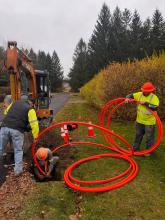
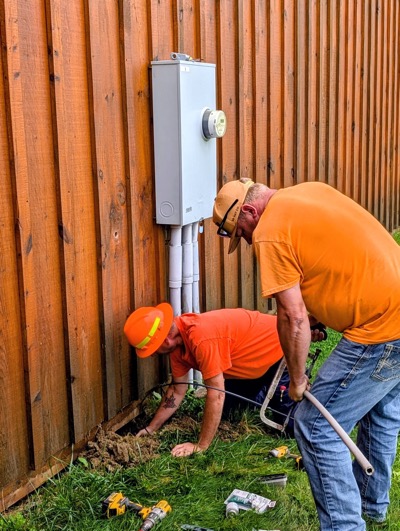
To hit their buildout milestones before the state grant closes at year-end, the village and town announced free installation through 2026, including underground burial service regardless of distance, plus a free Wi-Fi router for Town of Columbus and Town of Sherburne residents who connect to the fledgling network.
“We all learned how important internet access was during COVID-19,” New York Assemblyman Joe Angelino said of the funding and expansion plan. “This is being built upon the Sherburne village electric grid and it’s going to be a fiber optic grid internet service going out to 65 miles in rural town roads in Sherburne and Columbus.”
The Benefits Of Open Access
Unlike traditional regional broadband builds that subsidize private monopoly networks, Sherburne operates an open-access model. The municipality owns and maintains the physical fiber-optic distribution system, while partnering with independent Internet service providers to deliver retail connections to homes and small businesses.
The village’s public utility leverage has kept capital operational overhead lower than that of greenfield competitors. Because Sherburne already manages poles, bucket trucks, rights-of-way, and billing infrastructure through its municipal electric utility, the marginal cost to hang and maintain fiber strand has remained low.
In deployed markets, the town offers locals the choice of fiber from two different ISPs. Both Fybercom and Fiberspark offer Sherburne residents the choice of two options: a symmetrical 100 megabit per second (Mbps) tier for $40 a month and a symmetrical 1 gigabit per second (Gbps) tier for $60 a month.
The tiers do not include usage caps or long-term contracts, and are significantly faster and less expensive than services offered by the dominant regional telecom monopolies in the state: Charter and Frontier Communications. In 2018, NY State considered the unprecedented step of kicking Charter out of the state after it repeatedly misled regulators about network deployments.
Pricing includes a $30 a month maintenance and operations “utility fee” paid to the town of Sherburne.
State Support Paves Way For Local Networks
While most states have prioritized channeling federal broadband funding predominantly into private, incumbent regional telephone and cable companies with a long history of failing to live up to their deployment promises, New York took a different route by leveraging American Rescue Plan Act (ARPA) funds to establish the ConnectALL Municipal Infrastructure Program (MIP).
Administered through Empire State Development, the initial $228 million MIP fund specifically restricted grants to publicly owned, open-access broadband infrastructure.
According to a state announcement, the existing MIP program, launched in early 2024, has already funded roughly $300 million in assorted open access fiber projects across 24 New York counties, resulting in more than 2,300 miles of new fiber optic infrastructure and 68 new wireless hubs serving more than 96,000 homes and businesses.
Most of this funding was made possible by the 2021 federal American Rescue Plan Act (ARPA). A state broadband office dashboard tracks all active municipal projects funded to date.
The MIP’s flagship programs include efforts in Sherburne, as well as an open access municipal fiber network build in Dryden, New York, which has been steadily delivering affordable next-gen fiber to the long-underserved rural communities of Dryden and nearby Caroline (population 3,321).
By leveraging local electric utility infrastructure and state funding programs like ConnectALL, Sherburne has demonstrated that small rural communities can not only successfully deploy and sustain high-speed community-owned fiber networks, but extend their expertise to neighboring communities also long trapped on the wrong side of the digital divide.
Header image courtesy of Village of Sherburne Facebook page
Inline image of fiber installation courtesy of Village of Sherburne Facebook page