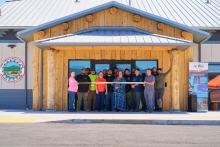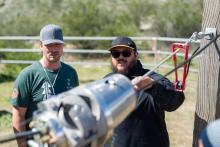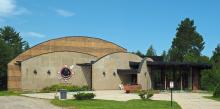


The Santa Ynez Band of Chumash Indians recently reached a major milestone with the launch of the Tribe’s long-awaited Chumash Fiber Network, providing next-gen, affordable broadband access to a California community long-neglected by regional private monopolies.
For generations, telecom giants treated Tribal reservations and rural enclaves across California with predictable neglect: underinvesting in core infrastructure, charging exorbitant rates for slower asymmetrical copper, and insisting low population density makes modern fiber deployment economically unviable.
Like many communities, the Santa Ynez Band of Chumash Indians has taken matters into their own hands with the Chumash Fiber Network, now providing speeds up to five gigabits per second (Gbps) to reservation residents.
Spanning 13 miles of underground fiber across 1,400 acres of ranch land, the network is slated to connect roughly 400 locations — serving an estimated 853 residents — alongside Tribal administrative buildings, health facilities, and the new 143-home Camp 4 residential development.
Funding for the network was provided by Tribal Technical Assistance and federal planning grants via the National Telecommunications and Information Administration (NTIA) Tribal Broadband Connectivity Program (TBCP), as well as a $4.7 million grant awarded under the California Public Utilities Commission’s (CPUC) Last Mile Federal Funding Account.
State grant support was coupled with California’s open-access Middle Mile Broadband Initiative (MMBI), which is attempting to give emerging competitors and municipalities a leg-up in a market long-dominated by extractive regional telecom monopolies.
Unlike legacy cable and phone providers that nickel-and-dime captive subscribers with hidden fees, usage limits, and arbitrary speed throttling, the Chumash Fiber Network was engineered as an essential public utility.
Built using underground passive optical network (PON) architecture, the network was designed to withstand severe weather, seismic shifts, and escalating wildfire hazards. Tribal leaders say they gave the underground physical infrastructure a 200-year design horizon — built to serve the community ten generations forward, with optical electronics easily upgradeable to 25GS-PON (25 Gbps symmetrical) without re-trenching conduit.
“The obvious choice was XGS-PON,” Chumash Project Manager David Fein recently told CPUC officials.
“Today it is XGS, and already they are testing 10, 25, and even 50 gigabit PON. So that same 10 Gbps service will be able to be expanded to 25 and to 50, easily, over the next 20 years or so. This will enable our service to continue for the next few generations. This technology was the only way to fit the requirement. We had to bury the fiber, and we wanted it to be resilient, robust, and redundant.”
At launch, the network delivers symmetrical performance up to 5 Gigabits per second (Gbps) — a stark contrast to legacy DSL and coaxial cable networks whose crippled upload tiers choke telecommuting, telehealth, and remote learning. To ensure the network is affordable, pricing starts at $40 a month for symmetrical 100 megabits per second (Mbps) fiber.
For the Santa Ynez Chumash, building a communications utility is a natural extension of decades spent securing essential infrastructure. The Tribe raised private funds to pipe running water to the reservation in 1969, developed an advanced wastewater reclamation plant in 2000, and has steadily expanded local energy resiliency.
As CPUC last-mile disbursements begin translating into physical reality, the Chumash rollout provides a replicable blueprint for Indian Country: bypass unresponsive incumbents, leverage open-access middle-mile backhaul, bury durable fiber resilient to climate destabilization, and keep network governance entirely in local hands.
“You have companies that come in, interest groups that come in, and they develop relationships for now,” recently noted Tribal Chairman Kenneth Kahn. “We develop relationships for now, tomorrow, and the future.”
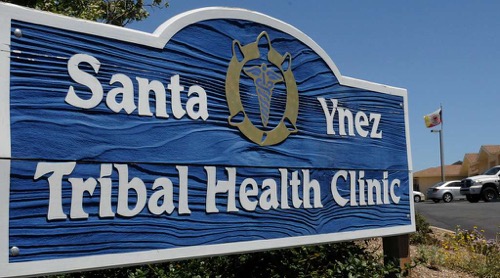
Inline image of health clinic sign courtesy of NARA and DVIDS Public Domain Archives