

Researchers say they’re concerned that a massive influx of new federal grant money being redirected to Elon Musk’s Starlink satellite broadband company in Ohio will be thwarted by the simple fact that many targeted locations don’t have a clear, unobstructed view of the sky.
Tom Reid of Reid Consulting conducted a study earlier this year taking a closer look at the 30,000 locations in Ohio that are poised to receive subsidized service from Starlink, and found that as many as 70 percent of the target locations were covered by tree canopy preventing the minimum 110-degree field of view Starlink dishes require.
“Only about 30 percent of the households awarded in the state of Ohio have a clear enough view of the sky to get a good, stable Starlink signal,” Reid recently told local Ohio public media.
Ohio is slated to receive $793 million in federal Broadband, Equity, Access, and Deployment (BEAD) grants to fund fiber expansion. But after the Trump NTIA last year changed the program to benefit Elon Musk, Starlink quickly became the biggest state beneficiary of public tax money, receiving more than $51.6 million in grants.
The Trump administration’s changes not only eliminated affordability and equitable deployment requirements, they directed millions of dollars away from higher-capacity future-proof fiber, and toward the back pocket of a billionaire who had already planned to deploy the LEO satellite network without subsidization.
The administration then claimed that by shifting taxpayer money away from fiber toward slower and less reliable satellites, they reduced the total cost of BEAD from $42.5 to $21.5 billion. Law mandates that the entirety of those funds be used for broadband access, but those funds have fallen into a federal bureaucratic black hole the administration remains murky on.
“They’re celebrating the fact that they’re only spending half of the money,” he said. “The way they’re only spending half the money is by doing pretend broadband for a lot of people,” Reid said.
Lawmakers have spent the better part of the last year pressing the NTIA for a clear timeline on when this money will be sent to the states. The NTIA last week finally acknowledged that it will approve some of this money for additional grant funding rounds by states, though specifics, limitations, and timelines remain unclear.
Reid also told Telecompetitor that to actually use the Starlink broadband services they’re subsidizing, Ohio residents may be on the hook for significant additional costs – between $15,000 and $50,000 per location to construct towers between 50 and 150 feet tall – to ensure their Starlink dishes have a clear view of the sky.
“LEO services represent an amazing technological feat,” Reid said. “However, many of the locations slated for LEO will be unable to receive the service due to terrain or foliage obstructions. It has been suggested that homeowners, at their own expense, build towers ranging in height from 50’ to 150’ to get a clear view of the sky — an absurd logistical and financial burden.”
Clear Sky Concerns Piggyback on Existing Congestion Woes
The concerns about whether subsidized locations can even use the service taxpayers are paying for comes on the heels of ongoing concerns that the Starlink LEO network lacks the capacity to scale up to meet real-world demand. And whether the high price of Starlink puts it out of reach for those most in need of affordable access.
A recent report from Ookla found that Starlink’s median speed is consistently short of the 100/20 Mbps benchmark that the Federal Communications Commission set as defining broadband in 2024.
Sascha Meinrath – X-Lab Director and Palmer Chair of Telecommunications at Penn State University – released a study last year showing that congestion would be an ongoing problem for the company.
The study indicated that providing service to any more than 7 Starlink customers per square mile would have a deleterious impact on network performance.
The company has at times implemented “congestion charges” as high as $1,500, and users of the Starlink subreddit are increasingly complaining about network congestion, traffic throttling, and eroded performance. And this is before millions of new federal-government-subsidized users begin to flood the network.
The company is potentially making things worse with its recent announcement that it would be leveraging Starlink to also provide cellular phone service via the network. To do this, Starlink would require customers to also install multiple new small cell antennas around their property, further raising consumer costs and putting additional strain on the network.
“SpaceX is accelerating the hyperbolic and inane statements about what they're doing — whether data centers in space, speed and capacity claims, or moon rocket production,” Meinrath told ILSR. “They're like a grift-factory producing a product that people are becoming increasingly tolerant to, so they need to keep upping the dose.”
Meinrath said that 15 years ago he was tasked by the USPS Inspector General to game out the idea of turning local post offices into community network Wi-Fi feeders, and found it to be “incredibly” logistically demanding in a way that wasn’t practical.
“SpaceX will not be able to do what they're claiming; but now they need some mechanism for offloading cellular traffic because they've promised satellite offloading from terrestrial networks. Except that'll cause massive new congestion problems within their existing network architecture.”
"This ranks as one of the top three dumbest ideas in my four decades of being in this industry," Earl Lum, founder of analyst company EJL Wireless Research, told Light Reading.
Claims Of Favoritism Around The Country
While the SpaceX IPO prospectus claims that Musk’s Starlink network will quickly soar from 1.0 million active users to more than 3 million, most objective telecom experts have repeatedly stated that’s not happening. Congestion and network performance will likely come to haunt policymakers who portrayed Starlink as some sort of technological magic bullet.
Some states appear to be waking up to the fact that the Trump administration has redirected billions of dollars away from future-proof fiber networks and toward the country’s wealthiest man for services he already planned to deploy. In Texas, state officials have put all BEAD grant awards on hold to investigate claims of Musk favoritism.
Telecom workers unions like the Communications Workers of America had warned state leaders that fiber optic investments would be more reliable and result in significantly more actual local jobs. But state leaders, eager to please the Trump administration and wary of losing funds, have often turned a blind eye to the real-world challenges of a niche communications tech.
Header image of tree canopy courtesy of Wikimedia Commons, Attribution 4.0 International, CC BY 4.0
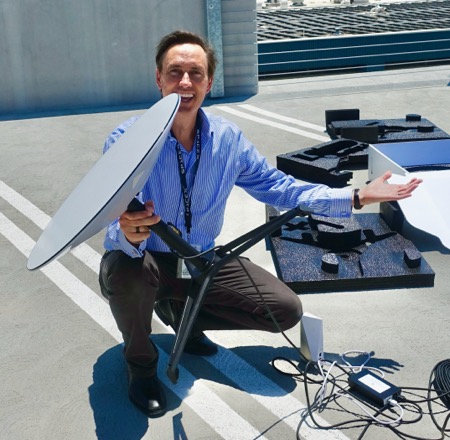
Inline image of smiling man assembling Starlink dish courtesy of Wikimedia Commons, Attribution 2.0 Generic, CC BY 2.0
Inline image of Space X building in Hawthorne CA courtesy of Wikimedia Commons, CC0 1.0 Universal Public Domain Dedication
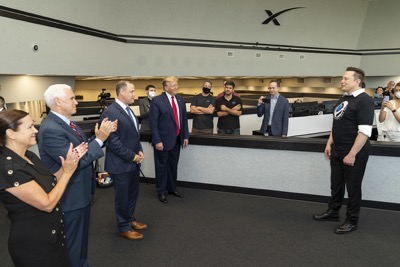
Inline image of President Trump and Elon Musk courtesy of the White House, Public Domain Mark 1.0 Universal, PDM 1.0