
state laws

Content tagged with "state laws"

Displaying 1 - 10 of 389

Gibson Connect's Rural Cooperative Model - Episode 658 of the Community Broadband Bits Podcast
In this episode of the podcast, Chris talks with Scott Goff of Gibson Connect, a subsidiary of Gibson Electric in Tennessee. 

They explore how the electric co-op’s long-standing community trust helped launch a successful fiber network, bringing reliable, affordable Internet to areas that had long been unserved or underserved. 

Scott shares stories of rural residents experiencing broadband for the first time, the challenges of state restrictions, and how Gibson Connect balances growth with a cooperative, member-first philosophy.

This show is 26 minutes long and can be played on this page or via Apple Podcasts or the tool of your choice using this feed.

Transcript below.

We want your feedback and suggestions for the show-please e-mail us or leave a comment below.

Listen to other episodes or view all episodes in our index. See other podcasts from the Institute for Local Self-Reliance.

Thanks to Arne Huseby for the music. The song is Warm Duck Shuffle and is licensed under a Creative Commons Attribution (3.0) license

BEAD Falls Apart | Episode 115 of the Connect This! Show

Connect This! Show

Catch the latest episode of the Connect This! Show, with co-hosts Christopher Mitchell (ILSR) and Travis Carter (USI Fiber) joined by regular guests Kim McKinley (TAK Broadband) and Doug Dawson (CCG Consulting), and special guest Josh Etheridge to talk about all the recent broadband news that's fit to print. Bountiful, Utah and Oakland, California announce newsworthy milestones to improve connectivity for households, but the big news is looming structural changes to the Broadband Equity Access and Deployment (BEAD) program. And wouldn't you know it, but NTIA releases them just ten minutes into the live show. 

Join us live on June 7th at 2pm ET, or listen afterwards wherever you get your podcasts.

Email us at [email protected] with feedback and ideas for the show.

Subscribe to the show using this feed or find it on the Connect This! page, and watch on LinkedIn, on YouTube Live, on Facebook live, or below.

Jim Baller Testimony Outlines the Consequences of State Preemption Laws

In September, we wrote about the elimination of significant state barriers in Arkansas and Washington as legislators at the state level pushed to overturn the laws protecting monopoly providers which prevent localities from building and operating their own broadband infrastructure. 

The result of those moves is that the number of states which maintain barriers to community-owned networks fell to 17, heralding significant progress for the future.

The same week, Coalition for Local Internet Choice (CLIC) President Jim Baller testified before the Missouri House of Representatives' Interim Broadband Development Committee to address the state of preemption across the U.S. There, he argued that the "Missouri Legislature should follow the lead of Arkansas and Washington State and repeal the restrictions in R.S.Mo. § 392.410, once and for all. It should also reject any proposed new restrictions on municipal, cooperative, or public-private broadband projects." 

During the course of his remarks he makes a powerful case against "state barriers to municipal, cooperative, or public-private broadband initiatives":

[The] are not only bad for the communities involved, but they also hurt the private sector in multiple ways. They prevent private companies from making timely sales of equipment and services to municipal or cooperative networks. They impede companies from using advanced public or cooperative networks to offer businesses and residential customers an endless array of modern products and services. They thwart economic and educational opportunities that can contribute to a skilled workforce that would benefit existing and new businesses across the state. They also deny the community the economic and social benefits from which everyone in the community can benefit, including the private sector. 

He continues:

The State of State Preemption – Seventeen is the Number

In years past, states have implemented preemptive laws that make it more difficult or impossible for communities to build their own Internet networks. 

These state barriers were often enacted at the behest of large telecom monopolies to limit competition, and include everything from outright bans on municipal broadband networks to oppressive restrictions and requirements which create legal uncertainty for communities attempting to offer telecommunications and Internet services, including via partnerships.

When the Covid-19 pandemic hit the United States in March 2020, there were 19 states maintaining significant restrictions on municipal networks. Today, the number of states upholding these barriers has been reduced to 17. The pandemic served as a turning point in the fight for local authority, and in the past year, Arkansas and Washington adopted legislation significantly rolling back legislative barriers on publicly owned broadband networks. 

In February of 2021, both chambers of the Republican-dominated Arkansas State Legislature voted unanimously to send Senate Bill 74 to State Governor Asa Hutchinson, who signed the bill into law. The legislation grants government entities the authority to provide broadband services and expands the financing options available to municipalities to fund municipal broadband projects.

In May of 2021, Washington State Governor Jay Inslee signed two bills expanding municipal authority to provide retail Internet services to end-users, House Bill 1336 and Senate Bill 5383. Both bills reduce barriers to municipal networks, but House Bill 1336, which completely removes all previously-held restrictions on public broadband in the state of Washington, is expected to take legal precedence.

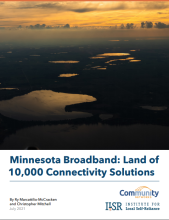
Minnesota Broadband: Land of 10,000 Connectivity Solutions

Image

In a new report, the Institute for Local Self-Reliance showcases the diverse range of approaches communities and local Internet Service Providers (ISPs) have taken to expand affordable, high-quality Internet access in Minnesota. It includes a series of case studies that detail how communities are meeting the connectivity challenges of a broken marketplace shaped by large monopoly service providers. 

Download Minnesota Broadband: Land of 10,000 Connectivity Solutions [pdf] here.

The profiled projects include municipal networks, public-private partnerships, cooperatives, and private investment. They run from the most rural areas of the state to Minneapolis. Some examples include:

  • RS Fiber Cooperative, in south central Minnesota, which has brought fiber to local businesses and town residents. Rural residents benefit from RS Air, a fast wireless service available at affordable prices.
  • Arrowhead Electric Cooperative’s fiber network in Cook County, which succeeded beyond original projections. It provides fast and affordable Internet access to one of the most far-flung parts of the state.
  • St. Louis Park’s partnerships with both ISPs and the builders of large condominium complexes. One of the providers working with St. Louis Park is better known as the fastest ISP in Minneapolis, USI Fiber.
  • Christensen Communications, a 100+ year-old telephone company in south central Minnesota. The company demonstrated a strong commitment to its communities when the pandemic hit, and is now going above and beyond to build fiber with federal subsidies.
  • The Fond du Lac Band, in northern Minnesota, which built a fiber-to-the-home network that is rare in Indian Country.

Ry Marcattilio-McCracken, co-author of the report and Senior Researcher with ILSR’s Community Broadband Networks initiative, said of the report’s findings: 

Report: Minnesota Communities and Local Providers Build Diverse Solutions for Affordable, Reliable Internet Access

Our new report, Minnesota Broadband: Land of 10,000 Connectivity Solutions [pdf], showcases the diverse range of approaches communities and local Internet Service Providers (ISPs) have taken to expand affordable, high-quality Internet access in Minnesota. It includes a series of case studies that detail how communities are meeting the connectivity challenges of a broken marketplace shaped by large monopoly service providers. 

The profiled projects include municipal networks, public-private partnerships, cooperatives, and private investment. They run from the most rural areas of the state to Minneapolis. Some examples include:

  • RS Fiber Cooperative, in south central Minnesota, which has brought fiber to local businesses and town residents. Rural residents benefit from RS Air, a fast wireless service available at affordable prices.
  • Arrowhead Electric Cooperative’s fiber network in Cook County, which succeeded beyond original projections. It provides fast and affordable Internet access to one of the most far-flung parts of the state.
  • St. Louis Park’s partnerships with both ISPs and the builders of large condominium complexes. One of the providers working with St. Louis Park is better known as the fastest ISP in Minneapolis, USI Fiber.
  • Christensen Communications, a 100+ year-old telephone company in south central Minnesota. The company demonstrated a strong commitment to its communities when the pandemic hit, and is now going above and beyond to build fiber with federal subsidies.
  • The Fond du Lac Band, in northern Minnesota, which built a fiber-to-the-home network that is rare in Indian Country.

Ry Marcattilio-McCracken, co-author of the report and Senior Researcher with ILSR’s Community Broadband Networks initiative, said of the report’s findings: 

Minnesota communities and local ISPs have found creative and sustainable ways to build future-proof networks across the state, despite a broken marketplace and state barriers that favor slow-moving, out-of-state monopoly providers clinging to outdated technology. Lawmakers must stand up for the cities and towns that sent them to the legislature, and remove the obstacles that prevent a more competitive market and local broadband solutions.

New Fact Sheet: Ohio’s Community Broadband Solutions

The Ohio Senate attached an amendment to the state's budget bill last week which would place significant restrictions on the establishment of new community broadband solutions. It would also, if passed in its current form, place substantial barriers on the operation and expansion of existing municipal networks and other publicly owned and operated projects.

Cities across Ohio have expanded Internet infrastructure in thoughtful, forward-looking ways. These municipal networks have created local government savings, increased speeds, promoted service competition, and powered economic development.

 Some cities have specifically addressed the affordability gap in cities, where many residents have been left behind in a broken market where large Internet Service Providers (ISPs) have underbuilt networks, leaving hundreds of thousands of broadband-hungry Ohioans in the digital dust.

This fact sheet [pdf] outlines the many long-term benefits that municipal broadband projects have brought to the state. For instance:

Ohio Inches Closer to Ban on Municipal Broadband

Well, they did it. The Ohio Senate passed its two-year $75-billion budget bill yesterday, which included an amendment that effectively bans the creation of municipal broadband networks without much in the way of public debate.

If the amendment contained in the Senate’s budget survives the budget process, it would make Ohio the first state in a decade to erect barriers to the establishment and expansion of municipal broadband networks.

The vote was along party lines, with 25 GOP State Senators voting in favor of the Senate budget bill and the chamber’s eight Democrats voting against it. With the House having passed its budget bill in April, now the two legislative bodies have until June 30 to negotiate the differences.

According to the Columbus Dispatch, the House and Senate budget bills agree on about 60 percent of what’s contained in the Senate spending proposal. Where the House and Senate disagree is on the size of a state income tax cut, school funding, access to subsidized childcare, and broadband.

Ohio on Cusp of Municipal Broadband Ban

When the Senate version of the state budget bill was unveiled earlier this week, it included an amendment that saddles community-owned projects with an array of conditions designed to prevent, stifle, and discourage political subdivisions from building and operating networks that meet the connectivity challenges of its residents. It also takes aim at existing projects which enhance the resiliency of regional communications, telehealth, and public safety operations.

Among the most pernicious consequences would be that it only allows for municipal broadband networks to be built in “unserved” areas of the state, defined as geographic regions where residents do not have access to “broadband service capable of speeds of at least 25 Mbps downstream and at least 3 Mbps upstream.”

Ohio Budget Amendment Aims to Kill Municipal Broadband

The Ohio State Senate is set to vote today on the state budget bill that includes an amendment which, if signed into law, would be a major setback for municipal broadband projects in the Buckeye State and protect the big incumbent Internet Service Providers from competition. 

If passed and signed into law it would make Ohio the first state in a decade to erect barriers to the establishment and expansion of municipal broadband networks. This is a surprising and disappointing move, especially for families who have spent the last year experiencing firsthand the poor Internet connectivity that comes with a broadband market dominated by monopoly providers with no incentive to put the interests of the public ahead of shareholder returns.

Erecting Barriers

When the Senate version of the state budget bill was unveiled earlier this week, it included an amendement with an array of conditions designed to prevent, stifle, and discourage cities from following through with any plan for a city-run network to meet the connectivity challenges of its residents.

The first is a provision that would only allow for municipal broadband networks to be built in “unserved” areas of the state, defined as geographic regions where residents do not have access to “broadband service capable of speeds of at least 25 Mbps downstream and at least 3 Mbps upstream.”

But a recent Ohio Broadband Strategy report released in 2019 under the direction of Ohio Lt. Gov. Jon Husted pegged the number of Ohioans without access to broadband at just around 1 million. According to the independent broadband tracking firm BroadbandNow, which ranks Ohio 24th in the nation on the broadband access scale, as of June 2021 there were 618,000 Ohio residents who did not have access to broadband with speeds of 25/3 or faster, which means that approximately 94 percent of Ohioans have access to wired broadband with speeds of 25/3 or faster. Restricting municipal networks to only those households with no service whatsoever would effectively preclude new networks in large parts of the state.

Congress’ Community Broadband Act Gains Support From 45 Organizations

Since it was first introduced in Congress in March, the Community Broadband Act of 2021 has gained widespread support from over 45 organizations representing local governments, public utilities, racial equity groups, private industry, and citizen advocates. 

The legislation -- introduced by U.S. Representatives Anna Eshoo, Jared Golden, and U.S. Senator Cory Booker -- would authorize local communities to build and maintain their own Internet infrastructure by prohibiting laws in 17 states that ban or limit the ability of state, regional, and local governments to build broadband networks and provide Internet services. 

The Act also overturns state laws that restrict electric cooperatives' ability to provide Internet services, as well as laws that restrain public agencies from entering into public-private partnerships.

States have started to remove some long-standing barriers to public broadband on their own. In the last year, state lawmakers in both Arkansas and Washington removed significant barriers to municipal broadband networks, as high-quality Internet with upload speeds sufficient for remote work, distance learning, telehealth, and other online civic and cultural engagement has become essential. 

Community broadband networks offer a path to connect the unconnected to next-generation networks. State barriers have contributed to the lack of competition in the broadband market and most communities will not soon gain access without public investments or, at the very least, the plausible threat of community broadband.

The Many Benefits of Publicly-Owned Networks