Fast, affordable Internet access for all.
Fast, affordable Internet access for all.

Last year, the Confederated Tribes of the Colville Reservation in Washington State were one of 327 Native Nations to receive wireless spectrum as part of the FCC’s Rural Tribal Window program.
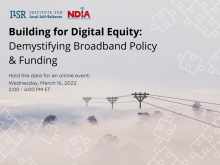
We're living through a time with an unprecedented level of broadband infrastructure funding, fueled not only by the American Rescue Plan, but the Consolidated Appropriations Act, the Coronavirus Capital Projects Fund, and the Infrastructure Investment and Jobs Act. Hundreds of community-driven projects are already underway, but finding solid footing amidst these programs, statutes, and evolving rules is difficult. To help, the Institute for Local Self-Reliance is teaming up with the National Digital Inclusion Alliance for a two-hour livestream event to demystify the landscape. On Wednesday, March 16th, from 2-4pm ET, we're hosting an online conversation to bring together local stakeholders, policy advocates, and funding experts in one place. We're calling it Building for Digital Equity: Demystifying Broadband Policy and Funding.

In November, a majority of voters in China (not the country, but a small town in Maine) cast their ballots in opposition to a $6.4 million proposal for a municipal broadband network that, if built, would have provided high-speed Internet access to every household and business in this central Maine town of 4,300.

<p>Located in the most northeastern part of Tennessee, BrightRidge has served as Johnson City’s public power utility for nearly 80 years.

Dickson, Tennessee (pop. 15,500) was the third municipal electric system to take power from the Tennessee Valley Authority after its creation in 1933, but the utility actually predates the regional electric generation system by almost 30 years.

<p>The <a href="https://www.pewtrusts.org/en/">Pew Charitable Trusts </a>has begun publishing memos that will be useful for state broadband offices as they beef up staff to ensure state broadband grant funds are not wasted and track whether states are awarding grants to proposed projects in a way that advances

In this episode of the Connect This! Show, co-hosts Christopher and Travis Carter (USI Fiber) are joined by regular guests Kim McKinley (UTOPIA Fiber) and Doug Dawson (CCG Consulting) to talk about current events in broadband.
The panel will reflect on RDOF: one year later, how demands for remote work are fueling the broadband boom, and the latest news in broadband.

With a little less than a year left in its projected build schedule, Fort Collins (pop.

The FCC’s Rural Digital Opportunity Fund (RDOF) Reverse Auction was completed a little more than a year ago to much fanfare and spilled ink, and though we’ve seen irregular updates over the last twelve months, we thought it worth the time to round up what we know so far in an effort to see where we’re at and determine what is likely to come.

Because of the pandemic, for the past two years the annual Net Inclusion conference had been held virtually. This year Net Inclusion 2022 – bringing together digital inclusion advocates, academics, Internet Service Providers, and policymakers – will return to an in-person event.
Fairfield City, California is one of several cities in the state hoping to lean on both California’s broadband expansion initiative and the American Res