As Digital Inclusion Week 2026 kicks off October 4-10, the Building for Digital Equity webinar series — co-hosted by the Institute for Local Self Reliance’s (ILSR) Community Broadband Networks Initiative and the National Digital Inclusion Alliance (NDIA) — returns on October 8th.
A recent Government Accountability Office report reveals what’s been obvious to broadband deployment experts for years now: the federal government’s multi-agency approach to closing the digital divide is undermined by a lack of coordination and data-management among agencies.
Researchers say they’re concerned that a massive influx of new federal grant money being redirected to Elon Musk’s Starlink satellite broadband company in Ohio will be thwarted by the simple fact that many targeted locations don’t have a clear, unobstructed view of the sky.
Chris and Doug Dawson break down new Ookla FWA data, critique the FCC’s flawed mapping challenges, examine the final BEAD funding numbers, and tackle the wild economics of artificial intelligence.
The New Hampshire Electric Cooperative (NHEC) has been awarded a $5.58 million federal broadband grant to help expand affordable fiber access to the rural and underserved parts of its service territory in The Granite State.
Paulding Putnam Electric Cooperative (PPEC) was awarded $13.2 million in federal broadband grant support to help fund a major fiber-to-the-home expansion to rural unserved segments of northeast Indiana.
Researchers tells Pennsylvania House Communications & Technology Committee that persistent attacks by the federal government on Internet affordability protections and social safety nets are directly resulting in a drop in overall broadband adoption, with large numbers of low-income Americans unable to afford modern connectivity — and the vast benefits it provides.
On July 7 at 12 noon ET, the next installment in the joint webinar series from the American Association for Public Broadband (AAPB) and the Institute for Local Self-Reliance (ILSR) will go live and showcase a new financing and governance model being put into real-world action that allows for communities to control their digital futures. The conversation will be grounded in two case studies — Kendall County and Lewiston — that illustrate what it actually takes to move a community fiber project from idea to operating network, using a creative “63-20” tax-exempt bond model championed by Pivot-Tech Development, which specializes in public-private partnerships for community-owned broadband networks.
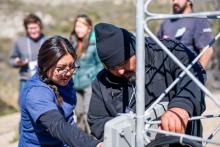
California community leaders, activists, and a coalition of partners gathered earlier this month to celebrate the launch of a new broadband infrastructure project at Sequoia Courts and Sequoia Courts Terrace in Fresno, bringing free high-speed Internet access to more than 350 residents. The Fresno grant was for $471,000, with $1,000 or less per unit cost to build, according to details on the project included in a California Public Utilities Commission (CPUC) filing, which notes that the enterprise-grade wireless mesh network used in the project was more costly, but provided “flexibility and scalability for future expansion.”
The Institute for Local Self-Reliance today released its comprehensive 2026 census of Tribal Internet networks, finding that the number of active Tribal-owned and operated broadband networks has doubled since ILSR first conducted this research in 2020, while offering a new way to interact with these networks’ stories.
Trump Federal Communication Commission Chairman Brendan Carr has announced vague potential changes to the FCC’s E-Rate program that could harm program funding, effectiveness, and the overarching goal of bringing affordable Internet access to long-neglected schools and rural communities trapped on the wrong side of the digital divide. The reforms come as Carr also looks to make changes to the FCC’s broadband mapping efforts, something consumer groups say could harm the government’s ability to measure which communities need improved, affordable access, or suffer from a pronounced lack of broadband competition.
Today, the American Prospect published an analysis authored by our own Sean Gonsalves that examines how a recently filed bill in California aims to strip telecommunications oversight authority away from the California Public Utilities Commission and undermines the state's effort to make broadband more affordable.
New York City Public Advocate Jumaane Williams – a non-voting member of the New York City Council with the right to introduce and co-sponsor legislation – released a detailed “Get Connected” report calling “for the city to deliver high-speed, low-cost citywide municipal Internet service akin to a public utility.” The 53-page report lays the policy groundwork for what at least has the potential to become the Mamdani administration's signature infrastructure initiative.
Grays Harbor Public Utility District (PUD), a wholesale open access telecom utility in Washington state, will soon enter phase four of an ambitious fiber expansion project that will bring affordable next-gen broadband access to rural residents written off by the monopolies that were supposed to serve them. The PUD also says that Phase 4 of the PUD’s fiber internet expansion in south Elma, Porter and Cedarville will be reached later this Spring, bringing access to locals who have been waiting for years for faster, more reliable, and more affordable service.
The California State Assembly recently voted 67-1 to strip telecom oversight authority away from the CPUC and shift it to a more easily lobbied state legislature – and an as-yet-undefined state broadband office. The effort still has a long road before it’s formalized. Assembly Constitutional Amendment 9, authored by Assemblymember Tasha Boerner, D-Encinitas, now moves on to the California Senate, where it needs to secure a two-thirds vote before appearing on a statewide ballot before California voters.
UTOPIA Fiber says it deployed more than a million feet of fiber and conduit across Utah last year accumulating 67,000 total subscribers, as the collaborative open access fiber provider continues to make steady inroads in transforming the state’s broadband competition landscape. According to a new update by the organization, UTOPIA not only laid a million feet of fiber across Utah last year, the network continues to see steady subscriber growth and profitability.
In the marathon to bring universal high-speed Internet service to the most rural state in the nation, Vermont is heading into the last-mile stretch of the race with the finish line in sight. While federal grant programs from the American Rescue Plan Act and BEAD have been vital, advocates and community providers have long insisted that building the infrastructure is only half the battle. Getting people connected – and keeping them connected – requires tackling affordability head-on, as Vermont broadband leaders are doing with the state’s CUDs, demonstrating that community ownership and affordability can go hand in hand.
Leading members of the fiber industry descended on Orlando, Fla. this week for the Fiber Broadband Association's annual Fiber Connect conference to take stock of a national inflection point fueled by the federal BEAD program and the all-consuming rise of AI. Themed “Light Years Ahead,” the underlying take-away was that the buildout boom is far from over and the easy part is mostly behind us, according to numerous reports from those in attendance.
The city of Longmeadow, Massachusetts has failed to get a two-thirds voting majority necessary to move forward with its plan to deploy affordable fiber to every city resident. The vote comes after local telecom monopolies were caught funding an out of town dark money nonprofit to sow doubt about the benefits of the project in the minds of the local electorate.