
In 2020, former New York City Mayor Bill de Blasio unveiled an Internet Master Plan that was one of the most ambitious municipal broadband proposals in U.S. history.
It detailed a $2.1 billion commitment to deploy publicly-owned, open-access fiber across the city’s five boroughs, promising to reshape how the nation's largest city would connect a then-estimated 1.5 million city residents without Internet access.
Then, Mayor Eric Adams came into office and quietly killed it.
Now, with new Mayor Zohran Mamdani – whose entire political brand is built on making essential services affordable to the people who need them most – pursuing a popular affordability agenda that has energized his base and inspired electoral interest far outside the Big Apple, the prospect for a city-wide municipal Internet network is back on the radar.
Last week, Public Advocate Jumaane Williams – a non-voting member of the New York City Council with the right to introduce and co-sponsor legislation – released a detailed “Get Connected” report calling “for the city to deliver high-speed, low-cost citywide municipal Internet service akin to a public utility,” laying the policy groundwork for what at least has the potential to become the Mamdani administration's signature infrastructure initiative.
The Cost of Killing the Master Plan
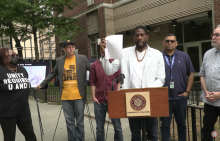
At a press conference with advocates and tenants at the Grand Street Guild Housing Complex, where NYC Mesh has successfully installed fiber connections, Williams said “in the [I]nternet age, we cannot afford to be disconnected, yet many can’t afford to connect.”
“The digital divide is more than generational, it’s also geographic and it’s economic. Some neighborhoods – unfortunately primarily Black and Brown lower-income areas – are paying the highest rates for the slowest speeds.”
Williams said it was a form of digital discrimination that “is particularly prevalent in the Bronx. Customers in the Bronx pay the highest average costs per month – $79.83 – for the slowest average speeds…among the boroughs.”
“The [I]nternet today is as foundational and essential as any other utility, but our city has yet to treat it as such,” he said. “By leveraging existing infrastructure and building new pathways, we can create a municipal system that provides affordable and accessible [I]nternet for all.”
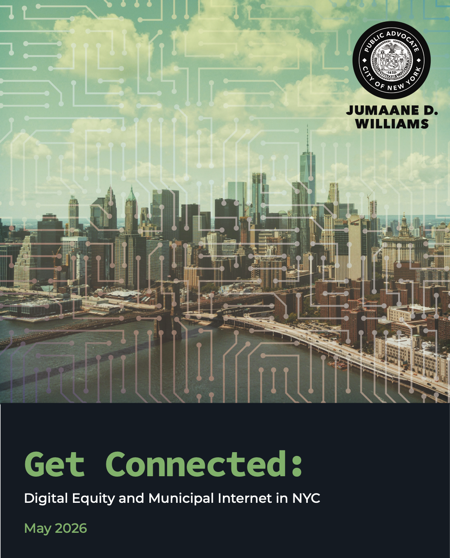
In the 53-page “Get Connected” report, it credits the de Blasio administration’s comprehensive “Internet Master Plan,” highlighting its intention to “uplift smaller ISPs, particularly ISPs that are Minority/Women-owned Business Enterprises (M/WBE).”
It also calls out the Adams administration for cancelling the Internet Master Plan – a move that was not only “was devastating for non-profits and small ISPs who invested tens of thousands of dollars to purchase equipment and begin installations (and) did not get paid for their work,” but that also “empowered corporate ISPs like Verizon, Optimum, and Spectrum to continue their de facto monopolies, especially in those New York City neighborhoods with only one available corporate ISP.”
Specifically, the report criticized the Adams administration for the rollout of its replacement program, known as “Big Apple Connect” – which transferred broadband contracts to the very monopolies the Internet Master Plan had been designed to work around.
The consequences weren’t pretty. People's Choice Communications (PCC), a worker-owned cooperative formed by Spectrum employees who left the company rather than accept cuts to their wages and health benefits, had been contracted under the Master Plan to build out Internet infrastructure in several New York City Housing Authority buildings.
PCC installed rooftop antennas and Wi-Fi nodes that brought connectivity to 2,500 residents in the Melrose Houses, with a community governance model that gave residents a direct voice in decisions about data, service quality, and use of revenue that would be generated. But, the report notes, “after Big Apple Connect was rolled out, the City canceled PCC's contract and instructed it to disassemble its equipment, which had been paid for out of pocket.”
And to add insult to injury, “Big Apple Connect contracted with Spectrum to provide internet to Melrose Houses, the same ISP whose previous actions led to PCC being created in the first place.”
The problems with the Adams administration approach, the report explains, can be traced back to the franchise agreement with the private consortium CityBridge – an agreement that was originally struck in 2014 to replace the city’s aging payphone infrastructure with a network of public Wi-Fi kiosks known as LinkNYC.
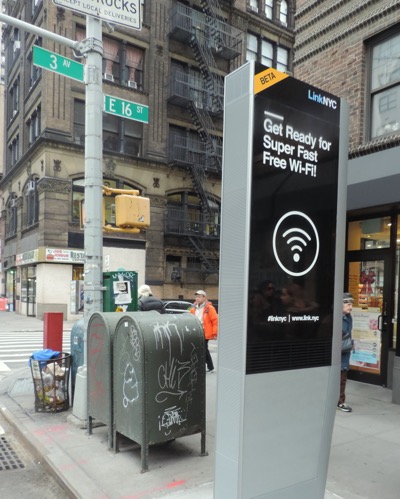
How that was used under Adams’ tenure offers a cautionary tale about what happens when the city outsources its digital infrastructure needs to a private consortium and then fails to hold it accountable. CityBridge promised hundreds of millions in revenue to the city from kiosk advertising, but met its own projections only once in the first five years.
When the advertising model collapsed, CityBridge pivoted to Link5G towers that were designed to lease space to wireless carriers, which drew fierce opposition from neighborhood preservation groups, privacy advocates, and community organizations who criticized the towers for being ugly, disruptive, and installed with little notice to affected residents, to say nothing about how they were only useful for New Yorkers who could afford 5G-capable phones.
The results were disappointing. Despite years of promises and a franchise agreement restructured multiple times to keep CityBridge afloat, the initiative literally delivered far less than advertised. Or as the report put it: “As of 2024, only two of 200 already installed Link5G towers have been installed with 5G equipment.”
While the report provides a candid assessment of the city’s broadband expansion efforts over the previous two Mayoral administrations, it does acknowledge that “the city has taken some important steps in recent years to renew infrastructure and reach people, including through public-private partnerships that have had real impact.”
Still, the report says, “we can go further.”
What “further” looks like, the report says, are: “municipal systems that provide affordable and accessible internet for all (which) have been achieved in other municipalities like Chattanooga, TN, and models (that) exist in the five boroughs today, such as NYC Mesh, that we can learn from and build upon.”
What "Going Further" Actually Looks Like
To that end, the “Get Connected” report lays out a three-phase roadmap that spans 15 years and is designed to build momentum while avoiding the pitfalls of previous efforts – beginning with enforcement and accountability measures before moving to construction.
Over the first two years, the plan calls for strengthening the city's oversight of its existing infrastructure obligations – including a full audit of Empire City Subway and the Office of Technology and Innovation, establishing an independent task force on conduit leasing reform, and conducting a feasibility study on whether Con Edison's infrastructure could be used for municipal broadband.
The plan also calls for guaranteeing a “just transition” for any workers displaced by the shift – a nod to what happened to PCC and the workers who built the Melrose Houses network only to be left in the cold when the political winds changed with the Adams administration.
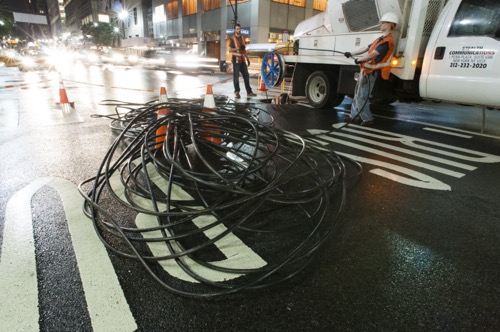
The middle phase, spanning years two through seven, is where the real construction would begin. The plan envisions developing a municipal fiber backbone network, streamlining the arduous application process for neighborhood network access points, and establishing a sliding-scale fee structure to ensure service is accessible to all income levels. (Before the federal Affordable Connectivity Program that offered eligible households a $30/month discount on Internet service was allowed to expire, 54 percent of New York City residents were eligible for the program, highlighting the need for an affordability solution).
It also calls for incorporating the existing CityBridge infrastructure – however imperfect – into the municipal broadband buildout rather than abandoning it, while partnering with technology-focused community organizations to educate residents about the new system.
The long game (years seven through 15) is the most ambitious part and includes: launching fiber-to-the-home pilot programs in the city's most underserved neighborhoods and deploying fiber conduit into major capital projects the city undertakes, so that new roads, bridges, and transit infrastructure automatically lay the groundwork for expanding the network.
It’s not clear yet what traction the new Public Advocate plan will have with the rest of the City Council or the Mayor's Office – though, given Mamadani’s championing of a plan to build a city-owned grocery store, the political environment is certainly ripe, as he has already indicated that he sees Internet access an important issue, having recently announced a $2 million expansion of the Neighborhood Internet program at an affordable housing development in the Bronx.
Still, even if Williams’ plan is embraced by the Mayor’s Office as a once-in-a-generation opportunity to break the grip of a telecom monopoly, it would still have to contend with the deep-pocketed lobbying and opposition campaign the plan would surely be met with from Big Cable and the city’s telecom giants keen to protect their territory in the largest municipal broadband market in the nation.
Watch the Public Advocate "Get Connected" press conference below:
Header image of NYC Public Advocate Jumaane Williams at press conference podium screenshot from YouTube livestream press conference
Inline image of LinkNYC kiosk courtesy of Wikimedia Commons, CC BY 3.0, Attribution 3.0 Unported
Inline image of fiber installation work in Manhattan courtesy of Wikimedia Commons, CC BY-SA 3.0, Attribution-ShareAlike 3.0 Unported