As Digital Inclusion Week 2026 kicks off October 4-10, the Building for Digital Equity webinar series — co-hosted by the Institute for Local Self Reliance’s (ILSR) Community Broadband Networks Initiative and the National Digital Inclusion Alliance (NDIA) — returns on October 8th.
A recent Government Accountability Office report reveals what’s been obvious to broadband deployment experts for years now: the federal government’s multi-agency approach to closing the digital divide is undermined by a lack of coordination and data-management among agencies.
Researchers say they’re concerned that a massive influx of new federal grant money being redirected to Elon Musk’s Starlink satellite broadband company in Ohio will be thwarted by the simple fact that many targeted locations don’t have a clear, unobstructed view of the sky.
Chris and Doug Dawson break down new Ookla FWA data, critique the FCC’s flawed mapping challenges, examine the final BEAD funding numbers, and tackle the wild economics of artificial intelligence.
The New Hampshire Electric Cooperative (NHEC) has been awarded a $5.58 million federal broadband grant to help expand affordable fiber access to the rural and underserved parts of its service territory in The Granite State.
Paulding Putnam Electric Cooperative (PPEC) was awarded $13.2 million in federal broadband grant support to help fund a major fiber-to-the-home expansion to rural unserved segments of northeast Indiana.
Researchers tells Pennsylvania House Communications & Technology Committee that persistent attacks by the federal government on Internet affordability protections and social safety nets are directly resulting in a drop in overall broadband adoption, with large numbers of low-income Americans unable to afford modern connectivity — and the vast benefits it provides.
New York Governor Kathy Hochul has announced a dramatic expansion of the state’s Municipal Infrastructure Program. It will result in an additional $36 million cash infusion for the growing number of creative, community-owned and operated fiber expansion projects in the state, as the existing program has already funded more than $268 million in assorted open access fiber projects across the state.
ILSR publishes new piece in Tribal Business News on how the future of tribal broadband has quietly but fundamentally shifted over the last few months. A recent announcement by the Trump administration upended the Tribal Broadband Connectivity Program, canceling over $160 million in announced grants and leaving nothing but questions about the hundreds of millions of dollars remaining in the program.
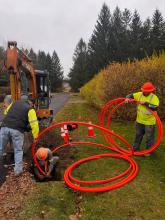
Lamoille FiberNet's $24 million public-private partnership with Fidium Fiber to deliver fiber broadband access to nearly every deliverable address in Lamoille County has been completed. The collaboration resulted in the deployment of 550 miles of fiber, resulting in gigabit-capable next-generation broadband access being made available to 5,000 unserved or underserved addresses across the county.
In 2025, we saw seven new municipal broadband networks across the country that were lit up for service. As is usual, it was a mixture of partnerships, business models, and construction approaches to meet the unique challenges of a patchwork broadband landscape.
Kitsap Public Utility District continues to expand its popular open access fiber network, bringing affordable next-generation broadband access to island locals. An updated KPUD case study indicates that the existing network is currently comprised of more than 900 miles of fiber, with 21 new distribution nodes coming online early 2026. That node expansion is being heavily aided by $6.6 million in American Rescue Plan Act (ARPA) funding.
The free event, featuring Keller & Heckman attorneys Sean Stokes and Casey Lide, will focus on the most pressing legal considerations facing community broadband projects, partnerships, and compliance. The discussion will be moderated by Sean Gonsalves of ILSR and Gigi Sohn, executive director of AAPB, who will guide the conversation designed to draw out practical insights for local governments, utilities, cooperatives, and broadband advocates.
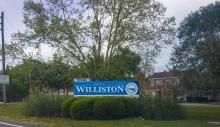
The city of Williston, Florida is joining the ranks of municipalities across the nation that are building their own fiber broadband networks with an eye on ubiquitous, affordable access. City leaders say they’re preparing to launch a city-owned $4.6 million fiber optic ISP to break the local telecom monopoly logjam and finally provide fast, affordable access to the local populace.
Alton, Illinois officials say they’ve struck an expanded agreement with AltonWorks, a company built specifically to revitalize the city and deal with residents’ longstanding frustration at the lack of affordable, next-generation broadband access. Altonworks is partnering with i3 Broadband, which broke ground on a new $25 million FiberNet project. FiberNet is projected to reach 94 percent of the city's residents with fiber broadband speeds up to 10 gigabits per second (Gbps).
Chicopee Electric Light (CEL) has chosen Sertex Broadband Solutions to help the Massachusetts-based municipal utility expand access to affordable fiber across the city of 55,000.
Two dozen California cities are making progress bringing affordable fiber to 16,500 new locations in the Golden State. The collaborative middle mile project, dubbed the Gateway Cities Council of Governments' (GCCOG) Gateway Cities Fiber Optic Network Project, could revolutionize connectivity for a broad swath of Californians long stuck on the wrong side of the digital divide.
“Digital Equity Unwrapped” – a special livestream bringing together advocates and broadband-for-all leaders who spent 2025 pushing for a more connected and inclusive nation – is slated for next Wednesday, December 17, beginning at 3 pm ET. Attendees will have screen-side seating for a virtual fireside chat with NDIA executive director Angela Siefer and American Association for Public Broadband (AAPB) executive director Gigi Sohn, two leaders who have shaped national conversations around broadband, digital inclusion, and local power.
With nearly $500 million still available in the Tribal Broadband Connectivity Program, recent announcements from the Trump Administration about how the program will move forward raised more questions than it answered, and only seemed to confirm many of the fears Tribal leaders had about the direction of the program. The announcement raised fears that NTIA may decrease investment in future-proof technologies, throw up hurdles for Tribal nations still wrestling with bad data, force Tribes to accept subpar solutions through the BEAD program, and weaken Tribal consent requirements.