
In yet another bruising blow in the fight to ensure equitable access to high-speed Internet service, an appeals court struck down federal rules this week that aimed to combat digital redlining.
The ruling came despite a mandate from the bipartisan infrastructure law passed during the Biden administration that directed the FCC to develop “rules to facilitate equal access to broadband internet access service” that would prevent “digital discrimination of access based on income level, race, ethnicity, color, religion, or national origin.”
Not adopted until 2023 after a lengthy rulemaking process and public comment period, when the FCC published its final digital discrimination rules it gave the agency the authority to penalize Internet Service Providers (ISPs) whose policies resulted in “disparate impact,” even if the agency couldn’t prove deliberate discriminatory intent.
Among the real-world “disparate impact” examples advocates presented to the FCC were instances such as when residents of Hope Village, a mostly Black neighborhood in Detroit, experienced a 45-day Internet outage during the height of the pandemic lockdowns – as well as studies that found many large providers charge poor, minority neighborhoods significantly more money for slower broadband access than their more affluent, less diverse counterparts.

Though the FCC had not exercised its anti-digital discrimination authority in a single instance, the US Court of Appeals for the 8th Circuit ruled that the FCC had exceeded its authority by even having a rule that threatened to impose liability on ISPs for “disparate impact,” instead of relying on instances of “disparate treatment.”
In line with the Trump administration’s assault on digital inclusion policies – most prominently exemplified by the sudden “termination” of the Digital Equity Act announced via a social media post exactly a year ago – FCC Chairman Brendan Carr lauded this week’s appellate court ruling.
“Today’s appellate court decision is another common-sense win for nondiscrimination,” Carr said in a statement, making the Orwellian claim that the rules would have actually “required broadband providers and many other businesses to discriminate against people based on their race, gender, or other protected characteristics.”
“Now, the FCC is focused on advancing our Build America Agenda and ensuring that regulated entities do not discriminate, including through our efforts to end invidious forms of DEI discrimination,” Carr said, implying that any efforts to protect historically-marginalized groups from discrimination is itself discriminatory.
“I commend the appellate court for correcting the FCC’s misguided 2023 decision. The court’s ruling follows the Supreme Court’s decision last week making clear that intentional discrimination is unlawful,” he added.
Carr’s statement mirrors a similar statement he issued shortly after President Trump's Executive Order titled "Ending Radical and Wasteful Government DEI Programs and Preferencing," which took aim at former President Biden's Executive Order 13985 that directed federal agencies to create Diversity, Equity and Inclusion programs.
The rollback efforts are part of a much broader Trump administration attempt to undermine civil rights reforms and enforcement, including the complete halt of all current and future civil rights litigation at the Department of Justice and the cancellation of the Digital Equity Act – a move that forced some digital inclusion organizations to scrap projects, lay off staff, or shut down entirely.
Impact vs Intent
At the heart of the court’s ruling was a dispute that was at the center of the FCC rule-making process.
As we noted at the time, the big monopoly incumbents all but exploded over the FCC’s decision to measure discrimination based on disparate impact, arguing that the new rules go beyond what the Infrastructure Investment and Jobs Act intended. A secondary argument they made was that the disparate impact approach micromanages business and will discourage providers from investing in certain areas for fear that they will be penalized for profit-seeking behavior.
Meanwhile, public interest groups and members of Congress lauded the FCC’s rules for its focus on disparate impact, a standard advanced by the disability community. In comments filed with the FCC, the American Association of People with Disabilities (AAPD) emphasized how people who are discriminated against experience the effects of discrimination whether or not it was the result of conscious bias.
“For decades, the disability community has noted that discrimination occurs unintentionally and often results from seemingly neutral policies,” the AAPD wrote in a letter to then FCC Chair Jessica Rosenworcel.
“Too often, disabled people experience discrimination not because of malicious intent or explicit exclusion within programs or policies but because the disabled people were simply not considered in the first place.”
Bill Callahan, a veteran digital equity advocate who has tracked the FCC's record on broadband discrimination for decades, wasn't entirely surprised by the ruling – or its limits. He notes that the first petition ever filed seeking anti-digital redlining rules from the FCC dates back to 1994, and that the agency has never shown meaningful evidence of enforcing universal service obligations over the past 30 years.

“The rule itself is pretty weak,” he said. “It gives aggrieved communities no clear path to challenge providers' behavior or get a formal hearing. It's pretty hard to see how it would have led to much enforcement.”
In addition, Callahan says, the statute's language was always a vulnerability. The law as written didn't clearly cover unintentional discrimination – a weakness in how the underlying law was drafted, not just how the FCC interpreted it.
In retrospect, Callahan wonders if the disparate impact framing was ever the strongest ground to fight on. Proving racial intent is notoriously difficult, he acknowledges – which is precisely why advocates pushed for a standard focused on outcomes rather than motives.
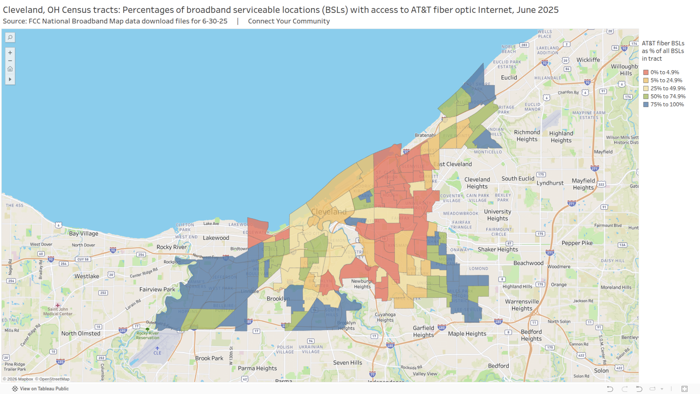
But economic discrimination against lower-income communities is easier to demonstrate. Providers like AT&T openly acknowledge that their decisions to withhold investment in many urban neighborhoods have been based on lower-income households’ presumed inability to pay.
“Does that make broadband investment in those areas ‘economically unfeasible’ and thus excused from FCC review under the statute? Or is it actually an admission of discrimination on the basis of income? Communities might have welcomed the opportunity to argue that out with the providers in formal evidentiary proceedings.”
Still, Callahan acknowledges that hindsight does not matter as much as what comes next. “What matters now is that the court and the Carr FCC have once again told providers like AT&T and Verizon they can go right on raising Internet costs for millions of working families by withholding fiber competition from their neighborhoods, leaving them at the mercy of overpriced cable monopolies.”
A Third Way
While supportive of the FCC’s digital discrimination rule-making, not everyone saw the debate as a binary choice between intent and impact – and advocated for less federal stick and more community-based carrot, as was initially envisioned by the Biden administration in its call for “support (of) broadband networks owned, operated by, or affiliated with local governments, non-profits, and co-operatives – providers with less pressure to turn profits and with a commitment to serving entire communities.”
In a letter to the FCC regarding the digital discrimination proposed rulemaking, a group of public interest organizations that included ILSR acknowledged that “the lives of Black and Brown people will forever be informed in some large or small way by practices of digital redlining and other exclusionary decisions of the past,” but also elevated an approach to closing the digital divide that focused more on “building trusted relationships, allowing communities to own infrastructure, build capacity, and experiment with solutions, and allowing for community-driven decision-making and knowledge-building.”
The letter went on to make the case for why it is crucial to prioritize community solutions where service is offered by trusted entities or providers operating in partnership with trusted community institutions. The letter emphasized how “challenging digital discrimination cannot be solely concerned with giving more Black, Brown, tribal, and people in rural areas broadband run by large corporations just to increase their upload and download speeds.”
This week’s court ruling, however – as noted by a Benton Institute analysis – was explicit in noting that by vacating the rule, it did not end the FCC's obligation under the infrastructure law.
The agency still has an “unfinished obligation to 'adopt final rules to facilitate equal access to broadband internet access service.' The FCC must go back through a notice-and-comment rulemaking to produce a new rule. Apparently, a new rule would be limited to prohibiting intentional (disparate treatment) discrimination and covering only broadband providers and subscribers.”
The parties in the case now have 45 days from May 6, 2026, to file a petition for a rehearing before a panel of judges or a rehearing before the full Eighth Circuit Court.
Meanwhile, a consortium of digital inclusion organizations and advocates are marking the one-year anniversary of the cancellation of the Digital Equity Act with a month of action running from May 8 to June 8, pressing Congress to restore Digital Equity Act funding in the FY2027 budget and keeping pressure on policymakers to recommit to digital inclusion.
The effort is a reminder that, however the legal battles play out in Washington, the community organizations doing the day-to-day work of getting people connected have no intention of standing down.
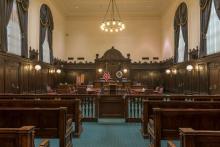
Header image of the courtroom in the John Minor Wisdom U.S. Court of Appeals Building courtesy of the Carol M. Highsmith Archive, Library of Congress, PDM 1.0, Public Domain Mark 1.0 Universal
Inline image of FCC Chairman Brendan Carr courtesy of Broadband Breakfast
Inline map of AT&T’s fiber availability in Cleveland (2025) courtesy of Bill Callahan
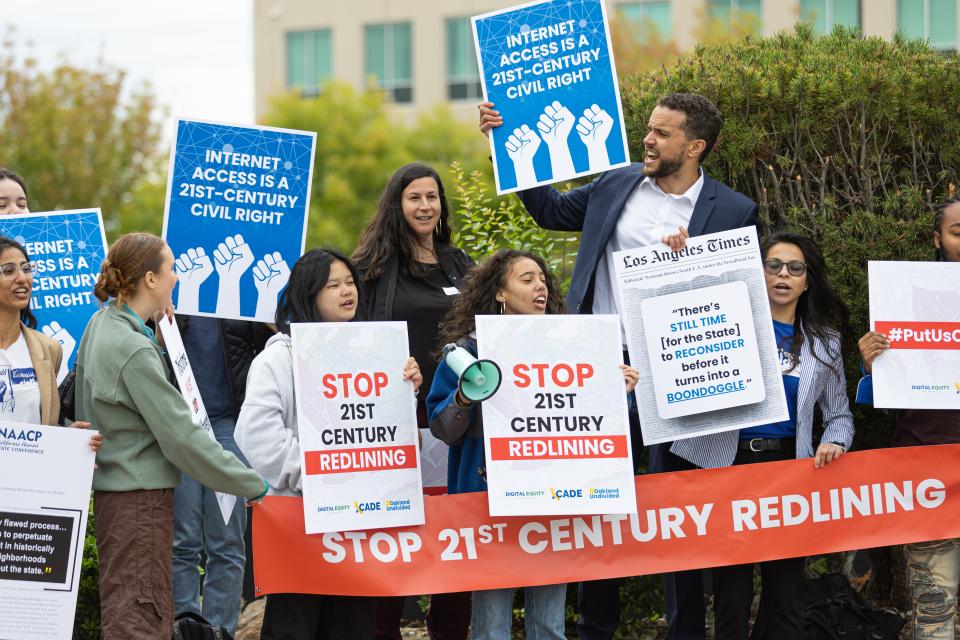
Inline image of OaklandUndivided day of action courtesy of OaklandUndivided