

With tax day as a backdrop, the Institute for Local Self-Reliance (ILSR) Community Broadband Networks Initiative and the National Digital Inclusion Alliance (NDIA) convened its quarterly Building for Digital Equity (B4DE) livestream yesterday that shined a light on how public dollars and tax policy intersect with digital equity.
The event – an ongoing series sponsored by UTOPIA Fiber – brought together community organizers, policy experts, and local government leaders on the frontlines of working to expand opportunities for those being left in the digital dust.
What set yesterday's B4DE apart was its featured focus on how the emergence of AI hyperscale data centers are impacting communities and how communities can fight for a better deal.
The Data Center Boom — and Its Costs
MediaJustice Senior Campaign Lead Brandon Forester and Jordana Barton-García, Connect Humanity Director of the Texas Rio Grande Valley Broadband Coalition, heated up the afternoon’s fireside chat with an unflinching look at the rapid expansion of AI infrastructure.
Forester was direct about what's really driving the surge: “The only idea they have left is scale” and warned that data center developers often arrive in communities – particularly in the South – promising economic benefits that rarely deliver. “They just need your space, they need your resources, and they need you just to let them do what they want to do,” he said.
Forester pushed back on the idea that data centers generate meaningful local tax revenue, noting how in Prince George's County, Maryland, where he lives, the projected annual return from a single data center amounts to roughly $6 million after state tax breaks, which are a fraction of what communities are led to expect.
Barton-García emphasized how communities have more power than they realize – but only if they act early. Her core message: get to the negotiating table before the deal is done.
She described the work underway in South Texas's Rio Grande Valley, where her coalition is developing a modular Community Benefit Agreement template that communities can use to negotiate enforceable commitments around water use, local hiring, workforce development, and long-term investment.
“The idea in negotiation is to create and claim value,” she said, noting that successful negotiations find the overlap between what a community needs and what a developer wants – whether that's workforce development, compute power for local institutions, or revenue-sharing arrangements that can fund community priorities in the long-term.
Forester acknowledged that resistance is sometimes the right call – but pointed to a potential silver lining: “We've seen the biggest kind of movement organizing around energy infrastructure…what we're going to be left with, I don't think, is the infrastructure of depreciating GPUs. I think it's going to be the power that communities have built and saying that we deserve to have our dreams honored.”
Also, both Forester and Barton-Garcia shared with the audience resources (here and here) that communities can use to think about dealing with AI data center proposals.
Policy Updates and Local Tools
Earlier in the program, Drew Garner from the Benton Institute for Broadband & Society updated attendees on the roughly $22 billion in BEAD non-deployment funds still awaiting federal guidance – more than half of what Congress allocated for the $42.5 billion program. As a resource, Garner shared Benton’s analysis that compared what public commenters said should be done with the funds versus what NTIA took away from recent listening sessions.
Amy Huffman, NDIA's Policy Director, previewed a forthcoming State Digital Opportunity Model Legislation Package NDIA developed with AARP that aims to give advocates a practical, modular toolkit for advancing digital equity at the state level.
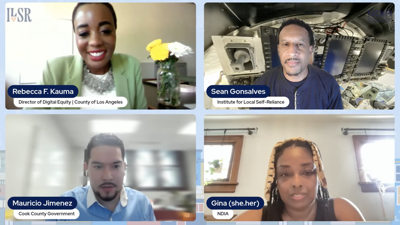
Lightning round presentations from Mauricio Jimenez of Cook County and Rebecca Kauma of Los Angeles County rounded out the program. Kauma, speaking to the challenges of the current moment, put it plainly:
“I'm just so thankful that despite not having the federal funding, all of our partners – we have over 80 organizations – are committed to helping us co-create this roadmap in this time, despite what's happening at the federal level. And that's what keeps me excited and engaged.”
Below you can watch the livestream in its entirety: