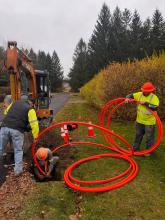
Bergen County, New Jersey officials say they’re making significant progress on their plan to dramatically expand Bergen County Fiber – the county’s new municipal fiber Institutional Network (I-Net) – with recently completed deployments in communities like Little Ferry and Lodi.
New Mexico Gov. Michelle Lujan Grisham signed into law today new legislation that aims to provide tens of thousands of low-income households in “The Land of Enchantment” an Internet lifeline similar to the now-expired federal Affordable Connectivity Program.
The Bois Forte Band of Chippewa (also referred to as Ojibwe) has officially begun construction on a foundational fiber optic broadband expansion project in northern Minnesota.
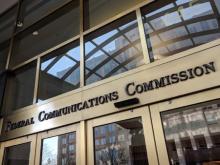
In late 2024 the Biden FCC implemented a new rule requiring that broadband providers include a “nutrition label for broadband,” making any fees, restrictions, usage caps, or other limits clear at the point of sale. The proposal was well-intentioned. But a lack of enforcement made their impact lukewarm, and now the new FCC is looking to water down their effectiveness even more.
As communities invest in broadband infrastructure, a bigger question looms: who controls the data flowing through those networks? Sascha Meinrath joins us to unpack the growing intersection of connectivity, surveillance, and civil liberties
Another round of two-year ACLS fellowships has opened up that aims to take those with degrees in sociology, literature, political science, geography, history, and similar fields and place them with social justice-oriented nonprofits around the United States.
Chittenden County Communication Union District recently completed a planned fiber extension into the heavily rural communities of Essex Town, Essex Junction, Jericho, Shelburne, Westford, and Williston.
lllinois State Sen. Rachel Ventura, D-Joliet, has introduced legislation directing regulators to set broadband price protections for low-income residents, though the bill text leaves key details to be determined later.
The Town of Dryden just signed up their 400th customer and continue to make steady progress expanding the popular network into rural enclaves in and around Dryden long deemed “unprofitable” by regional telecom monopolies. The first year and a half of operations focused on building the core fiber ring around the city. They’ve since shifted to the time-consuming task of extending last mile fiber access out to rural unserved and underserved homes in Dryden and nearby Caroline.
Last week, a California Assemblymember who had sponsored legislation for a broadband affordability law abruptly withdrew the legislation. But what really killed the broadband affordability bill in California? In explaining why Assemblymember Tasha Boerner withdrew the legislation, she did not say it was because of the pushback her office was getting from digital inclusion advocates across the state – or because of industry objections for that matter. Boerner laid it at the feet of the Trump administration.
Isle au Haut has completed its municipally-owned fiber network with ample help from locals – and federal and state grants. After a decade of planning, several dozen residents of the island (with a summer population of around 300) recently celebrated a ribbon cutting ceremony on June 28, alongside build partners that included the Island Institute, Axiom Technologies, and Hawkeye Fiber Optics.
Four leading broadband deployment scholars release new analysis today that may help state broadband offices evaluate “the capacities and saturation limits of the Starlink satellite infrastructure.” The overarching goal is to help states determine where – and if – Starlink can meet federal requirements for broadband, which is defined as delivering minimum connection speeds of at least 100 Megabits per second (Mbps) download and 20 Mbps upload.
The Paulding Putnam Electric Cooperative (PPEC) says it has officially launched the construction of a major new residential fiber expansion project that should dramatically improve affordable fiber access across major swaths of Northwest Ohio and Northeast Indiana. According to an announcement by the co-op, mainline construction of the extended network technically started last April in the Haviland and Latty substation area, and extended during the month of June to the Roselm substation area.
From inaccurate broadband mapping data and an over-reliability on industry-provided coverage claims, to inconsistent broadband definitions and patchwork federal oversight, a new study by the Pew Charitable Trusts examined decades of U.S. broadband policy, and data analysis and found plenty of room for improvement. Pew’s analysis of U.S. broadband data collection found numerous areas of concern that have been repeatedly brought up by researchers over the last few decades.
Hudson, Ohio officials are now accepting bids on a promising new fiber-to-the-home network that should dramatically improve affordable, next-generation broadband access in the city of 23,000. It’s just the latest effort by a city that has been exploring the option of municipal broadband infrastructure for more than a decade.
The Sault Ste. Marie Tribe of Chippewa Indians will host a four-day Tribal Broadband Bootcamp on the Tribe's Marquette campus in Michigan’s Upper Peninsula in August. It will be the second held in the Great Lakes region, designed primarily for members of 36 federally recognized Tribes across Michigan, Wisconsin and Minnesota. Participants will be reimbursed for travel costs, room and board, and meals.
ILSR publishes new piece in The American Prospect on how the "One Big Beautiful Bill Act" cuts food assistance benefits to households that pay for internet access.
The FCC’s Universal Service Fund has survived a Supreme Court challenge by a right wing activist nonprofit, but the program – which for decades has helped extend broadband to underserved rural homes and schools – still faces a precarious immediate future. It is a peculiar political story, given that the rural regions that overwhelmingly vote for Republicans are now seeing Republicans try to dismantle a program that has been crucial for rural investment and development.
If you missed our Building for Digital Equity “Wired for Freedom” Livestream, you can watch it in its entirety here. The second UTOPIA Fiber-sponsored event of the year, hosted in partnership with the National Digital Inclusion Alliance (NDIA), brought together community-based digital inclusion practitioners and policy experts to talk about the road ahead for expanding broadband access amid a rapidly shifting political landscape.