Earlier this month rural electric and broadband cooperatives gathered in Washington, DC, for their fifth-annual Broadband Leadership Summit. The topic du jour was broadly unpopular changes made by the NTIA to the Broadband, Equity, Deployment, and Access program (BEAD) created by the 2021 infrastructure bill.
Lawmakers are pushing the Trump administration to stop being murky on whether states will be able to access tens of billions in “non-deployment funds” mandated by Congress that have been temporarily hijacked by the administration’s unpopular changes to a once-in-a-lifetime federal grant program to expand high-speed Internet access.
California and the California Public Utilities Commission (CPUC) continue to heavily invest in state efforts to expand affordable Internet access, and bolster digital equity, inclusion, and education programs to ensure freshly-connected communities are able to make the most of it.
Chris and Doug Dawson unpack a new survey of rural Americans, the lawsuit over the Digital Equity Act, and what the FCC's latest satellite decisions could mean for the future of our skies
Moore Haven, Florida-based Glades Electric Cooperative has completed a long-planned fiber broadband network into largely unserved parts of the Sunshine State.
Today, The Verge published an in-depth piece authored by our own Sean Gonsalves and ILSR contributor Karl Bode that examines the BEAD program from its inception to the boondoggle its become.
The city council voted to provide a $3.1 million loan from the city’s sewer fund to complete the build-out of Fort Dodge Fiber. In 2021, the city borrowed $33.3 million to pay for building the fiber optic utility with a loan to be paid off with revenue generated by Fort Dodge Fiber as the project expanded. But thanks to inflation and increasing labor and material costs, that $33.3 million isn’t going to be enough to finish the project.
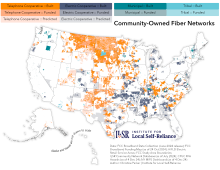
In September we released our updated map pinpointing the location of the 400 municipally owned Internet service providers now serving almost 800 communities across the United States. Today, we unveil our predictive map that provides a multi-layered look into the near future of community broadband networks.
Consumer advocacy groups that frequently appear before the Federal Communications Commission are not happy with President-elect Donald Trump’s pick to run the agency. Brendan Carr, the agency’s senior Republican who’s now set to take the reins in January, wrote the Project 2025 chapter on the FCC.
Though Northampton, Massachusetts residents still broadly support the construction of a city-owned municipal fiber broadband network, city officials are celebrating the arrival of Gateway Fiber which will soon be delivering a more affordable fiber option, and more broadband competition, to the traditionally underserved city. Gateway Fiber recently unveiled plans to deliver multi-gigabit speeds to large swaths of the city. The company, which will finance the entirety of the build, says it’s already invested $3 million in the project so far.
Louisiana’s only publicly-owned broadband provider says it’s expanding access into nearby Church Point, bringing affordable fiber access to the town of nearly 4,200 residents. LUS Fiber was awarded a $21 million grant to expand fiber outside of Lafayette as part of the U.S. Department of Commerce’s National Telecommunications and Information Administration’s (NTIA) Broadband Infrastructure Program (BIP).
California’s $2 billion Last Mile Federal Funding Account Grant Program (FFA) has announced another $207 million in new broadband grants across Amador, Los Angeles, and Solano Counties. According to the state’s announcement, $61 million in new grants were awarded by the California Public Utilities Commission (CPUC) for five Last Mile FFA broadband infrastructure grant projects in Amador and Solano Counties, bringing affordable fiber Internet access to approximately 10,000 Californians.
A recent U.S. News And World Report survey of U.S. broadband subscribers shows that Americans are increasingly paying more money for broadband access. The survey also indicates broad public support for the recently defunded Affordable Connectivity Program (ACP), and other government-backed efforts to cap soaring broadband subscription costs.
On the most recent episode of the Connect This! Show, the panel was joined by California-based Internet Exchange builder Matt Peterson of SFMIX to talk about the need for better, more practical, more forward-thinking middle mile networks across the United States.
The Electric Cooperatives of Arkansas say they recently finished delivering fiber broadband capability to more than one million Arkansans as part of a $4.66 billion expansion. More than 40,000 miles of fiber have been installed by 17 cooperative broadband providers, including 15 local broadband providers, one wholesale broadband provider, and one middle-mile fiber company.
Now that the election has been settled, many in the broadband space are wondering what, if anything, will change with the incoming Trump administration. We have to entertain the possibility that BEAD will change substantially.
At their core, maps are about using data to tell a story. And we may be biased, but we love a good map about the Internet around here. Hexes, polygons, heat maps: they're all equally as good. Whether in service to educating the public, or making a policy point, or helping local leaders make more informed choices as they work for the collective good, maps can be a powerful tool. Come and join us on a journal during the month of November, as we build 30 maps about the Internet in 30 days.
Today, we unveil our updated list of the 16 states in the U.S. with preemption laws still in place that either prevent or restrict local municipalities from building and operating publicly-owned, locally-controlled networks. These states maintain these laws, despite the fact that wherever municipal broadband networks or other forms of community-owned networks operate, the service they deliver residents and businesses almost always offers faster connection speeds, more reliable service, and lower prices.