
feature

Content tagged with "feature"

Related Topics
Displaying 71 - 80 of 198

UTOPIA Fiber Marks Another Banner Year

UTOPIA Fiber is celebrating another banner year.

Created in 2009 by a coalition of Utah cities to cultivate a competitive market for fast affordable fiber Internet, the nation’s largest community-owned open access network recently announced it officially hit the 70,000 subscriber mark.

UTOPIA (Utah Telecommunication Open Infrastructure Agency) is now delivering fiber-to-the-home (FTTH) access in 21 Utah cities, partnering with 19 private-sector ISPs, while offering business-class service in 50 cities.

Over the past year – having deployed 1.9 million feet of fiber-optic cable, 1.3 million feet of underground conduit, 68,190 feet of aerial strand, and 8,660 handholes – UTOPIA’s growth in 2024 means fiber access is now available to 23,684 new homes and an additional 1,974 businesses in Utah, UTOPIA officials said.

Image

This comes after having completed its West Haven City buildout and the nearly complete construction of Bountiful Fiber’s network, which is on track to be finished by July. Additionally, UTOPIA has also completed fiber installations in 22 homeowner associations (HOAs) and are gearing up to connect more in the coming months.

UTOPIA Fiber executive director Roger Timmerman pointed to the surging demand for affordable fiber connectivity as to what’s fueling the growth:

“Residents are the driving force behind these fiber projects because they need better Internet now, not years down the road.”

For Timmerman, the truth is in the ledger. UTOPIA added 11,256 new subscribers in 2024, which pushed its subscriber total to over 70,000 – half of whom joined the network in the past three to four years.

Carson, California Breaks Ground On New Municipal Fiber Network

Leveraging years of regional fiber collaboration, Carson, California has broken ground on a municipal broadband pilot network city officials hope will someday be expanded to bring affordable fiber optic broadband to the entire city of 95,558, situated just 13 miles south of downtown Los Angeles.

Carson is looking to leverage $8 million in federal and state grant money to connect 1,000 unserved households and 372 businesses, with City Hall, the Civic Center and Cal State Dominguez Hills serving as anchor institutions for the new network. A new city announcement says construction has begun, with the pilot construction phase to be completed in 18 months.

“This visionary project is set to transform Carson into a cutting-edge digital hub, revolutionizing broadband access for residents, businesses, and city services,” the city said in a statement announcing the groundbreaking.  

The new network deployment comes as the Los Angeles area prepares to host the 2026 FIFA World Cup, and is being built on the back of previous collaborative fiber deployments amid the state of California’s landmark effort to boost statewide broadband competition.

Image
Street rail overpass in Carson with the city name spelled out on side of overpass by spraypaint

“This project represents a major milestone for Carson,” Carson Mayor Lula Davis-Holmes said of the new deployment. “By investing in our own fiber network, we are creating a foundation for enhanced connectivity, economic growth, and future smart city initiatives. This is just the beginning of a transformative journey for our community.”

Jemez Pueblo Tribe Seeks ‘Light,’ Fiber Knowledge To Advance Digital Sovereignty

For Angela Diahkah, what started as a self-described “side hustle” is now her full-time job.

Diahkah – or “Ange,” as she sometimes goes by – is five years into serving as Network Operations Supervisor and Digital Navigator Program Manager for JNET, the Tribally-owned broadband provider for the Pueblo of Jemez.

Just 50 miles northwest of Albuquerque, Angela leads the charge in building a new fiber network, the gold-standard of Internet connectivity, that once complete will serve her community (one of the 19 Pueblos in New Mexico).

Last week, she was at the 17th Tribal Broadband Bootcamp (TBB) in Aguana, California in the hills above Temecula Valley, along with a half dozen JNET technicians-in-training and JNET Director Kevin Shendo. The 30 or so other TBB participants – representing broadband leaders from several other federally-recognized Tribes – were also there for the three-day immersive learning experience focused on building and operating Tribal Internet networks.

Held in different tribal regions several times a year since the initiative began in 2021, this most recent bootcamp was back at TBB co-founder Matthew Rantanen’s “RantanenTown Ranch.”

Image
Angela looks at her crew explore fiber splicing equipment on a table outdoors on RantenenTown Ranch in the desert-like foothills of Anguana, Califonia

“We're basically trying to find a light in a dark tunnel and just work with what’s best for us,” Angela told ILSR in describing why she and her JNET crew had come, just as they are in the early stages building out their own fiber-to-the-home network.

“We want to expose them to the network,” literally and figuratively, she said.

Study: Affordable Connectivity Program More Than Paid For Itself

A new study by The Brattle Group found that the FCC’s Affordable Connectivity Program (ACP) generated more savings for taxpayers than it cost. Healthcare savings generated by the low-income program alone more than offset its annual burden to taxpayers, undermining claims that the program was dismantled as an act of fiscal efficiency.

The ACP, part of the 2021 infrastructure bill, provided 23 million low-income households a $30 broadband discount every month. It provided a larger $75 a month discount for low-income residents of widely underserved tribal areas.

The ACP also provided low-income Americans a $100 subsidy to help them afford a laptop, tablet or a desktop computer.

Generally viewed as a rare bipartisan success story, the ACP took direct aim at a primary problem across U.S. broadband: affordability.

Image
House Speaker Mike Johson holds his hand flat out jutting out as he speaks to a crowd

But the program was unceremoniously allowed to expire in 2024 after GOP leaders including House Speaker Mike Johnson refused to even bring funding bills to the House floor for a vote, despite widespread support from industry, consumer groups, and even then Republican Ohio Senator JD Vance.

ILSR and AAPB To Host Community Broadband Film Fest

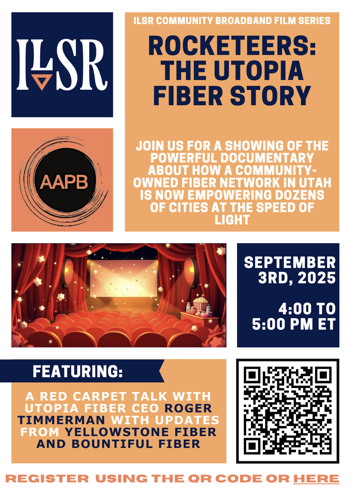
Consider this your invitation to the first Community Broadband Film Fest.

Slated for March 27 from 4 to 4:45pm ET, the livestream event will feature the world premiere of “Building Fiberhoods in Holland” – a mini eight minute documentary on how the city of Holland, Michigan came to build a municipal broadband utility to supercharge its local economy.

The short film tells the story of how – after almost a decade of consideration, education, planning – Holland, Michigan embarked on a mission to build a city-owned fiber network offering fast, affordable, world-class Internet service.

Narrated by key leaders in the city of 33,000, viewers will learn how and why the city established its own municipal broadband utility to solve its local connectivity challenges.

Image
CBN Film Fest flyer

Hosted by ILSR’s Community Broadband Networks team and the American Association for Public Broadband (AAPB), the event will kick-off with virtual red carpet introductions of some of the film’s stars, including Holland Mayor Nathan Bocks.

After the screening, viewers will be able to engage the real life cast in a bit of Q&A.

Vermont Looks To Bring Oasis of Fiber-Connected Telehealth Hubs to ‘Healthcare Deserts’

Many rural healthcare facilities are struggling to keep their doors open. Some have been shuttered. Add to that the looming federal budget crisis threatening to end Medicare payments for telehealth and the urgency of what a coalition of Vermont healthcare leaders, librarians, and state broadband officials are doing comes into view. 

It’s called VITAL VT (Virtual Integration for Telehealth Access through Libraries in Vermont) – an exploratory effort being launched with a $10,000 grant from the Leahy Institute For Rural Partnerships, working in collaboration with the University of Vermont Medical Center and the Vermont Library Association.

The aim is to leverage the state’s unprecedented deployment of community-owned fiber networks and create a scalable, community-centered telehealth model. 

“We’re really looking to find any way to make any of our community members in Vermont get access to care – easier, better, quicker. So we’re wondering if telehealth (hubs) might be the right answer for that, if we’re able to put it right in people’s libraries, right in their own towns,” Roz King, chief of research for emergency medicine at the University of Vermont, told local CBS affiliate WCAX.

Data-mapping ‘Healthcare Deserts’

In speaking with ILSR this week, King said what spurred the initiative was a talk given by one of UVM’s medical students who noted how Vermont was beginning to see “healthcare deserts where in some rural counties PCP’s were aging out and no one was there to provide healthcare (services).”

Oswego County, NY Nabs $26 million ConnectALL Grant To Expand Fiber Access

Oswego County, NY officials are celebrating the award of a new $26 million New York State grant aimed at dramatically expanding affordable fiber access to long-underserved rural communities in the northwestern part of the state, just north of Syracuse.

According to the announcement by New York State Governor Kathy Hochul, Oswego’s latest grant award will help fund the deployment of 345 miles of new fiber infrastructure to largely rural unserved regions, helping to bring affordable broadband access to nearly 11,000 homes, businesses and community institutions across 22 towns and villages.

Oswego County will own the finished open access network and lease the fiber to Internet Service Providers (SPs), including Empire Access, "on a non-discriminatory and non-exclusive basis."

Empire, a family-owned ISP and named the fastest ISP in the nation by PCMag in 2021, currently offers local residents symmetrical 500 Megabit per second (Mbps) service for $50 a month; symmetrical 1 gigabit per second (Gbps) service for $65 a month; and symmetrical 2 Gbps service for $100 a month.

Cooperatives Playing Major Role In Arkansas’ ARPA-Fueled Fiber Expansion

The Arkansas State Broadband Office – ARConnect – continues to leverage American Rescue Plan Act (ARPA) funds to drive affordable fiber access into underserved parts of the Natural State.

Three funding rounds are winding their way to completion, as fiber connectivity is being made available to rural markets for the first time, with a heavy reliance on local cooperatives.

ARConnect officials say they’ve now awarded more than $534 million in grants that will expand access to 130,000 locations in total, with most of the projects completed by 2030. Including matching funds, $1 billion is expected to be invested in total, bringing notable improvements to an estimated 875,000 Arkansas residents.

The Arkansas ARC Grant Program began in February 2021, using federal Coronavirus State and Local Fiscal Recovery Funds (SLFRF) Program funding propped up by ARPA, which both Republican Arkansas state senators voted against.

Image
American Rescue Plan Act pic

As of last December, state officials have committed all but $4,832 of its $1.57 billion in ARPA funds to active projects in the state.

ARC Round 1 doled out $118 million in grants to 76 projects, expanding access to approximately 55,700 homes, businesses, and community anchor institutions.

ARC Round 2 awarded $274.4 million in grants to 87 different projects, impacting approximately 54,000 homes, businesses, and community anchor institutions.

Experts Point To The Big ‘Payback’ That Flows From Municipal Broadband Investments

At the “Municipal Broadband and Innovative Financing Models: Unlocking Economic Growth” webinar earlier today, attendees got an inside look at how successful community broadband networks have been funded – and how cities and towns can still finance networks even with the uncertainty now swirling around the federal BEAD program.

Co-hosted by ILSR’s Community Broadband Networks Initiative and the American Association for Public Broadband (AAPB), the webinar featured a wealth of municipal broadband financing knowledge from four guests with deep experience navigating the numbers.

Co-host Gigi Sohn, who was joined by ILSR’s Sean Gonsalves, began the webinar with a brief explanation on why AAPB and ILSR are joining forces for what will be a series of webinars designed to assist cities and towns in how local and state leaders can deal with solving local connectivity challenges where the big incumbent ISPs have failed to deliver ubiquitous and reliable service.

Image
Screenshot of Sean Gonsalves and Gigi Sohn during webinar

“I've been traveling around the country and I hear from a lot of communities who are very interested in a model where they control their broadband networks in their communities,” she said. “We want to kind of demystify the finance part and try to get communities more comfortable with how they can move forward.”

The first guest expert to take center screen was Ernie Staten, the City of Fairlawn, Ohio’s Public Service Department Director.

Cold Springs Rancheria Joins Seven Tribes and More Than 20 Public Entities as California Broadband Funding Winners

As federal broadband funding sources face continued uncertainty, California’s massive last-mile grant program continues to plow ahead, looking increasingly like a vital lifeline for communities hoping to ensure that every individual has access to robust, reliable, and affordable Internet access.

Cold Springs Rancheria of Mono Indians was among the applicants celebrating a winning grant application in the California Public Utilities Commission’s (CPUC) latest Federal Funding Account (FFA) announcement.

The grant marks the eighth successful application by a Tribal nation in this program and another in a long list of community-focused projects led by public entities like municipalities.

Image
Cold Springs Rancheria Tribe logo

Cold Spring Rancheria’s application, for up to $1.5 million dollars, will bring much-needed connectivity to a total of 94 units, including 5 anchor institutions, on the Reservation in Fresno County with 100 percent of the households served by this project qualifying as low-income.

Many residents on the Reservation lack access to a terrestrial Internet service offering speeds anywhere near the definition of broadband (100 Mbps Upload/20 Mbps Download). Those that do have access to purported “broadband” speeds must rely on out-of-date DSL connections and, as a result, struggle with slow and spotty connections.

After working for several years to find a viable solution to these connectivity challenges, Tribal officials can now look forward to the fastest and most reliable Internet access via fiber-to-the-home technology.

The new, Tribally-owned broadband network will help the Tribe achieve universal access.