
feature

Content tagged with "feature"

Related Topics
Displaying 41 - 50 of 181

Monahans, Texas Builds Its Own ‘Labor Of Love’ Fiber Network

Tired of the high prices, spotty coverage, and slow speeds of regional monopoly broadband providers, the remote West Texas city of Monahans has spent the last decade taking matters into their own hands.

Now, thanks to hard work, determination, and local philanthropy, the city’s 7,500 residents are headed for the right side of the digital divide.

Carroll Faulkner, who consulted with the city on its project, and Teresa Burnett, executive director of the Monahans Chamber of Commerce, told ILSR the project to bring Monahans into the modern era has been a challenging labor of love.

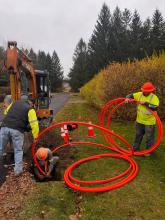
It has recently culminated in the completion of the first phase of the project, bringing affordable fiber to around 2,000 residents in city 36 miles southwest of Odessa.

Image
oil rig behind a wired fence in Sandhills State Park

“We are very passionate about this project,” Burnett told ILSR. “It's been a lot of ups and downs, and it's been 10 long years.”

The city’s network build is in partnership with Hosted America, which is acting as the first last mile ISP serving residents, and View Capital’s American Fiber Infrastructure Fund, which technically owns the finished network. Hosted America enjoys early exclusive usage of the network, but the duo say the network will ultimately be open access, allowing numerous partners.

Phase one of the network plan was completed roughly a year ago, bringing affordable fiber for the first time ever to around 2,000 locals. The full cost of phase one was expected to be around $4.5 million, said Faulkner, of which around $1 million was funded by the 2020 Coronavirus Aid, Relief, and Economic Security (CARES) Act.

The remainder of the funding was obtained from View Capital and a coalition of philanthropic organizations.

Trump Administration Imposed BEAD Changes Introduce Significant New Delays

Trump administration changes to the $42.5 billion Broadband Equity, Access, and Deployment (BEAD) grant program are poised to introduce years of potential new delays to the already slow-moving program, potentially undermining the program’s goal of bringing universal broadband access to mostly rural communities.

Worse, the looming changes would eliminate efforts to ensure taxpayer-funded broadband is affordable for low-income Americans, while driving billions in new subsidies to the world’s richest man and Trump mega donor Elon Musk.

Testifying this week before a Senate Appropriations Committee, Commerce Secretary Howard Lutnick confirmed that the National Telecommunications and Information Administration (NTIA) will "soon" issue a new Notice of Funding Opportunity (NOFO) that states will have 90 days to respond to.

The revisions will ensure that billionaire Elon Musk – and his capacity-constrained satellite broadband network Starlink – will receive significantly more taxpayer money. Such Low-Earth orbit satellite networks were slated to get some funds, but federal changes may result in them dominating grant funding, overruling the mix of technology states had originally preferred.

Other changes being implemented include elimination of provisions ensuring affordable access for low-income Americans.

Oakland Unveils Ambitious Plan to Build City-Owned Open Access Network

Just 40 miles north of the heart of Silicon Valley, the City of Oakland has its sights set on implementing an ambitious Broadband Master Plan.

Dubbed the OaklandConnect project – unanimously approved on May 20 by the Oakland City Council – the plan calls for the construction of a city-owned open access fiber network to expand affordable broadband connectivity to over 33,000 households that city surveys indicate are languishing without home Internet service.

While Oakland is served by Comcast and AT&T mostly (with a smattering of Sonic and T-Mobile hotspots), the service in many areas is substandard, expensive, or both – in a city where surveys indicate affordability as the primary reason so many do not have home Internet service.

Image
Oakland fiber map

Once the East Bay city of 436,000 completes network construction, it would be one of the largest publicly-owned open access networks serving a major metro area in the nation – and may serve as inspiration for other large cities to follow suit with a model that’s been proven to bring affordable local Internet choice in monopoly-dominated markets.  

“Cruel” E-Rate Rollback Harms Broadband Expansion Plans

Congressional Republicans are moving forward on a plan to kill a popular Federal Communications Commission (FCC) program providing free Wi-Fi to schoolchildren. Critics of the repeal say it’s a “cruel” effort that will undermine initiatives to bridge the affordability and access gap for families long stuck on the wrong side of the digital divide.

The effort, spearheaded by Texas Republican Senator Ted Cruz, leverages the Congressional Review Act to roll back FCC changes to E-Rate, a government program that helps subsidize deployment of broadband access to rural communities, libraries, and schools.

Accelerated by the remote education boom of pandemic lockdowns, communities country wide had petitioned the FCC to expand the program. The goal: allowing rural schools to leverage E-Rate funding to provide free mobile Wi-Fi hotspots to families that either couldn’t afford broadband – or found broadband entirely out of reach.

Image
Man tests WiFi on school buses

So in July 2024 the FCC voted to expand the program. Historically, E-Rate could only be used to improve access on school or library grounds. The expansion allowed schools to provide limited access to free Wi-Fi hotspots via school buses or other alternatives. The expansion did not involve an increase in the E-Rate budget or any new taxes on U.S. residents. It recognized that the concept of “school” had eclipsed the 20th century definition of a room in a community building.

“I believe every library and every school library in this country should be able to loan out Wi-Fi hotspots to help keep their patrons and kids connected,” former FCC boss Jessica Rosenwocel said when the reforms were announced. “It is 2024 in the United States. This should be our baseline. We can use the E-Rate program to make it happen.”

Pushback Mounts Over Trump Administration ‘Termination’ of Digital Equity Law

The Trump administration’s dismantling of a popular broadband grant program has been greeted with disgust and anger by those doing the heavy lifting to bridge the country’s digital divide, leaving many states' planned broadband expansions in limbo, and affordable broadband advocates contemplating potential legal action.  

The unprecedented choice to destroy digital skills training and broadband adoption programs created by an act of Congress is seeing escalating pushback by a growing coalition of frustrated lawmakers and state broadband offices.

Last week, President Trump announced via a Truth Social post that he was ending the Digital Equity Act, falsely claiming that the program was “unconstitutional” and “racist.”

“No more woke handouts based on race!” the President said. “The Digital Equity Program is a RACIST and ILLEGAL $2.5 BILLION DOLLAR giveaway. I am ending this IMMEDIATELY, and saving Taxpayers BILLIONS OF DOLLARS!"

Image
A black and white hand holds up a cell phone to photograph President Trump

But the popular program was perfectly legal, barely focused on race, and was proving to be of broad benefit to countless Americans – including many of the President’s own supporters in long-neglected rural counties.

The $2.75 billion Digital Equity Act was passed by Congress as part of the 2021 infrastructure bill. It mandated the creation of three different grant programs intended to shore up equitable, widespread access to affordable Internet, while providing the tools and digital literacy education needed to help neglected U.S. communities get online.

A legal challenge to the Trump administration’s unilateral decision to kill a law passed by Congress seems all but certain.

Longmont NextLight’s Affordability Program Picks Up Federal Slack For Low Income Locals

Since it first broke ground in 2014, Longmont, Colorado’s city-owned NextLight fiber network has won numerous awards and inspired countless communities nationwide. But the network, which recently expanded access to more than 28,000 area residents, is also trailblazing in another area: ensuring that fiber is affordable to low income, marginalized populations.

NextLight unveiled its locally-funded Internet Assistance Program (IAP) last year. The program provides low-income residents with a $25 discount off of NextLight’s already affordable fiber pricing. As a result, locals can receive symmetrical 100 megabit per second (Mbps) service for as little as $14.95 a month, and symmetrical 1 gigabit per second (Gbps) fiber for $45.

To apply, households must qualify for any of a number of existing federal programs, including the FCC’s Lifeline, Head Start, Medicaid-MSP or SLMP, Veterans or survivor’s pension, Section 8, WIC, food stamps, Federal Pell Grants, Supplemental Security Income (SSI), SVVSD Education Benefit, Temporary Assistance for Needy Families (TANF), or Food Distribution Program on Indian Reservations (FDPIR).

IAP was created to offset the collapse of the Federal Communications Commission's (FCC) Affordable Connectivity Program (ACP), which provided a $30 per month discount off of the broadband bills of low-income Americans. The program was summarily discontinued after Republicans in Congress refused to fund a program extension.

According to Longmont officials, not only is their IAP program available to a much broader qualification base, with more than 1000 subscribers now enrolled, the program is currently helping 14 percent more city subscribers than the FCC’s ACP did at its peak.

New Resource: Community Networks in California’s Federal Funding Account Broadband Grant Program

When California announced in 2021 that it would open a last-mile broadband grant program seeded with $2 billion, it was something of a watershed moment.

The Last-Mile Federal Funding Account (FFA) broadband program,* as it was called, instantly became one of the largest state-administered broadband grant programs ever. Along with other broadband programs overseen by the California Public Utilities Commission (CPUC), the FFA program sought to significantly close the digital divide by ensuring that at least 98 percent of households had broadband access.

Municipalities, cooperatives, Tribal entities and community-based nonprofit networks seized this opportunity to take charge of their digital futures, submitting nearly one hundred applications in more than 40 counties across the state.

As grant announcements began rolling out in June of 2024, the Institute for Local Self-Reliance (ILSR) began tracking where that money was going and, specifically, the kinds of applicants that were successful in the program. What emerged was indisputable: California’s Federal Funding Account broadband program was an unprecedented success for community networks.

At communitynetworks.org, we have published numerous stories highlighting innovative and successful applications, including projects by Plumas-Sierra Telecommunications, the City of Huntington Park, the City of Oakland, Cold Springs Rancheria, and the City of Indio.

Today we are releasing a new two-part dashboard based on the CPUC’s data that helps visualize the success of community-based projects in this transformative state program. (The CPUC also has a very helpful interactive dashboard with more detail on each project, but it does not share our focus on community networks). Hover on each visualization within this dashboard for additional detail.

Digital Inclusion Leaders Brace for Impact

Digital inclusion organizations are reeling after the Trump administration announced the Digital Equity Act grant programs, embedded in the bipartisan infrastructure law, was being cancelled months after federal grants had already been reviewed and awarded.

On Friday evening, President Trump announced via a Truth Social post that he was cancelling the Digital Equity Act, claiming it to be “unconstitutional” and “racist,” and, therefore, “ending this immediately.” Yesterday, state broadband offices began receiving letters from NTIA, the federal agency administering the program, to formally announce funding was being terminated.

As news began to trickle out, many of those working on these issues across the nation had more questions than answers as they scrambled to process a mix of confusion and frustration, especially mindful of the fact that the Digital Equity Act barely touches on the subject of race. Although Black, Brown, and Indigenous communities have been disproportionately left on the wrong side of the digital divide, only one of the of eight “covered populations” identified by Congress in the law even mentions race.

AAPB and ILSR Prepare For Inaugural ‘Future of Public Broadband’ Conference

Some of the nation’s leading thinkers and doers in the community broadband sector will connect and collaborate in the nation’s capital for the inaugural Community First: The Future of Public Broadband Conference and Hill Day next week.

Slated for May 14 and 15, the two-day conference is being hosted by the American Association for Public Broadband (AAPB) and New America Open Technology Institute (OTI), in partnership with ILSR's Community Broadband Networks Initiative, the Benton Institute for Broadband & Society, and the Community Broadband Action Network.

The in-person gathering will bring together public broadband champions, community leaders, policymakers, and industry experts to focus on strategy and advocacy in the face of potentially dramatic changes to the $42.5 billion BEAD program – the single-largest federal investment to ensure every household in the nation has access to high speed Internet connectivity.

Registration and tickets are still available here.

Image
Gigi Sohn AAPB

With the rise of community-owned broadband networks and cooperatives now flourishing across the nation, organizers are hoping to create “an essential space to share best practices, discuss financing, shape public policy, and support the development and expansion of public broadband networks.”

Massachusetts Lawmakers Hold Hearing Today on Affordable Broadband Bill

Legislation that would require ISPs operating in Massachusetts to offer qualifying low-income households high-speed Internet service for $15 per month is set to have its first legislative hearing.

The hearing is slated to run from 11 am to 1 pm ET today before the Massachusetts Legislature’s Joint Committee on Telecommunications, Utilities, and Energy. Committee members will hear testimony on multiple bills, including two companion pieces of legislation known as An Act Preserving Broadband Service for Low-income Consumers – S.2318 (filed by State Sen. Pavel Payano) and H.3527 (filed by State Rep. Rita Mendes).

The proceedings can be viewed here.

Inspired by New York Law

The hearing in Massachusetts comes as similar legislation is being considered by state lawmakers in Vermont and California – all three of which are modeled on New York’s Affordable Broadband Act which, after numerous legal challenges, went into effect in the Empire State in January of this year after the US Supreme Court declined to intervene and overturn a U.S. Appellate Court ruling that upheld the law.

Like the New York law, the bill being proposed in Massachusetts requires ISPs operating in Massachusetts to offer qualifying low-income households high-speed Internet service for $15 per month.

However, the Massachusetts bill set the minimum speed at 100 Megabits per second (Mbps) download to mirror the increased FCC definition for minimum broadband speeds that had been raised from the previous benchmark of 25/3 Mbps, which was the federal standard when the New York law was written.