
feature

Content tagged with "feature"

Related Topics
Displaying 111 - 120 of 181

New York Announces $70 Million For Municipal Broadband Projects

As states gear up to administer federal BEAD funds from the bipartisan infrastructure law, a handful of states are already making significant investments in municipal broadband using federal Rescue Plan dollars.

California, Maine, Vermont, and New York have each established grant programs that center municipal broadband projects (mostly fiber builds) – with New York being the most recent state to announce more than $70 million in grant awards through its ConnectALL Municipal Infrastructure Grant Program (MIP).

Courtesy of the U.S. Treasury’s Capital Projects Fund, the awards are part of a $228 million initiative to bring high-quality Internet connectivity and consumer-friendly choice to New York communities long-stranded on the wrong side of the digital divide.

Tribal Broadband Bootcamps Help Address 'Historic Gap in Internet Access on Tribal Lands’

What began as a three-day intensive learning experience focused on building and running Tribal Internet networks has become a can’t-miss gathering of broadband-minded Tribal leaders coming together to “shore up historic disparities in connectivity in Indian Country,” as the Associated Press recently reported.

Followers of this site have likely read or heard about ILSR’s deep involvement in the on-going series of Tribal Broadband Bootcamps (TBB) hosted in different Tribal regions several times a year since the initiative began in 2021. Now, word is spreading far beyond Indian Country.

Last week, the Associated Press shined a spotlight on the most recent bootcamp, which last month was once again convened at the southern California ranch of TBB co-founder Matthew Rantanen.

Image
Associated Press logo

The article, authored by AP reporter Kavish Harjai, provides an inside look at the most recent bootcamp, highlighting an aspect of the digital divide often overlooked in a nation that historically has been either hostile towards Indigenous communities or has treated Native Nations with benign neglect:

“More than 1 in 5 homes on tribal lands lack access to adequate broadband, compared to fewer than one in 10 on non-tribal land in 2024.”

“Tribal nations have struggled to connect to the web for a variety of reasons ranging from living in remote locations to lack of investment by [I]nternet service providers. The lack of service has hampered every aspect of 21st century life, from health care and education access to the ability to start a business and stay in touch with friends and family.”

The AP story captures the vision behind the initiative led by Rantanen and ILSR’s Community Broadband Networks program director and TBB co-founder Christopher Mitchell:

FCC Rejects Broader Relief For Growing List Of RDOF Defaulters

The Federal Communications Commission (FCC) says it won’t be providing broader relief for broadband operators that have defaulted on grant awards via the agency’s messy and controversial Rural Digital Opportunity Fund (RDOF) broadband subsidy program.

According to an FCC public notice, the FCC stated it found "no demonstrated need for broad relief" from provider penalties connected to either the RDOF or Connect America Fund II (CAF II) programs. It also shot down calls for a broader amnesty program for defaulters.

“Given the flexibility available under the existing default processes…we decline to provide a blanket amnesty,” the agency’s Wireline Competition Bureau said.

In a letter to the agency last February, a broad coalition of providers and consumer organizations suggested that either reduced penalties – or some sort of amnesty program – might speed up defaults, freeing areas for upcoming broadband infrastructure bill (Broadband Equity Access And Deployment, or BEAD) subsidies.

Image
FCC front entrance

The group was quick to point out that areas where RDOF and CAF II money has been committed are considered “served” for purposes of BEAD deployments, potentially boxing out many desperate U.S. communities from billions in potential funding.

“Many of the RDOF and CAF II awardees who cannot or will not deploy their networks are located in states with the greatest connectivity needs, like Missouri and Mississippi,” the authors wrote. “The Commission should not permit these unserved rural communities to face this type of double whammy and be left behind once again.”

But in its statement, the FCC insisted that changes to its approach aren’t necessary because, it claims, its existing processes are working.

Ting Brings Competition, Fiber Service and Microtrenching to Centennial, Colorado

The City of Centennial, Colorado is making steady inroads bringing affordable fiber Internet service to the city of 106,000, leveraging its city-owned fiber backbone and a partnership with the Charlottesville, VA.-based fiber provider Ting.

Just south of Denver – in a city known for its high-tech industry, craft breweries, and family-friendly neighborhoods – voter-approved efforts to get out from under the thumb of regional monopolies has driven a surge of competition, most recently exemplified by Ting’s continued delivery of affordable gigabit fiber.

Ting Public Affairs manager Deb Walker told ISLR that while the company couldn’t break out specific details on the number of passed fiber locations in the Centennial market, they’re making inroads on fiber deployments across Colorado.

“Now that Ting has city-wide networks built or under construction in three markets in the Denver region (Centennial, Greenwood Village and Thornton), and they share certain operational resources, we report progress on those markets together in our quarterly Ting Build Scorecard,” Walker said.

Image
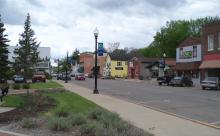
Streets at SouthGlenn in Centennial Co

“At the end of the first quarter of 2024, we had almost 31,000 serviceable addresses in the region, mostly in Centennial as we’re just starting the other two markets,” she added.

In 2021 Ting also unveiled the construction of a new 16,000 square foot office complex and data center, Walker said. Ting is also collaborating with Colorado Springs Utilities, which is building a fiber network throughout the city and connecting local homes and businesses.

Massachusetts’ Gap Networks Program Awards Verizon $37 million; One Muni Network Gets $750K

State broadband officials in Massachusetts have announced over $45 million in grant awards from the state’s Broadband Infrastructure Gap Networks Program with the lion’s share going to Verizon to “expand high-speed broadband [I]nternet infrastructure to underserved homes, business, and community anchor institutions across the state.”

State broadband officials say the $45.4 million in grant awards will be coupled with $40 million in matching funds from the awardees to expand broadband access to approximately 2,000 locations in 41 Massachusetts communities.

In 2022, as we previously reported here, Massachusetts was allocated a total of $145 million in federal Rescue Plan dollars to fund the Bay State program. With the state’s first round of funding from the Gap Networks Program awarding $45 million to four applicants, about $100 million is left in the pot for future funding rounds. Massachusetts has yet to receive its $147 million share of federal BEAD funds from the bipartisan infrastructure law, the spending rules for which are much more stringent than the more flexible CPF funding rules.

CBRS Spectrum: A Potential Boon To Community Broadband

Recent federal government efforts to expand use of public Citizens Broadband Radio Service (CBRS) spectrum could be of significant help to municipalities and local communities looking to bridge the digital divide with the increasingly popular wireless technology.

CBRS spectrum refers to 150 MHz of spectrum in the 3.5 GHz band. In 2015, the FCC adopted rules for shared commercial use of the band, creating a three-tiered structure to avoid interference with military radar during collaborative use of the spectrum.

For municipalities, the spectrum has already proven to be a valuable way to deploy wireless access to the public. In Syracuse, New York, the city last fall launched a new public wireless network on the back of CRBS. In Longmont, Colorado, the St. Vrain Valley School District used CBRS to build a private LTE network connecting 4,000 students in partnership with NextLight, which operates Longmont's city-owned municipal fiber network.

Not all community deployments of CRBS have delivered satisfactory results for municipalities, however. The STEM Alliance in Westchester County, New York retired their efforts to deploy a CBRS network in Yonkers after they struggled with urban capacity constraints and low usage.

San Francisco Wins National Award For Providing Free High Speed Internet Service To Affordable Housing Residents

As the Affordable Connectivity Program (ACP) is now bankrupt and no longer helping low-income households pay for home Internet service, the City of San Francisco is being honored with the 2024 Community Broadband Project of the Year Award by the National Association of Telecommunications Officers and Advisors (NATOA) for its Fiber to Housing (FTH) program.

Built on the back of the city’s municipally-owned fiber optic network – which since 2002 has been used to connect city and public safety facilities, hospitals, libraries and street lights – California’s fourth most populous city is well on its way to extending the city-owned network to deliver free high-speed Internet service to 30,000 affordable housing units across the city.

Image
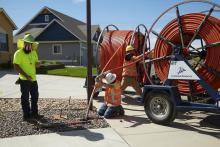
San Francisco technicians deploying fiber across roof

The program currently serves over 14,300 affordable housing units in the city, as well as 1,500 beds at homeless shelters across 115 sites, city officials say. An additional 10,000 residential units are expected to be connected in the coming fiscal year, with the aim of serving 30,000 units by July 2025.

According to the city’s website, the program has connected 52 public housing locations across the city to “fiber-optic and Ethernet cabling in every housing unit.” An additional 63 housing locations are getting free Internet through onsite Wi-Fi with download speeds ranging from 60 to 120 Mbps (Megabits per second), which exceeds the 50 Mbps service Comcast’s Internet Essentials offers.

Somerville And Washington Maine Begin Fiber Network Construction

The towns of Somerville and Washington Maine have kickstarted their long-percolating efforts to deliver fiber broadband to both long-neglected rural municipalities.

In an update posted to both towns' respective websites, officials say that the municipalities’ partner, Axiom Technologies, has begun construction on a dual-town fiber deployment funded by state and federal grants.

Somerville (est. pop. 600) and Washington (est. pop. 1,590) will be offering many local residents fiber access for the first time. Both of the deployments were made possible by a 2022 Broadband Infrastructure Program (BIP) grant from the NTIA, coordinated via the ConnectMaine Authority (now part of the Maine Connectivity Authority (MCA)).

Image
Maine Connectivity Authority logo

Established in 2021, the MCA is a quasi-governmental agency funded through a combination of federal and state resources, and tasked with ensuring the even, equitable deployment of broadband access to all corners of the Pine Tree State. They’ll be playing a central role in the disbursement of the state’s $272 million upcoming BEAD subsidy awards.

Fiber Finally  

According to a Washington, Maine FAQ, the total cost of network deployment for the town was $2,913,919 ($2,622,527 from the NTIA, $291,392 from the state). The Somerville FAQ indicates that their segment of the network construction was $1,601,901 ($1,441,711 from the NTIA, $160,190 from the state).

New York State Is Trying To Make It Easier For Municipal Broadband To Succeed

In March, Charter Communications tried (and failed) to include a poison bill in New York State’s budget bill that would have hamstrung community broadband. In stark contrast, a New York legislator this month introduced new legislation he says would make it easier than ever for New York state municipal broadband projects to thrive.

State Senator Jeremy Cooney of Rochester has introduced the Broadband Deployment Assistance Act of 2024 (S9134), which would streamline the permitting process for municipal broadband projects by "amending the general municipal law, in relation to requiring substantially similar permits for broadband deployment to be processed together at the same time and on an expedited basis."

“With a quicker timeline and more efficient process for local governments, we can create affordable options for New Yorkers that empower them to take control of their digital destiny,” Cooney wrote in an editorial published at Syracuse.com.

Image
New York State Seal

Cooney says he was motivated by a lack of broadband competition in New York State. New York is dominated by Charter Communications, which was almost kicked out of the state in 2019 for poor service and  misleading regulators about broadband deployment conditions affixed to its 2016 purchase of Time Warner Cable.

Vermont CUD Maple Broadband Moving Quickly To Expand Access

Vermont’s Communications Union Districts (CUDs), which were the subject of a recently released ILSR report, continue to make steady inroads in delivering high-quality broadband access to long-neglected rural Vermont residents.

That includes locally owned not-for-profit municipal operation Maple Broadband, which has completed the first phase of its broadband network and is busy on an expansion.

Maple Broadband is technically an extension of the Addison County Communications Union District (ACCUD), a coalition of 20 different member towns working collaboratively to bring gigabit-capable fiber to residents long left unserved or underserved by regional telecom giants.

In September of 2021 Maple Broadband announced a public private partnership with Vermont-based Waitsfield and Champlain Valley Telecom (WCVT), to build and operate a district-wide fiber network. The $30 million network is, in part, propped up by ARPA funds and a $9.1 million grant from the Vermont Community Broadband Board (VCBB).

Image
Maple Broadband logo

Three years later and the CUD says it has completed the first phase of its network; laying 143.5 miles of fiber and passing 1,647 homes and businesses in portions of the Vermont towns of Cornwall, Orwell, Shoreham, Whiting, Salisbury, and Middlebury.