Fast, affordable Internet access for all.

Fast, affordable Internet access for all.

Today marks a full year since Gigi Sohn was nominated to fill the fifth and final seat on the Federal Communications Commission (FCC).
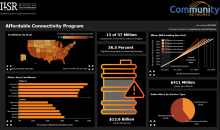
Since the launch of the Affordable Connectivity Program last January, millions of households have benefitted from the $30/month connection subsidy to help pay for their broadband bills.

Lehi City, Utah has broken ground on its new citywide fiber optic broadband network. The network, which city leaders say should take somewhere around three years to complete, will be built on the back of Lehi’s Utilities Department, part of a growing trend of U.S. utilities using an historic infusion of federal funding to expand affordable broadband connectivity. The Lehi Fiber Network will operate as an open access network, meaning that multiple ISPs will be able to utilize the city’s new infrastructure, providing a much-needed dose of broadband competition to local residents and businesses alike. Five ISPs have already committed to providing service over the city-owned fiber.

The sixth annual Indigenous Connectivity Summit kicked off today in Winnipeg, Manitoba, Canada, bringing together Indigenous community members and leaders; network operators; researchers; and policymakers to focus on how Indigenous communities in the United States and Canada can expand access to fast, affo

Alabama and New Mexico voters will soon be given the midterm option of changing their state constitutions to help boost broadband funding and deployment, albeit in notably different ways.

Avon, Colorado will soon be joining Project THOR, an open access middle mile fiber alliance of 14 communities spearheaded by the Northwest Colorado Council of Governments (NWCCOG).

A new study from the Digital Equity LA initiative lays bare how low-income communities of color are impacted by the quiet business decisions of the county’s monopoly Internet service provider. Slower and More Expensive/Sounding the Alarm: Disparities in Advertised Pricing for Fast, Reliable Broadband details how Charter Spectrum “shows a clear and consistent pattern of the provider reserving its best offers - high speed at low cost - for the wealthiest neighborhoods in LA County.” Not only does it highlight how economically vulnerable households in LA County pay more for slower service than those in wealthy neighborhoods, it also provides evidence for how financially-strapped households are also saddled with onerous contracts and are rarely targeted by advertisements for Charter Spectrum’s low cost plans.

Join us live on Thursday, October 20, at 11am ET for the latest episode of the Connect This! Show. Co-hosts Christopher Mitchell (ILSR) and Travis Carter (USI Fiber) will be joined by regular guests Kim McKinley (UTOPIA Fiber) and Doug Dawson (CCG Consulting).

Lexington, Tennessee is the latest U.S. city that will soon see the expansion of more affordable fiber thanks to the city-owned utility, Lexington Electric System (LES). LES’ recent $27.49 million state grant award will be the backbone of a new initiative that will both improve the utility’s electrical services, and deliver a long overdue dose of broadband competition to the area. The plan is deploy over 2,100 miles of fiber to bring high-speed Internet access to 22,000 residents across Henderson, Decatur, Benton, Carroll and Hardin counties that already receive electricity service from the utility.

In late August, Warren County Commissioners in northwest Pennsylvania issued a RFP that sought to establish a public-private partnership to bring high-speed Internet connectivity to rural parts of the county near the Allegheny National Forest and River.