
oregon

Content tagged with "oregon"

Displaying 51 - 60 of 68

Eugene Opens Up Dark Fiber for Commercial Connectivity

Businesses are now finding affordable connectivity in Eugene, Oregon, through a partnership between the city, the Lane Council of Governments (LCOG), and the Eugene Water and Electric Board (EWEB), reports the Register-Guard. A new pilot project has spurred gigabit Internet access in a small downtown area for as little as $100 per month.

According to the article, the city contributed $100,000, LCOG added $15,000, and EWEB spent $25,000 to fund last mile connections to two commercial locations. LCOG's contribution came from an $8.3 million BTOP grant.

The fiber shares conduit space with EWEB's electrical lines; the dark fiber is leased to private ISPs who provide retail services. XS Media and Hunter Communications are serving customers; other firms have expressed an interest in using the infrastructure.

Moonshadow Mobile, a firm that creates custom maps with massive amounts of data, saves money with the new connection while working more efficiently.

To upload just one of the large files Moonshadow works with daily — the California voter file — used to take more than an hour. Now it can be done in 77 seconds, [CEO Eimer] Boesjes said.

“This completely changes the way our data engineers work,” he said.

“It’s a huge cost savings, and it makes it much easier for us to do our work. We can do our work faster.”

The upgrade also will help spur innovation, he said.

“We can start developing tools that are tuned into fiber speeds that will be ubiquitous five to 10 years down the road, so that gives us a huge advantage,” Boesjes said.

The upgraded fiber also could bring more work and jobs to Eugene, he said.

“In December one of my customers said, ‘You can hire another system administrator in Eugene and we’ll move this work from Seattle to Eugene if you have fiber,’ and [at that time] I didn’t have fiber so that opportunity went away,” Boesjes said.

Gig City Sandy: Home of the $60 Gig

Located at the foot of Mount Hood in Oregon, Sandy's municipally-owned full fiber network offers gigabit Internet service for under $60 to every resident in the city. Sandy is one of the few municipal FTTH networks that has been built without having a municipal electric department.

The Institute for Local Self-Reliance released this short video this week about the city’s approach—it should be a model for others who want faster Internet, but remain paralyzed by the big telecom monopoly stranglehold.

City managers, frustrated that they couldn't even get a DSL line in to City Hall started off by building their own wireless and DSL network, beginning in 2001. Today, 60% of the community has already subscribed to the Fiber-to-the-Home network, or is on a waiting list. View the video below, or on YouTube here.

Be sure to check out our report on Sandy, SandyNet Goes Gig: A Model for Anytown, USA.

SandyNet Now Offering Gigabit FTTH in Oregon

Back in September, SandyNet announced that its FTTH gigabit network was officially up and running. The utility will continue to expand and eventually bring the network to all 4,000 households. Light Reading recently spoke with Joe Knapp, Sandy's IT Director and general manager of the broadband utility about the new offering. With a population of 10,000, Sandy is in Oregon between Portland and Mount Hood.

The network is completely underground. Sandy is one of many communities that have developed smart conduit policies, reducing the cost and preparing the environment for deployment over a period of years.

You can listen to our discussion with Knapp on Sandy's conduit policy in Episode 17 of the Community Broadband Bits podcast. We also spoke with City Manager Scott Lazenby about Sandy's conduit policies during Episode 48.

Like many other communities we study, Sandy invested in connectivity out of necessity. Knapp told Light Reading:

"We started out because we couldn't get a DSL line at city hall," says Joe Knapp, IT director for the City of Sandy and general manager of SandyNet. The utility first built a 900MHz wireless network, then WiFi, then a wireless mesh network to connect residents to broadband, he says. "That became so popular that we took about 40% of the market with wireless, but that was a hard thing to sustain."

The journey to FTTH was not an easy one:

"We started to realize that a lot of communities are doing this," Knapp says. "It took three years of beating my head against the wall to finally get it to happen."

Gigabit speeds are something to boast about, but Knapp says SandyNet will not go to extremes to push them:

"As a muni network, we view this as trying to benefit the community. I tell them to try the 100-Meg service first -- we're actually not pushing the gig that hard."

Chris Joins Sarah Morris on Oregon Radio to Discuss Cost of Connectivity

This is the third year the Open Technology Institute (OTI) at New America Foundation studied the cost and quality of connectivity in the U.S. Once again, the results indicate we trail behind peer countries. On November 11th, Chris joined Sarah Morris, one of the report authors, to discuss the report's findings, municipal networks, and how Title II reclassification may change the landscape. They joined Dave Miller for the Think Out Loud program on Oregon Public Broadcasting. 

In addition to detailed data analysis on where the best speeds and prices are,  The Cost of Connectivity 2014 provides reviews of several other papers from sources such as Akamai, the FCC, and the American Enterprise Institute.

Some notable findings from the report:

  • The average cost of plans in nearly every speed tier studied for the report was higher in the U.S. than in Europe.
  • Cities considered speed leaders have consistently increased speed offerings on an annual basis. In places where the speed was not increased, as in Lafayette, rates decreased. Almost half of the speed leaders cities offer gigabit speeds. 

OTI made special note of the success of municipal networks in places where traditional providers are not willing to invest:

Although there are many examples of successful locally-owned networks, we focus on Chattanooga, TN; Bristol, VA; and Lafayette, LA, which now offer some of the fastest and most affordable high-speed residential products available in the country despite the fact that they have some of the lowest population densities among the cities we survey.

The Dalles Pays off Its Network Debt Ahead of Schedule

Of the more than 400 communities around the country that have built and benefitted from community networks, the town of The Dalles in Oregon may have a case for the title of “most bang for the buck.” Their commitment of $10,000 12 years ago to leverage a $1.8 million “QLife” fiber optic network has lead to a massive, $1.2 billion dollar investment from Google in the form of a huge data center, employing nearly 200 people and generating millions in tax revenues for the local community. And at the end of September, the QLife board of directors announced that they had paid off the loans used for network construction more than three years ahead of schedule. 

We covered part of The Dalles’ network story two years ago: a small city of just 13,000 was told by Sprint in 2000 that it would have to wait 5 to 10 years for broadband Internet access. Meanwhile, local manufacturing was declining and employers were overlooking the town due to its outdated infrastructure. Before building the QLife network, The Dalles had no access to the major long haul fiber pathway that happened to run right through town. As city manager Nolan Young told Andrew Blum in an interview for his book “Tubes,” it was like “being a town that sits next to a freeway but has no on ramp.” 

The city decided enough was enough, and partnered with the county and the local public utility district on a plan for a $1.8 million, 17 mile fiber optic loop through the community that would connect anchor institutions and offer middle mile access to private providers. 

CenturyLink Seeks Apartment Buildings for Gigabit in Portland

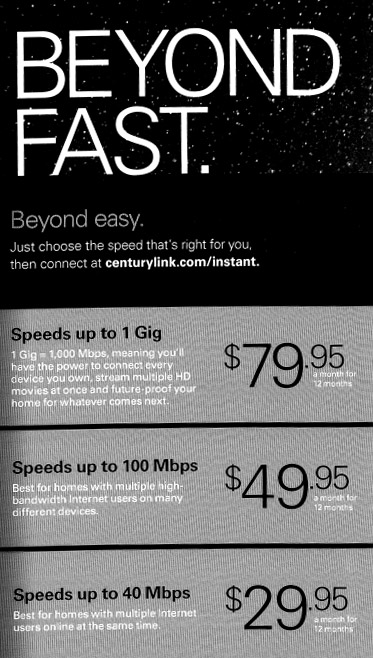
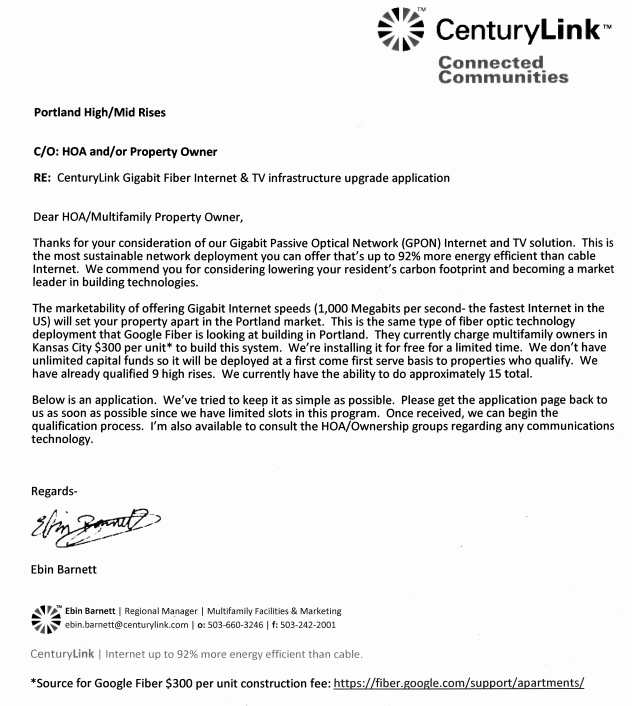
In the wake of Google's announcement that Portland could be one of the next communities for the Google Fiber network, CenturyLink is circulating an offer to select apartment buildings to apply for CenturyLink fiber. This appears to be more than the standard fiber-to-the-press-release responses we often see from the big telephone companies that prefer to lobby, litigate, and lie rather than invest in next-generation networks. CenturyLink notes it has the "ability to do approximately 15 total" apartment buildings. centurylink-promo-portland-2014.jpg The promotional sheet claims CenturyLink will offer speeds "up to" 1 Gig for $79.95/month for 12 months. 100 Mbps runs $49.95 and 40 Mbps is $29.95 - each for 12 months. No mention of upload speeds but CenturyLink has demonstrated a real aversion to symmetry so users can expect far slower upstream than what modern municipal networks and Google fiber deliver. The standard operating procedure in apartment buildings will be for CenturyLink to try to lock up the internal wiring to buildings and deny it to competitors. FCC rules make exclusive agreements with landlords unenforceable, but there are a host of tricks that incumbents use to prevent any competition and landlords getting a kickback often have little reason to encourage competition. The CenturyLink copy notes that its fiber optic GPON option is "up to" more than 92 percent energy efficient than cable modem Internet access. I have to wonder how it compares to DSL energy efficiency and whether that number holds up better than the "up to" 12 Mbps claims they make on DSL circuits that seldom peak at 5 Mbps. At any rate, it is more than we can expect in the many communities CenturyLink is serving where there the local government have done nothing to spur competition by investing in publicly owned assets that could form a municipal network or be used to entice independent service providers to enter the market. In particular, I would be curious where else CenturyLink is rolling out fiber to buildings without any upfront charges. centurylink-portland-mdu-letter2014.png
Video Explains the Public's Rights-of-Way

The publicly owned rights-of-way (ROW or PROW), are a misunderstood resource in many communities. Local governments manage them on behalf of the public, but are under pressure as very large, very profitable cable and telephone companies seek to prevent local governments from charging rent to those using the PROW.

This video from Oregon quickly explains some of the key issues around the PROW .

Smart Conduit Policy in Sandy, Mount Vernon Reduces Network Cost

More communities now embrace "dig once" policies to facilitate installation of future and current networks. The idea is to be mindful of trenching for transportation and utility projects and encourage collaboration between agencies. However, this is implemented in a variety of ways, some more effectively than others. By establishing requirements for conduit installation in development codes, communities can save big dollars if they build or expand a network in the future.

Communities such as Sandy, Oregon, and Mount Vernon, Washington, have instituted such policies. Both communities require private developers to install conduit when disturbing existing roads or building roads for new subdivision construction. Conduit itself is inexpensive and the digging is already done, so the added burden is light.

Both of these communities have plans, including maps, that allow them to be strategic in where they require conduit to be placed. They are not simply adding conduit blindly, though that policy may be better than doing nothing at all (experts are divided on the matter).

In Sandy, the code change (see Sec. 17.84.60) was a simple expansion of existing policy. The city added "broadband (fiber)" to the list of public facilities, such as public water, sanitary sewer, and storm drainage. Underground communication lines join a list of other required improvements that are to be installed in new developments at no expense to the city. Other items on that list include drainage facilities, mailbox delivery units, street lights and a underground power lines. (see Sec. 17.100.310).

Anticipated connectivity raises the value of new homes and makes them more attractive to today's buyers. Scott Lazenby, City Manager in Sandy, spoke to us for a recent podcast and told us how a developer in the area is excited about the potential. SandyNet plans to offer 100 Mbps Gbps residential service via the new conduit at an incredibly low $40 per month; the developer sees that as a major selling point.

Exploring Conduit Policies - Community Broadband Bits Episode #48

At any conference dealing with building broadband networks, one hears talk of open trench policies or "dig once" approaches. For today's episode of Community Broadband Bits, City Manager Scott Lazenby of Sandy, Oregon, joins us to talk about how Sandy has proactively placed conduit underground for fiber use. We discuss the instances where it is practical and where it is not to place conduit when other utility work has open streets. Sandy has an ordinance requiring new developments to have conduit placed with other utilities at no cost to the city. We previously spoke with Sandy's IT Director in Episode 17 of Community Broadband Bits and have written about Sandy numerous times. Read the transcript from this episode here. We want your feedback and suggestions for the show - please e-mail us or leave a comment below. Also, feel free to suggest other guests, topics, or questions you want us to address. This show is 17 minutes long and can be played below on this page or subscribe via iTunes or via the tool of your choice using this feed. Search for us in iTunes and leave a positive comment! Listen to previous episodes here. You can can download this Mp3 file directly from here. Find more episodes in our podcast index. Thanks to Eat at Joe's for the music, licensed using Creative Commons.

Ashland, Oregon, Wants To Increase Local Internet Commerce

Ashland, Oregon, home to Ashland Fiber Net (AFN), may soon be taking aggressive steps to bring more online business to the community. According to an Ashland Daily Tidings article, the City Council is seeking public input into proposed goals for the community. A targeted effort to bring more Internet-based businesses to town is one of the draft goals. The goal seems logical for a community with a network already in place.

AFN serves about 6,000 business and residential customers in this community of 20,000 people. In addition to AFN's retail services, four other local ISPs operate on the infrastructure.

The network is HFC, a cable network, but with far fewer homes on each local loop than the big cable companies typically have. This means that subscribers are far more likely to consistently achieve advertised speeds. Residential services range from $35 per month for 6 Mbps / 1 Mbps service to $75 monthly for 20 Mbps / 5 Mbps. AFN is one of the rare community-owned networks to enforce monthly data caps.

Fiber to the business is an option, but popular business packages are $65 per month for 15 Mbps / 4 Mbps and $85 per month for 25 Mbps / 5 Mbps. AFN also offers rural wireless service to a limited area. 

Ashland also sees some common sense advantages to increasing the number of small home based businesses that use its fiber resource. To that end, AFN provides a "Home Office" business Internet package. From the article:

Councilor Greg Lemhouse has championed the goal to increase the number of Internet-based businesses.

"It's an aggressive goal that says the city is committed to growing this industry," he said.

Lemhouse said many such businesses can be operated out of people's homes.

People who want to run Internet-based businesses often are well educated and are committed to their communities, he said.

Home Internet businesses can also be family-friendly, allowing parents to work from home and stay connected to their children, Lemhouse said.

With the discussion also comes some analysis of what sort of Internet businesses are already keeping shop in town. Also from the article: