
oregon

Content tagged with "oregon"

Displaying 61 - 68 of 68

How a Muni Network in The Dalles Led to a $600 million Data Center

As I recently mentioned in my endorsement of Tubes by Andrew Blum, the book explains how a municipal fiber network helped to attract Google to town. Google sited its first "built-from-scratch data center" there, a $600 million investment according to Stephen Levy. According to Blum, it all started back in 2000 when the community got fed up with incumbent telephone company Sprint.

The Dalles was without high-speed access for businesses and homes, despite the big nationwide backbones that tore right through along the railroad tracks, and the BPA's big network. Worse, Sprint, the local carrier, said the city wouldn't get access for another five to ten years. "It was like being a town that sits next to the freeway but has no off-ramp," was how Nolan Young, the city manager, explained it to me in his worn office...

The Dalles was suffering economically due to its reliance on industrial jobs that were slowly disappearing.

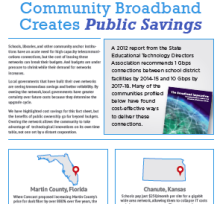
New Fact Sheet: Community Broadband and Public Savings

We have already published a fact sheet on the critical role community broadband plays in job development. Now, ILSR presents a collection of how community owned broadband networks save money for local government, schools, and libraries while providing cutting edge services. The Public Savings Fact Sheet is now available.

Though schools, libraries, and other community anchors need access to faster, more reliable networks, the big cable and telephone companies have priced those services so high that they are breaking the budget. But when communities create their own connections, affordable high capacity connections are only one of the benefits. A community owned network offers the promise of self-determination -- of upgrades on the community's time table and increased reliability for emergency responders.

The Public Savings Fact Sheet is a great piece to share to mobilize other members of your community. Share it with decision makers and use it to start meaningful conversations. Distribute it widely and often.

We are always developing new resources. If you have an idea for a new fact sheet, we want to hear it.

Community Broadband Bits 17 - Joe Knapp of Sandy, Oregon

Sandy has run a wireless network for over eight years and has just announced a partnership with i3 to bring FTTH to everyone using i3's technology to run trunk fiber lines through existing waste water and storm water pipes. We previously wrote about Sandy here. Joe Knapp, the IT Director for the city of Sandy and the General Manager of SandyNet, is our guest on this week's Community Broadband Bits podcast - episode 17. He discusses how Sandy began offering broadband access to itself, residents, and businesses and how they expanded to fiber originally. And toward the end, he gives us the low-down on how the partnership with i3 is structured. We want your feedback and suggestions for the show - please e-mail us or leave a comment below. Also, feel free to suggest other guests, topics, or questions you want us to address. This show is 30 minutes long and can be played below on this page or subscribe via iTunes or via the tool of your choice using this feed. Search for us in iTunes and leave a positive comment! Listen to previous episodes here. You can download the Mp3 file directly from here. Read the transcript of this episode here. Find more episodes in our podcast index. Thanks to Fit and the Conniptions for the music, licensed using Creative Commons.

Oregon's SandyNet to Use Sewers for Fiber Deployment

SandyNet, of Sandy, Oregon, recently announced that it plans to expand Internet service with fiber to every home and business in the city. The network, which has serviced the community for ten years, currently offers fiber to businesses along the Highway 26 corridor. Wireless service is available throughout town and in some rural areas around the City.

SandyNet plans to provide a range of tiers for fiber connectivity. Preliminary rates include residential fiber service of 100 Mbps for $39.95. Business service will vary from $69.95 per month to $499.95 per month for 1 Gbps. Construction is scheduled to begin spring of 2013 and the utility estimates service to be available by the end of the year in most neighborhoods.

The City will be working with i3 America, which uses city sanitary and sewer storm pipes as a makeshift conduit for fiber optic cable. i3's "FOCUS" system uses special armorerd cable designed to withstand a harsh environment and does not affect operation of clean or wastewater systems. Because this method uses existing pipes, construction costs can be up to 70% lower than traditional burying of conduit and fiber. The location of cable is much deeper in the wastewater pipes, so there will be less chances of damage due to construction or the elements.

From the press release:

The City of Sandy last year sponsored a "Why Wait for Google?" contest to gauge interest in fiber Internet service, and to select a neighborhood for a pilot program. Resients in every neighborhood expressed interest in the service , and i3 approached the city with a proposal to extend fiber to every building in the town.

Similar to the Google Fiber deployment in Kansas City, neighborhoods that show the most interest will be hooked up first. Residents and businesses are encouraged to sign up now.

Joe Knapp, IT Director and General Manager of SandyNet offered some details via email:

Community Broadband Bits 7 - Mary Beth Henry of Portland, Oregon

For the 7th Community Broadband Bits podcast, we talk with Mary Beth Henry from Portland, Oregon. Mary Beth is the Director of the Portland Office for Community Technology and Mt Hood Cable Regulatory Commission, as well as a past president of NATOA. Our discussion covers the long struggle to ensure local businesses and residents had a real choice in broadband providers in Portland. We start with how the famous "Brand X" Supreme Court decision came into being. But after Portland lost that case (indeed, after all of America lost due to that decision) it continued to push for smart telecommunications policies to benefit the community. Now Portland has its own network serving public entities (IRNE - the Integrated Regional Network Enterprise) and the public is discussing what it can do to get beyond the CenturyLink and Comcast duopoly. Below, we have embedded videos that Portland produced as part or Portland's Broadband Strategic Plan. You can find more documents and information about Portland's approach here. We want your feedback and suggestions for the show - please e-mail us or leave a comment below. Also, feel free to suggest other guests, topics, or questions you want us to address. This show is 18 minutes long and can be played below on this page or subscribe via iTunes or via the tool of your choice using this feed. Search for us in iTunes and leave a positive comment! Listen to previous episodes here. You can download the Mp3 directly from here. Read the transcript of this episode here. Find more episodes in our podcast index. Thanks to Fit and the Conniptions for the music, licensed using Creative Commons.

Personal Telco Project Video in Portland

A few years ago, I had the opportunity to meet some of the folks from the Personal Telco Project in Portland, Oregon. They have been around for a long time and do excellent work. This is how they describe themselves:
The Personal Telco Project is a 501(c)(3) non-profit organization located in Portland, Oregon dedicated to the idea that people have a central role in how their networks are operated. We do that by building our own networks that we share with our communities, and by helping to educate others in how they can too. To date, we have done this using Wi-Fi technology. We began in 2000 by turning our own houses and apartments into wireless hotspots (or "nodes"), and then set about building networks in public locations such as parks and coffee shops. There are currently about 100 active nodes participating in our project. We would like to see people and businesses in every corner and on every block of the city participating.
They have been involved in the discussion in Portland over how the City can ensure all residents and businesses have access to affordable, reliable, and fast connections to the Internet. I was just reminded of them by a video that discusses their work and some of the reasons communities need to build their own networks (below). They also have a YouTube channel with more videos about community broadband.

Oregon Town To Build Open Access Fiber Network Complement to Wireless Network

Sandy, a growing community of about 10,000 outside Portland in Oregon, is now building a FTTH network to expand on their successes offering city-run wireless broadband in 2003. They've done the whole wireless thing for 8 years but understand the future is high capacity, high reliability connections. They are starting with a pilot program that seized on energy created by Google's gigabit initiative -- they held a "Why Wait for Google?" contest that asked neighborhoods to show their potential interest in a fiber-optic network. When the Cascadia Village and Bornstedt Village won the contest, they were asked how they wanted to be involved:
What happens now? This is a pilot program, so we’re taking it step-by-step. We want the residents and property owners in Cascadia/Bornstedt Villages to be partners with us in making decisions on how this service will work. And we want it to be democratic: whatever we do, it will only be with the support of the majority of the residents and property owners who get involved. The first thing we need to know is: how would you like to be involved? We have a lot of options, depending on your level of interest, and how busy your life is. On one end of the spectrum is simply asking us to keep you informed through e-mail or letters, and at the other end is your active participation (over a course of several meetings) in the detailed planning for the implementation of this pilot project.

Telco Lies and the Truth about Municipal Broadband Networks

Image

From the Executive Summary (stats from 2005): The attention of policymakers in both parties is now focused on the question of how to promote competitive broadband markets that will deliver high-speed Internet access to all Americans at affordable rates. It is a difficult problem. Present estimates are that around 30% of US households subscribe to DSL or cable modem service. This compares to over 70% in countries like South Korea. Virtually every rural state remains underserved and uncompetitive. In urban areas, many families are priced out of the market. The telecom and cable kings of the broadband industry have failed to bridge the digital divide and opted to serve the most lucrative markets at the expense of universal, affordable access. As a result, local governments and community groups across the country have started building their own broadband networks, sometimes in a purely public service and more often through public-private partnerships. The incumbents have responded with an aggressive lobbying and misinformation campaign. Advocates of cable and DSL providers have been activated in several state capitols to push new laws prohibiting or severely restricting municipalities from serving their communities. Earlier this year, Verizon circulated a “fact sheet” to lawmakers, journalists and opinion leaders proclaiming the so-called “failures” of public broadband. Many of the statistics come from a widely discredited study of municipal cable TV networks published in 1998. This paper debunks these lies case by case, juxtaposing information direct from the city networks with quotations from the telco propaganda. The results are unequivocal and damning.