
oregon

Content tagged with "oregon"

Displaying 1 - 10 of 70

Coos-Curry Electric Co-op Completes Biggest Fiber Expansion In Co-op History
Oregon’s Coos-Curry Electric Cooperative (CCEC) and its subsidiary Beacon Broadband (BBI) say they have completed the biggest fiber expansion project in the cooperative’s history, dramatically expanding affordable Internet access to thousands of previously unserved rural households in the Southern part of The Beaver State.

Cooperative officials say the six-year, $60 million project was the largest infrastructure investment in the cooperative's 88-year history. 7,000 of the co-op’s 14,000 electrical customers are now subscribed to broadband service after the deployment of 14,000 miles of fiber optic lines that have also streamlined maintenance and monitoring of the electrical grid.

Originally, a CCEC engineering feasibility study estimated the build would cost $45 million, though CCEC’s board later revised the capital budget to $60 million to reflect steeper construction costs due to the rugged, rural coastal terrain.
Image
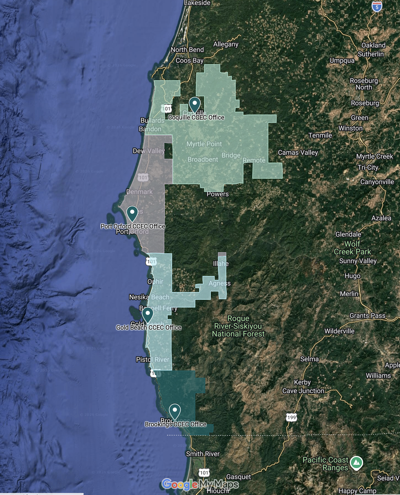
Coos-Curry Electric Coop service area map

To fund the project, the CCEC Board authorized BBI to secure up to $60 million in private borrowing through CoBank.

It was supplemented by several state and federal grants, including a 2020 $14.1 million Rural Digital Opportunity Fund (RDOF) grant, a $19 million grant from the Oregon Broadband Deployment Program (BDP) to expand high-speed Internet access to over 1,200 addresses in rural Curry and Coos counties, and a $7 million USDA Rural Development grant.
Oregon Picks New BEAD Winners After Four Bidders Retreat

The Oregon Broadband Office (OBO) has announced the preliminary awardees selected to assume Broadband Equity, Access and Deployment (BEAD) projects that were voluntarily declined by their original awardees.  

As ILSR has explored, the unpopular changes and massive delays introduced by the Trump administration to the BEAD program have resulted in not only a large number of states having to retool their plans, but many original project bidders retreating from their original proposals.

In some cases, soaring U.S. costs have resulted in ISPs reconsidering their commitment to original broadband expansion plans. 

In other instances, providers have grown frustrated with additional bureaucratic hurdles affixed to BEAD deployments by the NTIA.

Image
Oregon Broadband Office strategic plan cover sheet

According to an OBO announcement, four of the state’s original BEAD awardees declined a total of 15 projects prior to the state’s June 10 Notice of Intent to Award acceptance deadline. The projects represented 13,381 broadband serviceable locations (BSLs), approximately $122.9 million in requested grant funding, and more than $39.1 million in matching contributions.

Oregon is slated to receive $689 million in total BEAD funding to shore up Internet access to communities trapped on the wrong side of the digital divide.

Oregon’s Coos-Curry Cooperative Passes 5000th Fiber Customer Milestone

Oregon’s Coos-Curry Electric Cooperative just connected its 5,000th customer, marking a major milestone in the Oregon cooperative’s five-year-effort to bring affordable fiber access to rural state residents long stuck on the wrong side of the digital divide.

The recent celebration of the milestone, documented by the Curry Coastal Pilot, featured a homeowner whose recent fiber connection came 80 years after the same cooperative first connected the home for electrical service.

First created in 1939, the Coos-Curry Cooperative is one of over 200 U.S. electrical cooperatives leveraging their century-old experience in rural electrification to bring affordable fiber access to long-neglected parts of the country – markets that in most cases were left behind by regional telecom monopolies disinterested in improving affordable access.

The cooperative’s fiber wing, dubbed Beacon Broadband, was first launched back in 2021, and offers locals fiber optic broadband at three tiers of service: a symmetrical 500 megabit per second (Mbps) tier for $50 a month; a symmetrical 1 gigabit per second (Gbps) tier for $85 a month; and symmetrical 2 Gbps tier for $120 a month.

Unlike many regional Oregon private telecom monopolies, Coos-Curry Electric Cooperative’s fiber tiers don’t feature usage caps, long-term contracts, or hidden fees.

No Shareholders, Just Service: Sherwood, Oregon’s Community Broadband Success - Episode 634 of the Community Broadband Bits Podcast

In this episode of the podcast, Chris speaks with Mayor Tim Rosener and IT Director Brad Crawford of Sherwood, Oregon, about the city’s journey in building a community-owned broadband network. 

They discuss Sherwood's unique approach to expanding fiber access, how they’ve leveraged Urban Renewal funding to support the network’s growth, and their commitment to keeping service affordable for residents. 

The conversation highlights the importance of local control, the economic benefits of broadband investment, and Sherwood’s expansion into surrounding rural areas. 

Tune in to hear how Sherwood is proving that community broadband can be both cost-effective and high quality, all while prioritizing local service and support.

This show is 22 minutes long and can be played on this page or via Apple Podcasts or the tool of your choice using this feed.

Transcript below.

We want your feedback and suggestions for the show-please e-mail us or leave a comment below.

Listen to other episodes or view all episodes in our index. See other podcasts from the Institute for Local Self-Reliance.

Thanks to Arne Huseby for the music. The song is Warm Duck Shuffle and is licensed under a Creative Commons Attribution (3.0) license

Sherwood, Oregon Ferments ‘Future-Proof’ Fiber To Preserve and Expand Municipal Network

In the City of Sherwood, a mostly residential bedroom community 16 miles south of Portland, officials have been quietly cultivating a digital vineyard across Oregon’s “Gateway to Wine Country.”

As part of its on-going work to build out a citywide fiber network, Sherwood Broadband recently secured a $9 million grant from the Oregon Broadband Office Broadband Deployment Program (BDP) to continue expanding Sherwood’s municipally-owned network into neighboring rural communities just outside city limits.

The grant award is part of $132 million in federal Rescue Plan funds the state is doling out to an array of community-owned broadband initiatives for 16 projects across 17 counties.

Award winners include Beacon Broadband, a subsidiary of the Coos-Curry Electric Cooperative ($19.4 million); Jefferson County ($19.2 million); Douglas Fast Net, a wholly-owned subsidiary of the Douglas Electric Cooperative ($8.5 million); the Idaho-based member-owned cooperative Farmers Mutual Telephone Company, which offers broadband service in Malheur County, OR ($18.9 million); and a handful of independent providers like Blue Mountain Networks ($6.5 million) and Ziply Fiber ($10.2 million), recently acquired by Bell Canada.

How MINET is Expanding Broadband in Oregon - Episode 630 of the Community Broadband Bits Podcast

In this episode of the podcast, Chris speaks with PJ Armstrong, General Manager of MINET, about the innovative ways this municipal network is expanding connectivity in Monmouth, Independence, and Dallas, Oregon. 

They discuss MINET’s remarkable 75% market penetration, their unique partnership with investors for rural expansion, and their efforts to provide free Wi-Fi in local parks and public trolleys. Learn how MINET’s in-house team is taking on new challenges, such as underground infrastructure work, and how they’re navigating opportunities with federal programs like ARPA and BEAD.

Armstrong also shares insights into the community’s appreciation for reliable, locally operated Internet service and the complexities of extending broadband to unserved and underserved areas.

This show is 22 minutes long and can be played on this page or via Apple Podcasts or the tool of your choice using this feed.

Transcript below.

We want your feedback and suggestions for the show-please e-mail us or leave a comment below.

Listen to other episodes or view all episodes in our index. See other podcasts from the Institute for Local Self-Reliance.

Thanks to Arne Huseby for the music. The song is Warm Duck Shuffle and is licensed under a Creative Commons Attribution (3.0) license

Municipal Broadband Networks Deliver On Affordability Before And After ACP

In a recently published piece in The American Prospect, Sean Gonsalves, ILSR's Community Broadband Networks Initiative Associate Director for Communications, reports on four cities across the U.S. that are well prepared to deal with the demise of the Affordable Connectivity Program (ACP).  

The article – titled "The Municipal Broadband Solution" – begins by laying out why Congress created the popular program and how letting the ACP go bankrupt undermines the national "Internet For All" Initiative now underway. However, while digital equity advocates across the nation rightly lament the demise of the program, the focus of the article is on cities that have figured out how to deliver afforable high-quality Internet access even without the ACP.   

Here's a few excerpts:

Congress created the ACP to soften a harsh reality: Americans pay among the highest prices for broadband of any developed nation in the world, leaving tens of millions unable to afford internet service—something experts have long noted is a telltale sign of a broken market dominated by monopoly providers, and is at the very heart of why the U.S. digital divide is as massive as it is.

However, although federal lawmakers have known for over a year that the fund would be bankrupt by this spring, GOP congressional leaders have not budged on even bipartisan attempts to save the ACP, prompting the Federal Communications Commission (FCC) to announce in January that the agency was being forced to wind down the popular program.

It’s a major setback for the “Internet for All” effort, especially in light of a recent FCC survey that found 29 percent of ACP beneficiaries would be left without any home internet service whatsoever without the benefit, in an age when internet connectivity is a necessity for meaningful participation in 21st-century society.

Activists Say Time Is Right To Renew Fight For Community Broadband In Portland

Portland activists are renewing their calls to prioritize the construction of a municipally owned broadband network in the Oregon city of 635,000. With an historic infusion of federal subsidies and a looming shakeup of city politics, advocates for community-owned broadband say the time is right to finally revolutionize city telecom infrastructure with an eye on affordability.

“Ten years ago was a perfect time to embrace community broadband and nothing has changed,” Russell Senior, President of Personal Telco, a nonprofit wireless network, and Municipal Broadband PDX, a nonprofit advocating for publicly-owned fiber networks in Multnomah County, Oregon told ILSR.

“ISPs continue to exercise monopoly power and have their boot on the neck of subscribers,” he said. “The most practical and effective way to get out from under that boot, in light of persistent federal complicity, is local public ownership of the infrastructure that gives them that power.”

Image
Municipal Broadband PDX logo

Portland has historically been at the very center of the debate over monopoly power and competitive broadband access, and city officials have been contemplating a publicly-owned broadband network for more than 20 years. It’s a concept other Oregon cities, like nearby Hillsboro, adopted years earlier.  

HiLighting Hillsboro, Oregon - Episode 538 of the Community Broadband Bits Podcast

This week on the podcast, Christopher is joined by General Manager Brad Nosler and Senior Customer Support specialist Elizabeth Pereira, both from the city of Hillsboro, Oregon. The city's municipal broadband network, HiLight, is new, having begun signing up subscribers in the spring of 2021.

Notably, HiLight began building in the areas highest-need neighborhoods, where connectivity rates were disproportionately low. Equally importantly, HiLight has among the best income-qualified subscription tiers for families struggle to pay for access of any network in the nation, offering symmetrical gigabit service for just $10/month. Brad and Elizabeth talk with Christopher abou

This show is 33 minutes long and can be played on this page or via Apple Podcasts or the tool of your choice using this feed

Transcript below. 

We want your feedback and suggestions for the show-please e-mail us or leave a comment below.

Listen to other episodes here or view all episodes in our index. See other podcasts from the Institute for Local Self-Reliance here.

Thanks to Arne Huseby for the music. The song is Warm Duck Shuffle and is licensed under a Creative Commons Attribution (3.0) license.

The Straight Talk About Rural Fiber Deployments - Episode 517 of the Community Broadband Bits Podcast

This week on the podcast, Christopher is joined by Joseph Franell, President of Blue Mountain Networks (which serves more than 30 rural communities west of Portland) in Oregon. Joe joined the team at Ashland Fiber Network (AFN) before moving on to do work in rural parts of the state. During the conversation, Christopher and Joe talk about building fiber in some of the least-dense parts of the state. They discuss the importance of creativity and a willingness to pursue a variety of partnership models, the critical role that local broadband champions play in convincing Internet Service Providers (ISPs) to come to rural areas, and how dramatically different a provider looks when it's driven by principles and a commitment to the community that goes beyond a lightning-fast return-on-investment.

They dive into the specter of private equity, which has shown increasing interest in broadband infrastructure and the grassroots work done by broadband action teams over the last couple of years.

This show is 45 minutes long and can be played on this page or via Apple Podcasts or the tool of your choice using this feed

Transcript below. 

We want your feedback and suggestions for the show-please e-mail us or leave a comment below.

Listen to other episodes here or view all episodes in our index. See other podcasts from the Institute for Local Self-Reliance here.

Thanks to Arne Huseby for the music. The song is Warm Duck Shuffle and is licensed under a Creative Commons Attribution (3.0) license.