Just south of Mount San Jacinto in southern California, several small communities hope for better Internet access. The local cooperative has submitted a plan to build a next generation network fiber network further into Riverside County.
Currently, Anza Electric is drumming up funding for the proposed project. The co-op already has about $1.5 million to put toward the venture and is now requesting a $2.2 million grant from the state.
This network, called Connect Anza, will bring high-speed Internet service to several small, rural communities in Riverside County: Pinyon Pines, Garner Valley, and Mountain Center. High-speed Internet service of 50 Megabits per second (Mbps) will be $49 per month; service is symmetrical so upload and download speeds are the same. Residents will also be able to get phone service from the co-op for another $20 per month. Local fire stations and the Ronald McDonald camp for children with cancer will receive free Internet access through this project.
Image
Anza Electric Built a Network
The deployment continues Anza Electric’s previous project to connect more than 3,000 underserved households around Anza, California. The previous project was pushed forward by the overwhelming support of the electric cooperative’s member-owners, residents who receive electric service from the co-op.
Cooperatives around the country have built on their long legacy of delivering essential infrastructure by starting to deliver next-generation Internet services. Here, we cover the basics of cooperatives in rural areas and then discuss the details of electric and telephone cooperatives that have already branched out into Internet service. Finally, we highlight the first fiber optic cooperative provider, and discuss how other communities have better Internet service through building their own networks.
Cooperatives are part of the fabric of rural America. The member owners control the cooperative: each person receiving service is a member of the cooperative and can directly vote in elections for the Board of Directors or even become a member of the Board.
Starting in the 1930s, the U.S. Department of Agriculture supported communities as they created more than 900 electric cooperatives across the country. In the 1950s, the federal government again supported communities building telephone networks, crisscrossing the country with telephone cooperatives to connect rural communities.
Each technology brought new markets, revitalized economies, and revolutionized industries. Cooperatives have a long history of building and maintaining essential infrastructure and providing excellent service in rural communities. Now they have the chance to do that again by building next-generation networks for Internet service.
Rural Public Policies
Rural areas face a number of challenges that urban and suburban communities do not. Low population density coupled with rough terrain can make building infrastructure challenging. Added to these factors, rural communities may not have access to the same financial resources as larger towns and cities do.
Image
Cooperatives, however, have made infrastructure projects work in rural communities for nearly a century. They have access to funding from their membership base, local banks, and often the federal government. Some state governments have expanded their broadband grant and loan programs to include electric cooperatives. Other states have clarified laws and policies to recognize that electric cooperatives can build fiber networks for Internet service using their current infrastructure. A few states have even removed legislative hurdles that stymied investments by electric cooperatives. Technically, the 1996 Telecommunications Act, Section 253, prohibits states from stopping any co-op from offering Internet service, but co-ops in many states are loathe to challenge state law in court.
North Carolina
In 2019, the state removed restrictions that prevented electric cooperatives from using USDA funding for non-electrical purposes, such as broadband networks. Our 2016 report, North Carolina Connectivity: the Good, the Bad, and the Ugly, highlighted how this roadblock kept the state’s electric co-ops from providing service to many rural communities.
Tennessee
During the 2017 legislative session, this state has clarified the language in its laws to allow electric cooperatives to build networks for Internet service.
Indiana
Cooperatives already have access to utility poles, easements, and Rights-of-Way in the communities that they serve. Indiana, however, needed to clarify that electric co-ops can use this access to provide Internet service, so it passed the FIBRE Act. Other states, including Georgia, Maryland, and Texas, have since followed suit.
Minnesota & Colorado
Minnesota and Colorado have made funding easier to access for cooperatives interested in providing Internet service. Both states have designed grant programs that promote local solutions to connectivity problems. In Minnesota, cooperatives provide most of the Fiber-to-the-Home Internet service thanks in no small part to that grant program.
Overbuild Or Underbuild?
In Community Broadband Bits Podcast Episode 91, Christopher Mitchell and Lisa Gonzalez discusses strategies for building Internet infrastructure in rural are. What do communities need to thrive?
More than 900 rural electric cooperatives provide electricity to about 12 percent of the U.S. population. Their service area, however, covers more than half of the total land, nearly 2 million square miles. About 90 rural electric co-ops have embarked on fiber optic projects to increase Internet access for their members.
Several of these electric cooperatives started by building fiber optic lines to substations and large demand centers to increase the reliability of the electric system through better monitoring. This could then form the backbone of a network for Internet service to businesses and residents.
Articles and Interviews
We have written many articles and collected several reports detailing how electric cooperatives have tried to increase Internet access in their communities. These stories show the many different ways electric cooperatives have structured partnerships and programs for their members.
Image
Several electric cooperatives provide Internet service themselves. Some started pilot projects, while others built out to their entire service area. The Fiber-to-the-Home project by Valley Electric Association boosted the local economy in Pahrump, Nevada. The co-op has already added 31 new jobs because of the fiber service.
Others partner with an existing telephone cooperative or telephone company. Ouachita Electric in Arkansas is one of the many cooperatives to have done this. By combining their resources and expertise, this partnership is able to extend electric and Internet service throughout much of southern Arkansas.
Many electric cooperatives work together, such as Sho-Me Power in Missouri and LS Networks in Oregon. These cooperatives have provided connectivity for local ISPs and businesses, and now are looking to connect residents.
In episode 229 of the Community Broadband Bits podcast, Jon Chambers, the former head of the FCC Office of Strategic Planning and Policy Analysis, describes how electric cooperatives have the potential to bring Internet access to unserved rural America.
Mel Coleman, president of NRECA and CEO of North Arkansas Electric Cooperative, joined the podcast in episode 243 to discuss how the electric co-op had improved Internet access for its members and what other cooperatives are doing.
This is a list of the rural electric cooperatives that have programs and projects to increase connectivity in their service areas. They do not all provide Fiber-to-the-Home. Some only offer fiber connections to businesses or provide wireless last mile connections while others focus on dark fiber and fiber transport services for other Internet Service Providers. (Total: 109) (Last updated: 12/2019)
Electric Cooperative
State
Project
Central Alabama Electric Cooperative
Alabama
FTTH (announced)
Joe Wheeler Electric Membership Corporation
Alabama
FTTH (announced)
North Alabama Electric Cooperative
Alabama
FTTH
Tombigbee Electric Cooperative (freedom FIBER)
Alabama
FTTH
Wiregrass Electric Cooperative
Alabama
Fiber backbone (under construction) — collaboration with cable company to connect members
Arkansas Valley Electric Cooperative (WAVE Rural Connect)
Arkansas
FTTH
Craighead Electric Cooperative Corporation (Empower)
Arkansas
FTTH
North Arkansas Electric Cooperative (NEXT)
Arkansas
FTTH
Ouachita Electric Cooperative (ARIS)
Arkansas
FTTH — collaboration with telephone company
Ozarks Electric Cooperative (OzarksGo)
Arkansas
FTTH
South Central Arkansas Electric Cooperative (South Central Connect)
Arkansas
FTTH
Anza Electric Cooperative (ConnectAnza)
California
FTTH
Plumas-Sierra Rural Electric Cooperative (Plumas-Sierra Telecommunications)
California
FTTH & wireless with fiber backbone
San Luis Valley Rural Electric Cooperative (Ciello)
Colorado
FTTH
Delta-Montrose Electric Association (Elevate Fiber)
Colorado
FTTH
Southeast Colorado Power Association (SECOM)
Colorado
FTTH
Yampa Valley Electric Association (Luminate Broadband)
Colorado
FTTH
Blue Ridge Mountain EMC
Georgia & North Carolina
FTTH
Habersham Electric Membership Corporation (Trailwave; North Georgia Network Cooperative)
Georgia
FTTH; FTTB and Schools
Jefferson Energy Cooperative
Georgia
FTTB — collaboration with Pineland Telephone Cooperative
Illinois Electric Cooperative
Illinois
FTTH
Jo-Carrol Energy (Sand Prairie)
Illinois
FTTH & wireless with fiber backbone
Jackson County Rural Electric Membership Corporation (Jackson Connect)
Indiana
FTTH
Johnson County Rural Electric Membership Corporation
Indiana
FTTH — collaboration with NineStar Connect
NineStar Connect (merger between Central Indiana Power and Hancock Telecom)
Indiana
FTTH
Orange County Rural Electric Membership Corporation
Indiana
FTTH
South Central Indiana Rural Electric Membership Corporation
Indiana
FTTH
Tipmont Rural Electric Membership Corporation (Wintek)
Indiana
FTTH
Allamakee-Clayton Electric Cooperative (AC Skyways)
Iowa
Wireless with fiber backbone
Maquoketa Valley Rural Electric Cooperative (MVLink)
Iowa
FTTH
Bulter Electric Cooperative (Velocity)
Kansas
FTTH
Warren Rural Electric Cooperative Corporation
Kentucky
FTTH pilot projects (announced) — collaborations with North Central Telephone Company and Franklin Electric Power Board
Great Lakes Energy (Truestream)
Michigan
FTTH
Midwest Energy Cooperative (Midwest Energy and Communications)
Michigan
FTTH
Tri-County Electric Cooperative (HomeWorks Connect)
Michigan
FTTH
Arrowhead Electric Cooperative (True North Broadband)
Minnesota
FTTH
Meeker Cooperative Light and Power Association (Vibrant Broadband)
Minnesota
Wireless with fiber backbone — collaboration with Mabel Cooperative Telephone Company and Spring Grove Communications
MiEnergy Electric Cooperative
Minnesota
FTTH & wireless with fiber backbone
Mille Lacs Energy Cooperative (XStream Internet)
Minnesota
FTTH — collaboration with telephone cooperative CTC
Roseau Electric Cooperative
Minnesota
FTTH (announced) — collaboration with local telephone company
Alcorn County Electric Power Association (ACE Fiber)
Mississippi
FTTH (announced)
Coast Electric Power Association (CoastConnect)
Mississippi
FTTH (announced)
Delta Electric Power Association
Mississippi
FTTH
Monroe County Electric Power Association (M-Pulse Fiber)
Mississippi
FTTH (announced)
Natchez Trace Electric Power Association (NT Spark)
Mississippi
FTTH
Northcentral Mississippi Electric Power Association (Northcentral Connect)
Mississippi
FTTH
Northeast Mississippi Electric Power Association (North East Fiber, LLC/NE SPARC)
Mississippi
FTTH
Pearl River Valley Electric Power Association (PearlComm Fiber)
Mississippi
FTTH (Announced)
Prentiss County Electric Power Association
Mississippi
FTTH (announced)
Singing River Electric Power Association (Singing River Connect)
Mississippi
FTTH (pilot)
Southern Pine Electric Power Association
Mississippi
FTTH
Tallahatchie Valley Electric Power Association (TVI-Fiber)
Mississippi
FTTH (announced)
Tippah Electric Power Association
Mississippi
FTTH (announced)
Tishomingo County Electric Power Association
Mississippi
FTTH
Tombigbee Electric Power Association
Mississippi
FTTH (announced)
Barry Electric Cooperative (goBEC)
Missouri
FTTH
Callaway Electric (Callabyte Technology)
Missouri
FTTH — collaboration with Kingdom Telephone Cooperative
Co-Mo Electric Cooperative (Co-Mo Connect)
Missouri
FTTH
Grundy Electric Cooperative (Mid-States Services)
Missouri
FTTH
Pemiscot Dunklin Electric Cooperative (Pemiscot Dunklin Fiber)
Missouri
FTTH
Ralls County Electric Cooperative (Ralls Technologies)
Missouri
FTTH
SEMO Electric Cooperative (GoSEMO Fiber)
Missouri
FTTH
United Electric Cooperative (United Fiber)
Missouri
FTTH
Crawford Electric Cooperative / Sho-Me Power Electric Cooperative (Sho-Me Technologies)
Missouri
FTTB & Transport Services
Gascoasage Electric Cooperative / Sho-Me Power Electric Cooperative (Sho-Me Technologies)
Missouri
FTTB & Transport Services
Howell-Oregon Electric Cooperative / Sho-Me Power Electric Cooperative (Sho-Me Technologies)
Missouri
FTTB & Transport Services
Intercounty Electric Cooperative Association / Sho-Me Power Electric Cooperative (Sho-Me Technologies)
Missouri
FTTB & Transport Services
Laclede Electric Cooperative / Sho-Me Power Electric Cooperative (Sho-Me Technologies)
Missouri
FTTB & Transport Services
Se-Ma-No Electric Cooperative / Sho-Me Power Electric Cooperative (Sho-Me Technologies)
Missouri
FTTB & Transport Services
Southwest Electric Cooperative / Sho-Me Power Electric Cooperative (Sho-Me Technologies)
Missouri
FTTB & Transport Services
Webster Electric Cooperative / Sho-Me Power Electric Cooperative (Sho-Me Technologies)
Missouri
FTTB & Transport Services
White River Valley Electric Cooperative / Sho-Me Power Electric Cooperative (Sho-Me Technologies)
Missouri
FTTB & Transport Services
Valley Electric Association (Valley Communications Association)
Nevada
FTTH
Continental Divide Electric Cooperative (Red Bolt Broadband)
New Mexico
FTTH
Kit Carson Electric Cooperative (Kit Carson Internet)
New Mexico
FTTH
Delaware County Electric Cooperative
New York
FTTH — collaboration with local telephone companies
Otsego Electric Cooperative (OEConnect)
New York
FTTH
French Broad Electric Membership Corporation
North Carolina
FTTH
Lumbee River Electric Membership Corporation (Bluewave Communications NC)
North Carolina
FTTH — collaboration with Horry Telephone Cooperative
Roanoke Electric Cooperative (Roanoke Connect)
North Carolina
FTTH
Consolidated Electric Cooperative
Ohio
FTTH
East Central Oklahoma Cooperative (ecoLINK)
Oklahoma
FTTH (under construction)
Lake Region Electric Cooperative (Lake Region Technology & Communications)
Oklahoma
FTTH
Northeast Oklahoma Electric Cooperative (Bolt Fiber Optic Services)
Oklahoma
FTTH
Oklahoma Electric Cooperative (OEC Fiber)
Oklahoma
FTTH
Consumers Power (Peak Internet)
Oregon
FTTP (open access network) — collaboration with Pioneer Consolidated and Stayton Cooperative Telephone Company
Central Electric Cooperative (LS Networks)
Oregon
FTTB, Schools, & Transport Services
Douglas Electric Cooperative (Douglas Fast Net; LS Networks)
Oregon
FTTH; FTTB, Schools, & Transport Services
Hood River Electric Cooperative (CACHE Communications; LS Networks)
Oregon
FTTH; FTTB, Schools, & Transport Services
Umatilla Electric Cooperative (LS Networks)
Oregon
FTTB, Schools, & Transport Services
West Oregon Electric Cooperative (LS Networks)
Oregon
FTTB, Schools, & Transport Services
Sullivan County Rural Electric Cooperative
Pennsylvania
FTTH (announced)
Tri-County Rural Electric Cooperative
Pennsylvania
FTTH (announced)
Mid-Carolina Electric Cooperative (Carolina Connect)
South Carolina
FTTH
Newberry Electric Cooperative (Carolina Connect)
South Carolina
FTTH — collaboration with Mid-Carolina Electric Cooperative
Appalachian Electric Cooperative
Tennessee
FTTH
Cumberland Electric Membership Cooperative (Cumberland Connect)
Tennessee
FTTH (announced)
Forked Deer Electric Cooperative (Forked Deer Connect)
Tennessee
FTTH
Gibson Electric Membership Corporation (Gibson Connect)
Tennessee
FTTH
Holston Electric Cooperative (Holston Connect)
Tennessee
FTTH
Meriwether Lewis Electric Cooperative (MLConnect)
Tennessee
FTTH
Sequachee Valley Electric Cooperative (SVEConnect)
Tennessee
FTTH
Tri-County Electric Cooperative
Tennessee
FTTH
Volunteer Electric Cooperative (Twin Lakes, powered by VEC)
Tennessee
FTTH — collaboratin with Twin Lakes Telephone Cooperative
Bandera Electric Cooperative (BEC Fiber)
Texas
FTTH
Grayson Collin Electric Cooperative (Grayson Collin Communications)
Texas
FTTH
Guadalupe Valley Electric Cooperative
Texas
FTTH
Jackson Electric Cooperative (MyJEC.net)
Texas
FTTH & wireless with fiber backbone
Taylor Electric Cooperative (Access Fiber)
Texas
FTTH
Victoria Electric Cooperative (Infinium)
Texas
FTTH & wireless with fiber backbone
BARC Electric Cooperative (BARC Connects)
Virginia
FTTH
Central Virginia Electric Cooperative (Firefly Broadband)
Virginia
FTTH
Craig-Botetourt Electric Cooperative
Virginia
FTTH (announced)
Mecklenburg Electric Cooperative (EMPOWER Broadband)
Virginia
FTTH
Prince George Electric Cooperative (Ruralband)
Virginia
FTTH
Columbia Rural Electric Association (Columbia iConnect)
Washington
FTTH Pilot Project
Orcas Power & Light Cooperative (Rock Island Communications)
Washington
FTTH
Chippewa Valley Electric Cooperative (Ntera)
Wisconsin
FTTH — collaboration with telephone cooperative Citizens Connected
Telephone Cooperatives
There are about 260 telephone cooperatives in the United States. Many provide Internet service as a natural extension of their existing infrastructure. Many started out by providing dial-up and DSL services, but only recently have begun to transition to Fiber-to-the-Home. Some have already transitioned to an all-fiber network, having upgraded everyone in their territory to fiber.
The Rural Broadband Association (NTCA) has a gigabit certification program in order to draw attention to how many small telephone companies cooperatives have built these next-generation networks.
Articles & Interviews
We have featured a number of these cooperatives on our website. Some cooperatives choose to work with local governments or electric cooperatives while others focus on providing service alone. Below is just a small selection of the many cooperatives that have built Fiber-to-the-Home networks.
Episode 188 of the Community Broadband Bits Podcast features Eric Cramer, the President and CEO of Wilkes Communications/RiverStreet Networks. He explained how the telephone cooperative has built a Fiber-to-the-Home network throughout several counties in northern North Carolina.
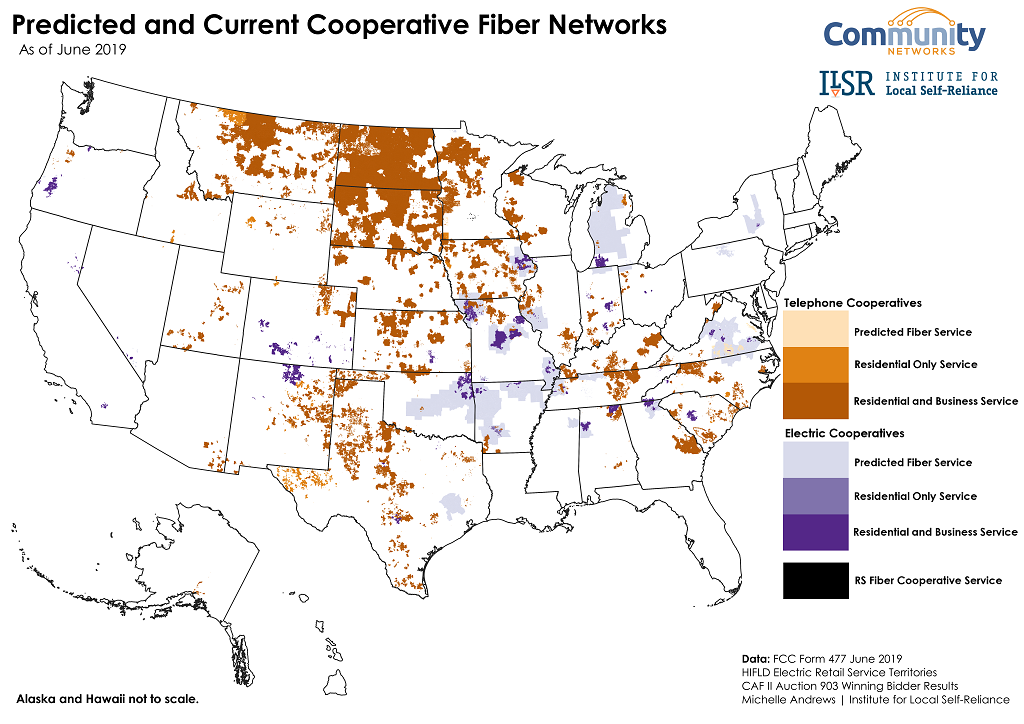
Cooperatives are not just telephone and electric. There is now a workable model for Internet cooperatives created from scratch. RS Fiber in Minnesota is the first cooperative formed for the express purpose of providing reliable, high-speed Internet service.
Yampa Valley Electric Association (Luminate Broadband)
Colorado
Electric
Yucca Telecommunications Systems
New Mexico
Telephone
Community Broadband Bits Podcast Episodes
Listen to our collection of Community Broadband Bits Podcasts to learn firsthand about how electric cooperatives have made the decision to provide Internet service.
What does it take for a telephone co-op in North Carolina to provide FTTH? President and CEO of Wilkes Communications and RiverStreet Networks explains
On the border of Tennessee and Kentucky, an electric cooperative looks to a more connected future. The Tri-County Electric Cooperative that operates across state lines is preparing to build a state-of-the-art network for high-speed Internet service throughout Trousdale County, Tennessee. This will be the first year of construction for the cooperative after several years of planning.
Tri-County Electric plans to soon begin services to Trousdale County, the smallest county in Tennessee. Many of the county's 8,000 residents' choice is limited to Comcast and AT&T, and Tri-County Electric's Vice-President and General Manager Paul Thompson noted that people in the county often only subscribe to about 6 Mbps download and 1 Mbps upload. With a steady membership base of 50,000 spread across two states and a close relationship with the county, the electric co-op is in a good position to move forward with the Fiber-to-the-Home (FTTH) project. The cooperative intends to offer an affordable base package that provides faster, more reliable connectivity than what the incumbents are willing to offer the rural communities.
Funding From The Feds
Since 2014, Tri-County Electric Cooperative has actively pursued financing for a FTTH network in the county. The co-op applied for a grant through the Rural Broadband Experiments program managed by the Federal Communications Commission. They did not receive any funding, but the process resulted in a tangible plan.
The process of applying for the grant built up community support for the project and enabled the co-op to identify key assets. As part of the grant application, they noted which census blocks they expected to connect and what community anchor institutions, such as schools, libraries, and government buildings, could be included. The Trousdale County government even passed a resolution giving explicit permission for Tri-County Electric to build and operate a FTTH network.
People in Otis, Massachusetts, are now seeing utility crews make space for fiber optic cable on poles as they prepare for the community’s publicly owned Internet network. The schedule calls for cable installation in August; the network should start serving residents and businesses this fall.
Working With A Neighbor
Like several other hill towns in western Massachusetts, Otis is working with Westfield Gas + Electric’s WhipCity Fiber, which will handle construction of the network. WhipCity will construct the network in phases, connecting premises as neighborhoods are completed. The project will connect 1,687 premises and will cost approximately $5 million.
Construction is finally able to commence because in May, the Massachusetts Broadband Institute (MBI) released funding for last mile broadband networks to several towns that advocated for their own solutions. Otis received $1.7 million. Communities like Otis that chose to invest in publicly owned infrastructure are required to contribute to the cost of their network.
MBI chose to release the funds after a drawn out situation in which unserved and underserved communities in the western part of the state first planned to unite as a broadband cooperative, WiredWest. MBI was the administrator of approximately $50 million in federal stimulus and state grant funding but withheld the funds. They felt there were problems with the WiredWest business model, but local towns and municipal network experts did not share those concerns. Instead, MBI planned to dole out the funding to large incumbent providers, which angered many of the local communities that have expressed dissatisfaction with treatment by those very companies over the years. Comcast will still obtain large amounts of the grant money to build out in several of the smaller communities. Those small towns will not be required to contribute, but 100 precent of their premises are not always served and they will not own the infrastructure.
Hey, Minnesota communities, are you looking for funding sources for your broadband project? If yes, and you plan on applying for a Minnesota Border-to-Border Development Grant Program, you should be getting your ducks in a row. The application period is fast approaching - July 3 through September 11.
For the 2017 grant period, the state legislature allocated $20 million to the program to expand broadband service in unserved or underserved areas of Minnesota. As a way to help you sort through the application process, the Minnesota Office of Broadband Development will be hosting several webinars early in the application period.
In an exciting milestone, this is podcast 100000000. Or 256 in decimal - you know, for the squares. While at the always-amazing Mountain Connect event in Colorado, I snagged an interview with Doug Seacat of Deeply Digital and Clearnetworx. They sought a grant from the Colorado Broadband Fund to deploy fiber and wireless to underserved Ridgway in western Colorado.
What happened next is shocking but hardly an anomaly. Using what is often called the "Right of First Refusal," where incumbents get to prevent competition in state broadband programs, CenturyLink not only blocked Clearnetworx from getting the grant but got itself a hefty subsidy for a very modest improvement in services.
Ridgway residents went from almost certainly having a choice in providers and gigabit access to seeing their taxpayer dollars used to not only make competition less likely but also effectively blocking the gig from coming to everyone in town. In this interview, we discuss the details.
West Virginia rural communities struggle with access to broadband but a bill in the state legislature is taking some first steps to encourage better connectivity. HB 3093 passed the House with wide support (97 - 2) and has been sent on to the Senate for review. The bill doesn’t appropriate any funding for Internet infrastructure projects around the state, but adopts some policies that may help local communities obtain better connectivity.
Revenue Neutral And Popular
The state is facing a $500 million budget deficit and lawmakers don't have the appetite to appropriate finds for Internet infrastructure projects. As in most states, policy bills do well during times of financial strife. Elected officials still want to do what they can to encourage better broadband so, according to at least one lawmaker, the revenue neutral nature of the bill has contributed to its success in the legislature. Delegate Roger Henshaw, one of the bill's co-sponsors, told Metro News:
“Notice this is a revenue-neutral bill,” Hanshaw said. “That’s in fact one of the reasons we’re rolling it out now. We have other bills here in both the House and Senate that are not revenue-neutral bills that were on the table for consideration.
“But with the clock ticking on us, it became clear that we probably ought to be looking at options to advance service that didn’t even have the possibility of a financial impact. This bill does not.”
Check out the 3-minute interview with Hanshaw on Soundcloud.
The Broadband Enhancement Council
West Virginia’s Broadband Enhancement Council was created in a previous session and receives more authority and responsibility under HB 3093. They are tasked with the authority to, among other things, gather comparative data between actual and advertised speeds around the state, to advise and provide consultation services to project sponsors, and make the public know about facilities that offer community broadband access.
Even though they don't have to chip in any local funds, the town of Shutesbury, Massachusetts, rejected Charter’s proposal to build a hybrid fiber coaxial network in their community. They don’t consider the proposal a “good long-term solution to bring broadband to our town" and prefer to build a publicly owned fiber-optic network for future-proof technology, provider accountability, and local control.
You Get What You Pay For
Unlike Charter’s proposal to serve only 96 percent of the homes in the community, the town made a commitment to include all members of the community some time ago. Charter would not extend its proposal to include about three dozen properties that are further out unless the town committed to providing funds above and beyond what the state offered to provide as part of the proposal. Board of Selectmen Chair Michael Vinskey went on to tell MassLive that Charter would not commit to a specific cost for extending a network to those additional homes.
In the words of Vinskey, committing to such an ambiguous arrangement, “would not be fiscally responsible.” No kidding.
Shutesbury authorized spending for a Fiber-to-the-Home (FTTH) network once already. In 2015, folks at the annual Town Meeting voted to approve $1.7 million in bonding to pay for the infrastructure. They’ll take another vote this May for the debt exclusion authorization, as required by state law.
Community leaders estimate deployment to every property at approximately $2.57 million. Their share of the state grants that are to be distributed by MBI come to $870,000 for construction and professional services. Like the community of Leverett, Shutesbury intends to use a modest property tax increase to fund the infrastructure investment.
Erwin Fiber is growing in stages and now that the utility in Erwin, Tennessee, has completed phase three of its Fiber-to-the-Home (FTTH) deployment, about half of its electricity customers have access to high-quality Internet access. That’s not all - phase four this spring will bring gigabit connectivity to more rural customers in two nearby mountain communities.
Reaching Out In Steps
All told, Erwin Fiber more than tripled its service area in 2016. A December grant from the Appalachian Regional Commission (ARC) will allow the utility to complete the spring build out, which will serve an additional 680 homes and 30 businesses. The Temple Hill and Bumpass Cove areas located in the mountains outside of downtown Erwin will have access to Erwin Fiber's symmetrical Internet access. Due to the remote character of these neighborhoods, people here had little prospect of obtaining high-quality Internet access from other providers. The 35-mile expansion will cost approximately $400,000.
November’s expansion added 2,200 homes and businesses, while a similar effort last March included 1,300 homes and businesses. Both expansions came after the community successfully experimented with a 2015 pilot project in which the city’s electric utility connected an initial 1,200 customers. The utility needed the infrastructure for the electric system other utilities; it was the right to to invest in the equipment for high-speed connectivity and phone service
Not An Impluse
The municipality of about 6,000 people had considered the investment some 15 years prior but couldn’t afford the investment until recent years when the cost of deployment decreased. In January, Christopher interviewed Lee Brown and John Williams from Erwin Utilities who discussed the community’s project and explained how the fiber infrastructure is benefitting all the utility customers, even those who don’t subscribe to FTTH services.
In January, Governor Bill Haslam announced that he and Senator Mark Norris would introduce legislation to provide grant funding and tax credits to private companies in order to expand rural connectivity in Tennessee. In a recent Knoxville News Sentinel, Christopher took another look at more subsidies to large private providers and how that strategy has worked out so far.
We've reprinted the op-ed here:
Christopher Mitchell: State needs better broadband, not subsidies
If you were tasked with improving the internet access across Tennessee, a good first start would be to examine what is working and what’s not. But when the General Assembly debates broadband, it frequently focuses on what AT&T and Comcast want rather than what is working.
Broadband expansion has turned into a perennial fight between Tennessee’s municipal broadband networks and advocates of better connectivity on one side and AT&T and Comcast on the other. On one side is a taxpayer-subsidized model, while the other depends solely on the revenues of those who choose to subscribe. But which is which?
AT&T has received billions of taxpayer dollars to build its networks, whereas Chattanooga, Tullahoma and Morristown, for example, financed their fiber-optic networks by selling revenue bonds to private investors and repaying them with revenues from their services. The big telephone companies are massively subsidized, whereas municipal networks have generally not used taxpayer dollars.
It is true that after it began building, Chattanooga received a Department of Energy one-time stimulus grant for $111 million, but that was actually less than AT&T is getting from just one federal program in Tennessee alone – over $125 million from the Connect America Fund. And most of the money to Chattanooga went into devices for its smart grid that have since led to massive job gains.
These community networks offer modern connectivity. Chattanooga offers 10,000 Mbps to anyone in its territory. AT&T is getting enormous checks from Uncle Sam to deliver 10 Mbps. Comcast will soon offer 1,000 Mbps, but only for downloads. If you are a small business trying to upload lots of data, Comcast won’t get you there.