


The Illinois Legislature has taken several major legal steps to not only improve broadband affordability in The Prairie State, but empower local cooperatives to expand affordable, reliable fiber access to state residents long trapped on the wrong side of the digital divide.
Illinois State Sen. Rachel Ventura (D-Joliet) recently introduced Senate Bill 3612, which would amend the state’s Utilities Act to require that large private telecoms in the state provide affordable, fast broadband access to low-income state residents.
More specifically the updated law, which would take effect at the beginning of 2027, would require ISPs to provide minimum broadband download speeds of 25 megabits per second (Mbps) for no more than $15 per month and $20 per month for high-speed service of at least 200 Mbps, including all recurring taxes and equipment fees, to qualifying households.
As with other proposals of its kind, recipients would need to already participate in existing low-income assistant programs.
“Investments in broadband are essential for all Illinoisans, regardless of whether they live in a rural, suburban or urban community,” Ventura said of the proposal. “We’ve entered a new age where broadband is no longer a luxury, but an essential amenity, driving economic activity, improving education, expanding health care access and enhancing public services for all.”
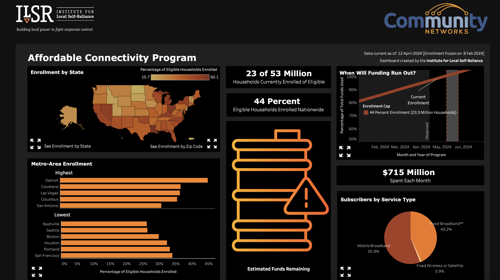
It’s the latest example of states trying to fill the broadband affordability void after federal Republican lawmakers refused to fund the expansion of the popular Affordable Connectivity Program, an FCC program that provided a $30 discount off of the broadband bills of those that already qualify for existing federal low-income support programs.
Republican lawmakers claimed they needed to kill the ACP to “save taxpayers money,” but follow up research indicated the program more than paid for itself through financial benefits driven by increased access to remote employment and health care opportunities.
The abrupt June 2024 cessation of the program, which provided discounts to 23 million Americans, is estimated to have forced roughly 5 million households (or around 10–12 million people) off of the Internet.
Enter a growing coalition of states that are steadily crafting ACP alternatives.
Some, such as New York State’s Affordable Broadband Act, directly require larger ISPs to provide discounted broadband access to low income residents. Others, like New Mexico’s Low-Income Telecommunications Assistance Program (LITAP), empower the state Public Regulation Commission to offer $30 per month broadband discounts for qualified households.
Seven additional states (Minnesota, California, Massachusetts, Connecticut, Vermont, Illinois, and Maryland) have passed or are currently debating some form of state-level broadband affordability legislation.
Partner Illinois Legislation Also Empowers Cooperatives
At the same time Illinois lawmakers contemplate improving broadband affordability, Ventura has also introduced Senate Bill 3613, which would amend the Broadband Advisory Council Act to empower local electric and telephone cooperatives to conduct their own market analyses and build next-generation fiber networks.
The legislation is inspired by progress seen in states like Minnesota and Colorado, which have prioritized providing grants to electrical utilities looking to leverage century-old expertise in serving rural communities to expand into reliable fiber access.
Last summer, Illinois leaders also passed the Electrical Service Broadband Deployment and Access Law, which provided electric cooperatives greater flexibility to deploy fiber infrastructure using existing electric easements and road rights-of-way – provided they’d received state or federal broadband funding like American Rescue Plan Act (ARPA) or Infrastructure Investment and Jobs Act (IIJA) funds, which included over $1.3 billion in federal grant support for the Connect Illinois Broadband Grant Program and other state digital equity initiatives.
"Having fast, reliable and affordable broadband is a necessity that should be accessible to everyone,” Janie Dunning, coordinator for Show Me Broadband, tells Citizen Weekly.
“Affordability remains the number one reason why Americans lack this essential service and many are having to choose between having Internet, paying their rent, buying food or taking care of their medical needs. This is unacceptable and states are going to have to take broadband affordability into their own hands."
In a world where federal lawmakers under the Trump administration have taken explicit aim at the grant funding headed toward municipalities and cooperatives, and instead redirected it to less reliable and more expensive satellite broadband service, state leadership to fill the gap is more important than ever.
Both SB 3612 and SB 3613 are currently awaiting hearings in the Senate Energy Committee, and will certainly face strong opposition from deeply-entrenched local telecom monopolies like AT&T, which is just a few years removed from being caught bribing a former Illinois house speaker in order to pass AT&T-favorable telecom legislation.
That legislation made it easier for AT&T to walk away from Carrier of Last Resort (COLR) obligations requiring it to maintain and repair heavily taxpayer subsidized copper-based landline and DSL infrastructure. In many states phone giants like AT&T and Verizon shuttered DSL and landline service, then refused to replace it with modern fiber alternatives.
More recently, broadband providers have joined forces to push Illinois Senate Bill 3838, dubbed the Broadband Deployment Act, which would streamline how internet service providers secure access to land along roadways. That initiative, which would only require 14 days notice before ISPs are allowed to do work on easement property, has seen some pushback from landowners who aren’t sure the revisions are necessary.
Collectively, the state has been very busy in trying to prepare for how to best spend $1.3 billion in looming federal subsidies in towns and cities long left on the wrong side of the digital divide.
Enter cooperatives, which lean heavily on their rural electrification experience to expand affordable fiber into neighborhoods long neglected by regional monopolies disinterested in infrastructure expansion that can’t provide immediate, significant investor returns.
Header image of Illinois State Capitol Building courtesy of Randy von Liski on Flickr, CC BY-NC-ND 2.0, Attribution-NonCommercial-NoDerivs 2.0 Generic
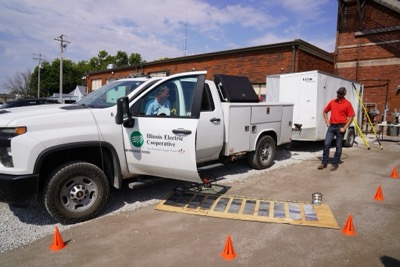
Inline image of Illinois Electric Cooperative truck courtesy of Illinois Electric Cooperative Facebook page