
resource

Content tagged with "resource"

Related Topics
Displaying 61 - 70 of 123

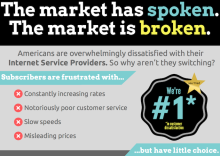
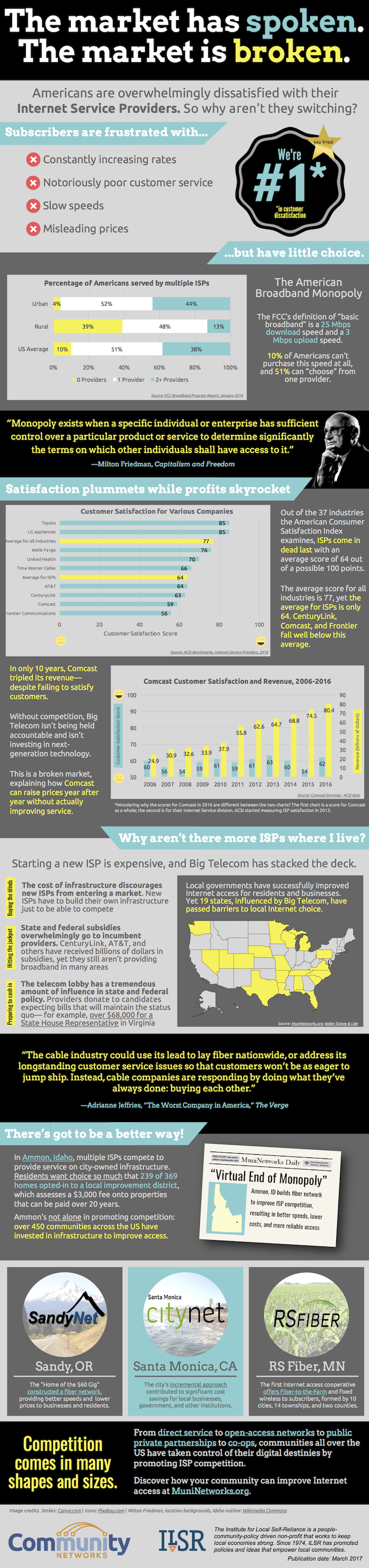
Infographic: The Market Has Spoken. The Market Is Broken.

“Monopoly” may be a fun family night activity, but if you live in a place where you have little or no choice for Internet access, it’s not fun and it’s not a game.

According to FCC data, most families don’t have a choice in Internet access providers, especially providers they like. Nevertheless, the biggest companies keep reporting increasing revenues every year. People aren’t happy with the service they’re receiving, but companies like AT&T and Comcast continue to thrive. What’s going on?

In a recent State Scoop piece, Christopher wrote: 

[T]he market is not providing a check to AT&T or Comcast power. They are effectively monopolies — and as we just saw — can translate their market power into political power to wipe out regulations they find annoying.

At the Institute for Local Self-Reliance, where we work to support local economies, this broken market is a major problem. Cable monopolies are bad for local businesses, which become less competitive from paying too much for unreliable Internet access. Communities cannot thrive without high quality Internet access today. 

We created this infographic to present the evidence showing that the market is broken. This resource also discusses why creating more competition in the current market is such a challenge. An effective way to overcome this broken market, however, is to consider what hundreds of local communities are already doing - investing in publicly owned Internet infrastructure. Our infographic offers a few examples of different models, each chosen to suit the communities they serve.

Get a larger version of the infographic here

market-broken-infographic-small-2.png

Get a larger version of the infographic here.

Kudos to intern Kate Svitavsky who created the infographic.

Stay up to date on community networks with our newsletter.

Video On Community Networks: One of Our Favs


Take a minute to learn just a few of the reasons why local communities invest in publicly owned networks. Our short 2012 video is a great way to share information about community networks - there can be other options beyond big cable and DSL providers.


Transcript: Community Broadband Bits Episode 246

This is the transcript for episode 246 of the Community Broadband Bits Podcast. Christopher Mitchell interviews Eric Lampland of Lookout Point Communications at the Iowa Association of Municipal Utilities. They discuss the importance of due diligence and feasibility studies. Listen to this episode here.

Eric Lampland: The first thing, however, I would suggest that you do is to know who you are as a city, to know exactly where you stand in your own personal knowledge about this kind of activity.

Lisa Gonzalez: This is Episode 246 of the Community Broadband Bits Podcast from the Institute for Local Self-Reliance. I'm Lisa Gonzalez. We're bringing back Eric Lampland to the show this week. For those of you who are regular listeners, you'll recognize Eric's voice from Episodes 80 and 128. He's the founder of Lookout Point Communications and his firm has consulted for a number of communities and other entities across the country. Eric has also worked with us on research projects. In this episode, he and Christopher have a discussion about feasibility studies. When communities decide it's time to make changes to improve local connectivity, they typically need to engage a consulting firm to provide a feasibility study that's unique to their situation. As you'll hear in the interview, just knowing where to start can be confusing. Eric and Chris tackle some of the questions local communities should consider when they're ready to take this step. What should they look for in a quality consultant? What should they ask for in a feasibility study? And what are some common challenges they face? For any local community where investment and better connectivity is a possibility, this interview is worth a bookmark. Learn more about Eric's firm at LookoutPt.com. Now here are Eric Lampland, founder of Lookout Point Communications, and Christopher talking about feasibility studies for local communities.

Feasibility Study? How to Start a Community Network - Community Broadband Bits Podcast 246

After discussing this issue time and time again, with community after community, we finally recorded our thoughts on how communities should get started when considering a community network. Eric Lampland, the guy behind Lookout Point Communications, is our guest on Community Broadband Bits podcast episode 246. 

We talk about common mistakes and the importance of developing a comprehensive vision when evaluating an investment or partnership to improve Internet access. 

We also talk a little about the importance of some technical knowledge and having at least one person championing the effort. This is not something a consultant can do for you - someone in the community has to take ownership and responsibility. 

These are very important considerations for any community considering what it should be doing in the modern era.

Eric has also been a guest on Episode 128 "Open Access and Incumbent Challenges" and Episode 84 "Justifying a Network with Indirect Cost Savings."

This show is 33 minutes long and can be played on this page or via Apple Podcasts or the tool of your choice using this feed

Transcript below. 

We want your feedback and suggestions for the show-please e-mail us or leave a comment below.

Listen to other episodes here or view all episodes in our index. See other podcasts from the Institute for Local Self-Reliance here.

Thanks to Break the Bans for the music. The song is Escape and is licensed under a Creative Commons Attribution (3.0) license.

Christopher On "The Takeaway": Monopolies, Munis, And Making A Difference

Christopher recently took some time to visit with John Hockenberry on The Takeaway from PRI and WNYC. The conversation covered municipal networks, big cable and telephone monopolies, and how local community initiatives for better connectivity are raising the bar in rural areas.

WNYC wrote about the show: 

Net neutrality advocates got some bad news when Ajit Pai was tapped by President Donald Trump to be chairman of the Federal Communications Commission — it appears that Pai wants to largely reverse the Obama administration's approach to the Internet.

Large telecommunications monopolies have been digging their heels in, but some citizens are fighting back. The Takeaway considers the broadband debates that currently are taking place with Christopher Mitchell, the director of Community Broadband Networks at the Institute for Local Self Reliance.

Listen to the interview; it’s about 4 minutes.

Pole Attachment Resource From Next Century Cities

Rights-of-Way rules vary from state to state and local policies can also influence how the publicly owned spaces are managed. Throw utility poles into the mix and the situation is even more complex. In order to help local communities get started on investigating pole attachment requirements in their states, Next Century Cities has published a Guide to Pole Attachments.

From the guide:

Utility poles have become one of the great battlegrounds in the effort to expand next-generation Internet network infrastructure deployment. Pole access determines whether a new provider is able to easily and cost effectively bring broadband infrastructure to a community. This in turn plays a significant role in the level of competition, and the services available to local businesses and residents. However, gaining access to these poles is often a long, difficult, and expensive process, making the barrier to entry incredibly high.

In addition to offering basics organized by state, the guide supplies information on One Touch Make Ready (OTMR) and FCC regulations. There are links to authorities you can use as starting points in your research, including FCC Report and Orders, state statutes, and policy papers. If you find yourself searching out pole attachment information on a regular basis, the guide is worth a bookmark. 

"Why Local Solutions?" Fact Sheet

The next time you’re attending a city council meeting, a local broadband initiative committee meeting, or just chatting with neighbors about better local connectivity, take a few copies of our Why Local Solutions? fact sheet.

Our new one-pager addresses three main reasons why local telecommunications authority is so important:

  • State and federal government won’t solve the problem - local residents, businesses, and elected officials know what they need, right?
  • Large telecom companies refuse to invest in rural areas - we've seen over and over how their promises to improve Internet access go unfulfilled.
  • Local leaders can best resolve local issues - they are accountable to the people they see every day and they experience the same reality.

In addition to providing some basic talking points to get the conversation moving, the fact sheet offers resources to guide you to more detailed information on publicly owned Internet networks. This resource is well paired with our other recent fact sheet, More than just Facebook. You've already started to get people interested in all the advantages of high-quality connectivity, now show them how local self-reliance it the most direct route to better access.

Download Why Local Solutions? fact sheet.

Other Fact Sheets At Your Fingertips

Fact sheets are a useful tool for getting your point across without overloading the recipient with too much information. They can easily be digested and carried to meetings with elected officials and often are just the right amount of information to pique someone's curiosity.

Check out our other fact sheets.

"More Than Just Facebook" Fact Sheet

Our newest fact sheet, More than just Facebook, provides an overview on how Internet access and fast, affordable, reliable connectivity reaches most aspects of our lives. We provide statistics on economic development, education, and methods of delivering Internet access. This fact sheet is a good introductory tool that points out how Internet access is much more than just social media.

We also offer some explanations of concepts that may not be familiar to people who don’t work in the telecommunications field or advocate for municipal networks. This fact sheet is a tool that lays out what publicly owned Internet infrastructure and better connectivity can mean for your community.

Share it with friends, relatives, and your elected officials who might wonder if they could do more than “Like” pithy posts if they had better connectivity.

Download More than just Facebook.

Press Kit On VA Bill: Information At Your Fingertips

Proponents of better connectivity in Virginia are setting off alarms about HB 2108, a bill that will effectively bar municipal networks and prevent local communities from working with private sector partners. In order to educate the public about the miseries this bill will present, Friends of Municipal Broadband developed a press kit with materials to help spread the word.

At a January 18th morning press conference, the grassroots group consisting of local community leaders, citizens who want to control their own broadband decisions, and members of the private sector who are concerned about partnering with local communities, handed out the information.

The kit contains:

Fact Sheet On Munis In Virginia

The latest addition to our list of fact sheets focuses on Virginia: Municipal Networks Deliver Local Benefits. We noticed that municipal networks in the “Mother of States” have spurred economic development, saved taxpayer dollars, and improved local connectivity. 

A number of local governments in Virginia that have invested in Internet network infrastructure have attracted Internet Service Providers (ISPs) to use the publicly owned assets to offer services to residents and businesses. Local governments are using fiber-optic networks to improve public safety, take control of their own connectivity needs, and attract or retain employers.

Download the fact sheet here.

Learn more about the Roanoke Valley Broadband Authority (RVBA) open access network, located in southwest Virginia. Christopher spoke with Frank Smith, President and CEO of the RVBA for episode 221 of the Community Broadband Bits podcast.

Take a look at our other fact sheets; we will continue to add state-specific editions so check back for more. Subscribe to our weekly email for a run down of stories so you can stay up-to-date on what's happening in community broadband networks.