
municipal broadband

Content tagged with "municipal broadband"

Displaying 61 - 70 of 191

AAPB Launches New Mentorship Program For Communities Considering Municipal Broadband

As interest in municipal broadband continues to grow across the U.S., the American Association for Public Broadband (AAPB) has launched a mentorship program that will pair communities interested in building publicly-owned, locally controlled broadband networks with cities and towns that have successfully done so.

“We’re excited to match AAPB members with communities seeking to take control of their broadband futures,” AAPB Executive Director Gigi Sohn said in announcing the program.

“We want to demystify the process for those communities that want to ensure that everyone in their city or town has affordable access to everything that broadband enables, and we believe that our members that own their broadband infrastructure are the best people to do that.”

Image
Community Nets map

While an increasing number of communities are exploring municipal broadband as a solution to local connectivity challenges after decades of frustration with the spotty, expensive service of big monopoly providers consistently ranked as among the most hated companies in America, local officials still must navigate the logistical, technical, financial, and political challenges associated with building and operating municipal networks.

Indio, California Gets $9 Million Grant For Fiber Network

Indio, California has been awarded a $9 million state grant the city will use to expand affordable broadband access. The grant award was made possible by California’s $2 billion Last Mile Federal Funding Account Grant Program (FFA), part of a broader $6 billion California “Broadband For All” initiative aimed at bridging the digital divide in the Golden State.

According to Indio officials and the now-finalized CPUC award, Indio – an incorporated city located in Riverside County and home to 92,000 residents – will receive $8.9 million to deliver gigabit-capable fiber to 479 unserved locations and an estimated 3,632 unserved local residents.

“We are still in the design phase and should release an RFP within the next couple of months for the actual build,” Indio Director of Information Technology Ian Cozens told ILSR.

Image
Indio CA fiber map

With 75 percent of the project’s initial target area classified as low-income, city leaders say residents can expect static pricing for at least ten years. The city will also ensure there’s a low-cost option for low-income families left adrift after House and Senate Republicans blocked the funding renewal of the federal Affordable Connectivity Program (ACP).

City officials, however, do not intend to stop there. The plan is to build a citywide fiber network, the full cost of which is estimated to be $35.2 million.

Beyond the Pivot: Fort Collins Connexion's Latest Milestones - Episode 616 of the Community Broadband Bits Podcast

In this episode of the podcast, Chris sits down once again with Chad Crager, Executive Director of Fort Collins Connexion, to discuss the city's progress in developing a sustainable municipal broadband network. Chad shares exciting updates, including reaching 21,000 subscribers and serving 80,000 premises, while highlighting the city's innovative approach to broadband, such as leveraging underground power infrastructure and implementing dig-once policies.

Chad also emphasizes Fort Collins' commitment to digital equity, explaining efforts to serve mobile home parks, the challenges of wiring such communities, and the introduction of Spanish-speaking staff to reach underserved populations. The discussion touches on the city's long-term sustainability plans, business model, and collaboration with local government, ensuring that Fort Collins Connexion remains financially resilient while fostering digital inclusion for all residents.

Tune in for an insightful look at how Fort Collins is balancing competition with incumbents, expanding broadband access, and setting an example for other cities looking to invest in community broadband.

This show is 30 minutes long and can be played on this page or via Apple Podcasts or the tool of your choice using this feed.

Transcript below.

We want your feedback and suggestions for the show-please e-mail us or leave a comment below.

Listen to other episodes or view all episodes in our index. See other podcasts from the Institute for Local Self-Reliance.

Thanks to Arne Huseby for the music. The song is Warm Duck Shuffle and is licensed under a Creative Commons Attribution (3.0) license

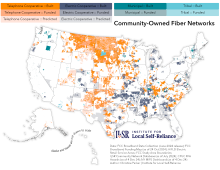
New Resource: Our New Community Network Map Shows the Explosion of Publicly Owned Networks

In 2011, we built our first map showing where community-owned networks were located across the United States. At the time, it aimed to illustrate what we knew to be true: that more than 100 communities were choosing to fill the local broadband marketplace by building and/or operating their own networks.

The goal was twofold: to highlight the work local governments were doing to fix the broken broadband market in their communities, and collect in one place the breadth,  depth, and variety of community-owned networks. Over time, we added Tribal networks, and those operated by telephone and electric cooperatives.

Today we release a new version of our Community Networks Map, showing where municipal networks operate across the United States and how they are bringing new, more affordable service and competition to communities around the country. From 130 networks covering a similar number of communities in 2011, the new map shows that municipally owned Internet service providers now total more than 400 networks covering more than 700 communities. A third of those networks provide high-speed Internet access to nearly every address in the communities where they are located.

Vermont Establishes ‘Long Drop’ Program to Help Connect Low-Income Households To Fiber Internet

Building fiber networks in sparsely populated rural communities is not cheap. And when it comes to deploying fiber drops to individual homes set back relatively far off the main roads where fiber lines pass by, it can prove to be cost prohibitive to connect those households.

But in Vermont, the push to ensure every household in the Green Mountain State has access to the gold-standard of Internet connectivity, the Vermont Community Broadband Board (VCBB) this week unanimously approved the creation of a new “low-income long and underground drop program.”

“We’re not talking about (connecting) multi-million mansions two miles off the road, but households with a true need,” VCBB Deputy Director Robert Fish tells ILSR, adding:

“What good is a fiber network if households can’t connect? This (program) is one way we can address affordability, whether it’s long aerial drops or underground.”

Re-Investing Leftover Federal Rescue Plan Funds

Approved by the VCBB at their regular meeting on September 9, the new program will use $2.5 million in leftover federal Rescue Plan funds to subsidize the cost of connecting low-income households in high-cost locations.

Image
Vermont Welcome sign

“These are Capital Project Funds (courtesy of the American Rescue Plan Act) from projects that came in under budget,” Fish explained, noting how most of the $245 million the state has received to build out broadband networks has already been awarded to the 10 Communications Union Districts (CUDs) now bringing fiber service to Vermonters long neglected by the big incumbent providers.

Alpine County Open Access Fiber Among Big Winners In Latest California FFA Grants

The California Public Utilities Commission (CPUC) has announced another $237 million in new grants that will help fund broadband expansion across 21 different California towns, cities, counties, and tribal communities. Meanwhile, numerous additional grants that are waiting in the wings are expected to get formal approval sometime in September.

Alpine, Mono, Nevada, Placer, Santa Barbara, and Tulare counties are among the latest winners in California’s $2 billion Last Mile Federal Funding Account Grant Program (FFA).

That program is an extension of California’s ambitious Broadband For All initiative, a $6 billion effort aimed at dramatically boosting broadband competition and access across the Golden State.

At an August 22 meeting, CPUC officials formally approved both a third and fourth round of FFA broadband funding. With these latest two rounds of funding, the CPUC says it has doled out $434 million in grant awards across 22 counties across California.

Open Access Fiber Comes To Alpine County Via Third FFA Round

The third round of formally approved grant awards included $95 million in funding for 10 broadband projects across California’s Alpine, Modoc, Riverside, Santa Barbara, and Tulare counties. This round of awards also included grants for the Fort Bidwell Indian Community in Modoc County and the Santa Ynez Band of Chumash Indians in Santa Barbara County.

Alpine County’s $7 million grant for fiber broadband expansion will be managed by the Golden State Connect Authority and help fund the Alpine County Broadband Network, an open access fiber network that will deliver fiber for the first time to 721 unserved locations and 818 unserved residents across Alpine County.

Paul Bunyan Communications Payout To Members Is Not A Tall Tale

The reasons why municipalities and cooperatives build community-owned broadband networks are numerous, often fueled by years of frustration with the spotty, expensive service offered by the big monopoly incumbents.

In northern Minnesota earlier this month, we came across yet another example of why an increasing number of localities are finding publicly-owned, locally-controlled telecommunication infrastructure so appealing: the “profits” don’t get funneled into the pockets of distant shareholders but are instead reinvested back into the local economy.

Image
Paul Bunyan Communications logo

In the case of Paul Bunyan Communications, the “profits” are shared with its members.

Earlier this month, the Bemidji-based telephone cooperative – which serves 30,000 members spread across its 6,000-square-mile service area – announced it is returning over $3 million to its members this year.

Capital Credit Retirements

As the cooperative explained in a recent press release:

“Paul Bunyan Communications is a not-for-profit company that strives to provide the highest quality service at the most affordable rates. As a cooperative, membership in Paul Bunyan Communications includes the opportunity to share in the financial success of the company.”

Shot Clock Winding Down on ARPA Funds For Broadband Projects

Communities looking to leverage American Rescue Plan Act (ARPA) funding for broadband or other local infrastructure need to act soon or risk losing access to a once-in-a-generation funding resource.

Most ARPA recipients seem well aware of the deadline, but data suggests more than a few communities could drop the ball.

As part of the 2021 American Rescue Plan Act (ARPA), $25 billion was specifically earmarked for broadband expansion.

But the law also created the State and Local Fiscal Recovery Funds (SLFRF) program, which doled out $350 billion for states, municipalities, and tribal governments to offset pandemic losses or flexibly invest in local infrastructure.

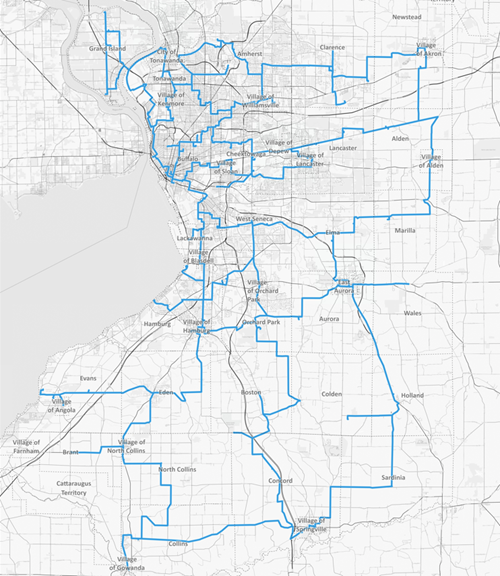
Maine Awards $9.6 Million For Fiber In Lincoln, Waldo Counties

Maine’s state broadband office, the Maine Connectivity Authority (MCA), has unveiled $9.6 million in new grant awards to help bring affordable fiber to 15,561 homes and businesses across 12 widely underserved communities in the Pine Tree state.

According to the announcement by the MCA, the grants will primarily be focused on leveraging public-private partnerships to drive fiber into unserved locations in Waldo and Lincoln Counties.

The grants are part of the MCA’s Partnerships for Enabling Middle Mile Program (PEMM), which addresses large-scale, regional broadband needs by leveraging middle mile infrastructure.

Image
Maine Middle Map

Lincoln County saw a grant award of $6 million matched by $24.3 million in private and public investment including county ARPA funds (which the MCA notes was the “highest percentage of financial commitment from any public-private partnership awarded through an MCA program to date”).

The deployment, which is expected to begin in 2025, involves a partnership between Lincoln County and Consolidated Communications and will bring fiber that passes 14,436 homes and businesses in Woolwich (in Sagadahoc County), Wiscasset, Alna, Dresden, Boothbay, Edgecomb, Waldoboro, Whitefield and Nobleboro.

“This is probably the most exciting thing since cable TV came into any of these towns,” Evan Goodkowsky, broadband infrastructure consultant for Coastal Maine Regional Broadband, told the Lincoln County News.

Oakland Secures $15 Million Grant To Bring Broadband Into Underserved Neighborhoods

After two years enmeshed in the unglamorous work of coalition-building, speed test data collection, and pushing state leaders to invest in better telecommunication infrastructure across Oakland’s most disadvantaged neighborhoods, digital equity advocates in the East Bay city are finally seeing the fruits of their labor pay off.

The city was recently awarded a $15 million grant from the state’s $2 billion dollar Federal Funding Account, administered by the California Public Utilities Commission (CPUC).

The grant will fund the construction of a city-owned, open-access, hybrid middle mile/last mile fiber network – one of a half-dozen grant awards the CPUC approved in the first round of funding, most of which went to support community broadband initiatives.

Courtesy of federal Rescue Plan dollars, the infusion of cash will allow the city to deploy nearly 13 miles of new middle mile 144-count fiber, upgrade almost 12 miles of existing city-owned fiber, and add 9 miles of new last mile fiber connections. As the city’s network is built, it will be connected to the state’s new massive open access middle mile network now under construction.

The FFA grants are part of California’s larger Broadband For All initiative, a $6 billion effort aimed at seeding competition and expanding broadband access across the Golden State.

The Oakland project not only paves the way for the city to connect 14 community anchor institutions (CAIs) and nine public safety buildings, it will also expand high-speed Internet access to thousands of unserved and underserved addresses in West and East Oakland.