
multi-dwelling units

Content tagged with "multi-dwelling units"

Displaying 11 - 20 of 49

Oakland Secures $15 Million Grant To Bring Broadband Into Underserved Neighborhoods

After two years enmeshed in the unglamorous work of coalition-building, speed test data collection, and pushing state leaders to invest in better telecommunication infrastructure across Oakland’s most disadvantaged neighborhoods, digital equity advocates in the East Bay city are finally seeing the fruits of their labor pay off.

The city was recently awarded a $15 million grant from the state’s $2 billion dollar Federal Funding Account, administered by the California Public Utilities Commission (CPUC).

The grant will fund the construction of a city-owned, open-access, hybrid middle mile/last mile fiber network – one of a half-dozen grant awards the CPUC approved in the first round of funding, most of which went to support community broadband initiatives.

Courtesy of federal Rescue Plan dollars, the infusion of cash will allow the city to deploy nearly 13 miles of new middle mile 144-count fiber, upgrade almost 12 miles of existing city-owned fiber, and add 9 miles of new last mile fiber connections. As the city’s network is built, it will be connected to the state’s new massive open access middle mile network now under construction.

The FFA grants are part of California’s larger Broadband For All initiative, a $6 billion effort aimed at seeding competition and expanding broadband access across the Golden State.

The Oakland project not only paves the way for the city to connect 14 community anchor institutions (CAIs) and nine public safety buildings, it will also expand high-speed Internet access to thousands of unserved and underserved addresses in West and East Oakland.

San Francisco Wins National Award For Providing Free High Speed Internet Service To Affordable Housing Residents

As the Affordable Connectivity Program (ACP) is now bankrupt and no longer helping low-income households pay for home Internet service, the City of San Francisco is being honored with the 2024 Community Broadband Project of the Year Award by the National Association of Telecommunications Officers and Advisors (NATOA) for its Fiber to Housing (FTH) program.

Built on the back of the city’s municipally-owned fiber optic network – which since 2002 has been used to connect city and public safety facilities, hospitals, libraries and street lights – California’s fourth most populous city is well on its way to extending the city-owned network to deliver free high-speed Internet service to 30,000 affordable housing units across the city.

Image
San Francisco technicians deploying fiber across roof

The program currently serves over 14,300 affordable housing units in the city, as well as 1,500 beds at homeless shelters across 115 sites, city officials say. An additional 10,000 residential units are expected to be connected in the coming fiscal year, with the aim of serving 30,000 units by July 2025.

According to the city’s website, the program has connected 52 public housing locations across the city to “fiber-optic and Ethernet cabling in every housing unit.” An additional 63 housing locations are getting free Internet through onsite Wi-Fi with download speeds ranging from 60 to 120 Mbps (Megabits per second), which exceeds the 50 Mbps service Comcast’s Internet Essentials offers.

Colorado Passes New Broadband Laws, Takes Aim At Landlord Monopolies

The Colorado legislature has passed several new broadband bills that should aid affordable broadband deployment in the state. According to a state announcement, the new bills do everything from expanding the leeway the state has in spending broadband funding, to providing some tax breaks to providers heavily invested in rural deployment.

Colorado has been a key player in the municipal broadband space, and is home to several major municipal broadband deployments (from Longmont’s Nextlight to Fort Collins’ Connexion) that have been proven inspirational to municipalities across the country.

Several of the new laws should prove helpful to municipal broadband operations and private sector ISPs alike.

Image
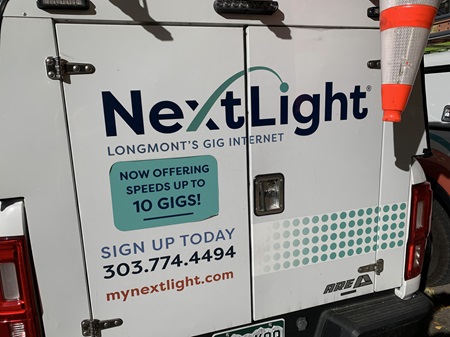
Longmont Nextlight Truck

HB 24-1334, for example, dictates that a multi-dwelling unit (MDU) building owner can’t deny a broadband provider access to the property to install broadband infrastructure. Muni operations in places like Dryden, New York have told ILSR repeatedly that they often face difficulty accessing MDU properties.

Texas Maps and Plans, Starlink and the Ozone, Sony Lawsuit, and Colorado MDU Laws | Episode 97 of the Connect This! Show

Connect This! Show

Join us Friday, June 28th at 2pm ET for the latest episode of the Connect This! Show. Co-hosts Christopher Mitchell and Travis Carter will be joined by regular guests Kim McKinley (UTOPIA Fiber) and Doug Dawson (CCG Consulting) to talk about library speed test maps in Texas and broadband plans in San Antonio, whether Starlink will mess with the ozone layer, music giant Sony trying to bully Cox into disconnecting users who engage in IP infringement, and the recent Colorado law aimed at improving competition in MDUs.

Email us at [email protected] with feedback and ideas for the show.

Subscribe to the show using this feed or find it on the Connect This! page, and watch on LinkedIn, on YouTube Live, on Facebook live, or below.

Remote video URL

New York State Is Trying To Make It Easier For Municipal Broadband To Succeed

In March, Charter Communications tried (and failed) to include a poison bill in New York State’s budget bill that would have hamstrung community broadband. In stark contrast, a New York legislator this month introduced new legislation he says would make it easier than ever for New York state municipal broadband projects to thrive.

State Senator Jeremy Cooney of Rochester has introduced the Broadband Deployment Assistance Act of 2024 (S9134), which would streamline the permitting process for municipal broadband projects by "amending the general municipal law, in relation to requiring substantially similar permits for broadband deployment to be processed together at the same time and on an expedited basis."

“With a quicker timeline and more efficient process for local governments, we can create affordable options for New Yorkers that empower them to take control of their digital destiny,” Cooney wrote in an editorial published at Syracuse.com.

Image
New York State Seal

Cooney says he was motivated by a lack of broadband competition in New York State. New York is dominated by Charter Communications, which was almost kicked out of the state in 2019 for poor service and  misleading regulators about broadband deployment conditions affixed to its 2016 purchase of Time Warner Cable.

As ACP Collapses, Newark Takes The Lead On Affordable Access

Newark, New Jersey is taking full advantage of its city-owned fiber network to expand affordable broadband access – with a particular eye on helping the city’s least fortunate.

Driven by past successes with city-owned fiber and Wi-Fi, Newark has announced the city is significantly expanding the availability of $20/month broadband service to numerous Newark Housing Authority (NHA) apartment buildings.

Image
Newark Housing Authority logo

This latest partnership with Adrena leans heavily on Newark Fiber, a 288-strand city-owned fiber network. Launched in 2016, the network has steadily been expanded to connect anchor institutions. But it’s also been a cornerstone of the city’s efforts to revitalize and assist many lower income – and long neglected – Newark neighborhoods.

“Nine percent of Newark families lack computers and about 20 percent of the city doesn't have an in-home broadband connection,” Aaron Meyerson, Chief Innovation Economy Officer & Director of Broadband for the City of Newark told ILSR.

Massachusetts and New York Look To Make Affordable Housing Broadband Ready

Massachusetts and New York officials hope to entice affordable housing property owners with new grant programs that would pay the retrofitting costs to expand high-speed Internet connectivity into decades-old affordable housing developments.

The programs aim to focus on the multitude of multi-dwelling units (MDUs) in those states, particularly housing developments built before the advent of the Internet.

With property owners and Internet service providers (ISPs) often reluctant to pay the costs of getting these buildings up to broadband speed, Massachusetts and New York have launched initiatives – using a portion of their federal broadband funds – to chip away at the digital divide in housing developments where a significant number of tenants live in buildings not wired to support reliable broadband or where the service is not affordable, thanks to agreements with monopoly providers.

Image
NY ConnectALL logo

New York Bytes Into Broadband Affordability

In December, New York Governor Kathy Hochul’s office announced the state’s ConnectALL Office (CAO) was setting aside $100 million New York State received from the federal Capital Projects Fund (courtesy of the American Rescue Plan Act) to bring broadband connectivity to 100,000 affordable housing units across the Empire State.

In announcing New York's Affordable Housing Connectivity Program, Hochul said:

“With work, school, and essential government services going digital, affordable homes need affordable, reliable broadband, and this funding will help bolster our efforts to build housing equipped with the basic tools that New Yorkers need to succeed.”

NextLight in Longmont, Colorado Expands Beyond City Borders

Since it first broke ground in 2014, Longmont, Colorado’s community-owned NextLight fiber network has won numerous awards and inspired countless communities nationwide.

With its citywide deployment nearing completion, and counterproductive state legal restrictions in the rear view mirror, city leaders are now working to expand the network beyond city limits.

City officials tell ILSR that network construction has now crossed north of Colorado Highway 66, outside of city limits and into the Anhawa and Strawberry Circle neighborhoods. The extension will bring service to around 125 homes that previously had access to Longmont electrical utility service, but not broadband.

Longmont officials say this latest expansion is being financed entirely by subscriber revenues and money set aside for capital projects, with no bonding or other supplementary funds involved.

Image
Longmont Nextlight Building

“We’ve been carefully evaluating our opportunities for expansion in order to make best use of the community’s resources,” NextLight’s Scott Rochat told ILSR. “Our total investment in this project is just under $300,000; based on our typical rate of adoption, we expect to see about a five-year payback. This also has the benefit of giving us a foothold on the north side of (Highway) 66 to help facilitate more expansion in the future.”

One Year After Launch, Dryden, NY Muni Network Making Steady Progress

One year after launching a municipal fiber network, Dryden, NY officials say they’re making steady progress in their quest to expand affordable fiber broadband to the entire town of 14,500.

While the effort hasn’t been without obstacles, town leaders say the public response to their foray into broadband has been overwhelmingly positive.

“While there are challenges, we are continuing to make great progress in the buildout,” Dryden Town Supervisor Jason Leifer tells ILSR. “We have support from our residents, who continue to show interest in this project. We also have financial support from Tompkins County in the form of grants–and from neighboring municipalities who are interested in replicating our model.”

The city’s network began with a 50-home trial pilot trial in the southwest part of town. The broader $15 million network will be funded by a combination of bonds, $2 million in federal COVID-19 disaster relief funding, an Appalachian Regional Commission grant, and eventually, subscriber revenues.

Image
Dryden Fiber map

The town took a phased approach to deployment, first by connecting the backbone of the network in the southeast of the city, followed by a focus on the western and eastern halves of the municipality, respectively. The Dryden fiber website features a build map that helps locals track network progress.

“We have currently passed over 420 addresses with our buildout,” freshly-appointed Dryden Fiber Executive Director David Makar tells ISLR. “This includes over 150 rental properties – mostly single family homes and apartments – as well as many owner occupied homes and businesses. We are still in phase one, and as we move into the village of Dryden and the hamlets of Varna, Ellis Hollow, and Etna, we will be in phase two.”

Metro Connect, AT&T FWA, MDUs, and RDOF | Connect This! Show Episode 90

Connect This

Join us Friday, March 1st at 3pm ET for the latest episode of the Connect This! Show. Co-hosts Christopher Mitchell (ILSR) and Travis Carter (USI Fiber) will be joined by regular guest Doug Dawson (CCG Consulting) and Kim McKinley (UTOPIA Fiber) and special guest Gigi Sohn (American Association or Public Broadband) to talk about the 2024 Metro Connect conference, multi-dwelling units, AT&T's fixed wireless dreams, and municipal network developments in Fort Pierce, Florida and elsewhere before ending the show with the Rural Digital Opportunity Fund (RDOF).

Email us at [email protected] with feedback and ideas for the show.

Subscribe to the show using this feed or find it on the Connect This! page, and watch on LinkedIn, on YouTube Live, on Facebook live, or below.


Remote video URL