
multi-dwelling units

Content tagged with "multi-dwelling units"

Displaying 1 - 10 of 49

Time for a Retrofit! - Episode 20 of Unbuffered

Unbuffered Logo - Two text bubbles

In this episode of Unbuffered, Chris is joined by Sean Gonsalves for a wide-ranging conversation about some of the latest stories shaping broadband and telecommunications.

Chris and Sean begin in Massachusetts, where they discuss the state's Residential Retrofit Program and how targeted investments are helping bring reliable, affordable Internet service to thousands of residents living in older affordable housing developments. They explore why focusing on existing housing can make a meaningful difference for communities that have often been left behind.

The conversation then shifts to Minnesota, where Windomnet, one of the state's longest-running municipal broadband networks, is being sold to a regional provider. Chris and Sean reflect on the network's legacy, the value it brought to the community over two decades, and why the success of community broadband shouldn't be measured by simple financial metrics alone.

From there, they examine new data showing how Americans are using more upstream bandwidth as upload speeds improve, reinforcing the importance of building networks that support both consumption and creation in an increasingly connected world.

Finally, Chris and Sean dive into one of the more unusual technology stories of the week: the Federal Communications Commission's approval of a proposal to test a satellite designed to reflect sunlight back to Earth. They discuss the regulatory questions surrounding the project, the potential unintended consequences, and what it says about the pace of technological innovation.

Throughout the episode, Chris and Sean connect today's headlines with broader conversations about community investment, local accountability, and building communications infrastructure that serves people for the long term.

This show is 40 minutes long and can be played on this page or via Apple Podcasts or the tool of your choice using this feed

You can also check out the video version via YouTube.

Transcript below.

We want your feedback and suggestions for the show-please e-mail us or leave a comment below.

Listen to other episodes (formerly Community Broadband Bits) or view all episodes in our index. See other podcasts from the Institute for Local Self-Reliance.

Thanks to Whitedrift for the song Operator, licensed Creative Commons Attribution (3.0).
Massachusetts' Residential Retrofit Program Hits Its Stride

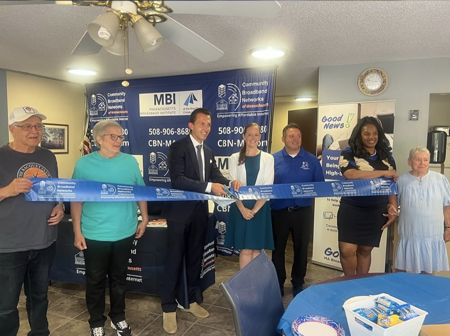
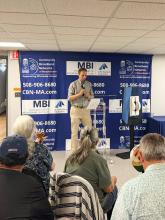
Late last month, officials from the Massachusetts Broadband Institute (MBI) and Community Broadband Networks America (CBN America) —  an independently-owned fiber Internet service provider — gathered with dozens of residents at two Southbridge Housing Authority properties to celebrate the expansion of the state's Residential Retrofit Program

The event marked the latest milestone for a program that, more than two years after its launch, has grown from a $22 million pilot project into a $74 million initiative to rewire some of the Commonwealth's oldest affordable housing stock in order to allow residents living there faster and more reliable access to the Internet.

For the roughly 150 residents at the two Southbridge properties — many of them elderly, on fixed incomes, or living with disabilities — the occasion really hit home. 

Diane Servant, board chair of the Southbridge Housing Authority and a resident herself, told the crowd gathered for the celebration what the upgraded wiring will mean for broadband-hungry residents.

“It's going to save you money, and that's always a plus for all of us on very fixed incomes,” Servant said. “Some of the perks are you will be able to do telehealth, talk with your children, talk with your grandchildren. It's just going to be fabulous.”

Image
MBI and CBN officials cut blue tape at ceremony

CBN America is handling the fiber build-out at the Southbridge properties, part of a broader push by the provider into southern Worcester County. In total, CBN was awarded $5.7 million in grant program funds to upgrade wiring in buildings across six different communities in the region, bringing all-fiber connections to 1,820 units, MBI officials tell ILSR.

ILSR and AAPB Webinar Shines Light on Connecting Multi-Family Housing

Closing the digital divide where it's most dense – inside multi-family housing – took center screen during yesterday's webinar hosted by the Institute for Local Self-Reliance Community Broadband Networks Initiative and the American Association for Public Broadband (AAPB).

Co-host and AAPB Executive Director Gigi Sohn framed the discussion as a new way of thinking about universal broadband access. 

"If you want to connect a community, we can’t just think street by street. We have to also think floor by floor, building by building," Sohn said. 

"Apartment complexes, public housing, condos, and mobile home parks contain some of the largest concentrations of unserved and underserved households in the country. These buildings should be cost-efficient to serve, but in reality they often present some of the toughest barriers – from wiring challenges and access restrictions to exclusive provider agreements and outdated policies."

The webinar, "High-Density, High Impact: Connecting Apartment Buildings, Public Housing and Multi-Dwelling Units," featured Cleveland-based DigitalC CEO Joshua Edmonds; REVinternet founder and CEO Brendan Kelly; and Anna Read, a Principal with the national consulting firm HR&A.

The conversation ranged from why MDU's matter to the business and technical realities of providing Internet access to those who live in them; as well how federal and state policies have helped or hindered the push to ensure everyone has the ability to meaningfully participate in a digital world.

Watch the webinar in its entirety below:

Where the Digital Divide Is Densest: Why Universal Internet Access Runs Through Apartment Buildings

On paper, it’s cheaper to connect densely-clustered residences. But, as many as 4.3 million households inside apartment, condo, and mobile-home complexes do not have Internet access – either because the service is unaffordable or because the building has antiquated wiring.

Given the importance of Internet access for meaningful participation in a digital economy – and because universal access to high-speed Internet has cascading community benefits that not only save subscribers and municipalities money, but also improve health outcomes – more cities and towns are looking to ensure high-performance Internet access is available in what industry insiders call “multi-dwelling units” (MDUs).

Next week, the increasingly popular webinar series hosted by the Institute for Local Self-Reliance (ILSR) Community Broadband Networks initiative and the American Association of Public Broadband (AAPB) will dive into the challenge head-on with a focus on how local communities can better serve the places where the largest numbers of disconnected Americans are clustered.

The free webinar – “High-Density, High Impact: Connecting Apartment Buildings, Public Housing and Multi-Dwelling Units” – is slated for March 19 from noon to 1 pm ET.

Registration is now open here.

“Most of the federal government’s funding focus for building new networks is targeted at sparsely populated rural areas. But the fact is: apartment buildings – especially those living in public housing in urban and suburban settings – represent large concentrations of unconnected or underconnected households,” AAPB Executive Director Gigi Sohn said. 

Chicopee Electric Light, Sertex Renew Partnership To Expand Affordable Fiber Access

Chicopee Electric Light (CEL) has chosen Sertex Broadband Solutions to help the Massachusetts-based municipal utility expand access to affordable fiber across the city of 55,000. The agreement is an extension of a 2019 deal with Sertex to help the utility launch residential broadband services under the Crossroads Fiber brand.

Frustrated by a lack of affordable broadband access, the city tabbed Magellan Advisors in 2015 to conduct a feasibility study into city-provided broadband access. 

After a survey showed a majority of city residents would support such an initiative, Chicopee Electric Light launched Crossroads Fiber in the summer of 2019 in a small pilot area.

Since then, the utility has been expanding access steadily to the rest of the city – joining a growing roster of city-owned utilities that are responding to broadband market failure by taking matters into their own hands.

California Law Lets Renters Opt Out Of Landlord ‘Bulk Billing’ Broadband Arrangements

*This is the second installment of an ongoing series we are calling Connected Complex looks at how states and local communities are working to address the often complex challenges involved in bringing high-speed Internet access to multi-dwelling units.

California lawmakers approved new legislation letting renters opt out of bulk-billing arrangements that force them to pay for Internet service from a specific provider. Lawmakers say they didn’t ban the practice for fear of undermining some of the more beneficial aspects of bulk billing, which can make deployments more financially tenable for smaller providers.

Starting January 1, AB1414 requires that landlords “allow the tenant to opt out of paying for any subscription from a third-party Internet service provider, such as through a bulk-billing arrangement, to provide service for wired Internet, cellular, or satellite service that is offered in connection with the tenancy."

Image
A logo that depicts clip art of several apartment buildings clustered together with "Connect Complex" at the top. Under the clip art is another phrase: "A Series on Internet Connectivity in Multi-Dwelling Units

The new law states that if landlords prevent tenants from opting out of such arrangements, tenants "may deduct the cost of the subscription to the third-party Internet service provider from the rent." Landlords are also prohibited from any sort of retaliation.

AB1414 passed the California state Senate in a 30–7 vote a month ago, and was signed into law by California Governor Gavin Newsom last week.

Massachusetts To Spend $31.5 Million On Broadband, Modernizing MDUs

*This is the first installment of an ongoing series we are calling Connected Complex looks at how states, local communities, and Internet service providers are working to address the often complex challenges involved in bringing high-speed Internet access to multi-dwelling units.

Massachusetts state leaders have announced a new $31.5 million investment to bring reliable, high-speed Internet access to residents in affordable and public housing statewide.

A key part of the major new investment initiative focuses on something that’s particularly challenging in the northeast: updating long outdated wiring in multiple-dwelling-units (MDUs) like apartments, condos, and housing developments, many of which were built before the advent of the Internet.

The funds are being provided by the Massachusetts Broadband Office’s (MBO) Residential Retrofit Program, which aims to deploy state-of-the-art broadband infrastructure to public and affordable housing properties across Massachusetts. MBI’s funding, in turn, was largely made possible by the 2021 American Rescue Plan Act (ARPA).

In partnership with the Massachusetts Broadband Institute (MBI), Gov. Maura Healey’s office awarded the grant money to four Internet service providers: Aervivo, Archtop Fiber, Comcast, and Community Broadband Networks FLX (CBN-FLX). All told, the funding is poised to deliver broadband access to 13,700 housing units across 60 Massachusetts municipalities.

Baltimore Close To Issuing RFP For Major Fiber Expansion

Baltimore activists and leaders say the city is making steady progress in efforts to bridge the digital divide in the city of 565,000. The efforts have culminated in several grant-fueled initiatives to deliver fiber and wireless to city apartment complexes, a city middle-mile network, and a looming partnership with regional providers to further expand affordable access.

When we last checked in with Baltimore, the city had just doled out $2 million of its American Rescue Plan Act (ARPA) funding to bring fiber to 12 new city apartment buildings. The deployment is in partnership with Waves, a nonprofit formerly known as Project Waves.

Waves was first launched in 2018 in direct response to the Trump FCC’s repeal of net neutrality and the general failures of federal telecom policy to address digital inequity. Project Waves (profiled by ILSR in 2023) initially used Point-to-Multipoint wireless connectivity to deliver free wireless broadband service to about 300 multi-dwelling unit (MDU) residents.

Image
Project Waves sign

Now Baltimore Director of Broadband and Digital Equity Kenya Asli tells Government Technology the city is putting the finishing touches on a Request for Proposal (RFP) to strike a new public-private-partnership with an as-yet-unselected broadband provider. The deal should further expand fiber access to unserved and underserved parts of the city.

“Folks want more options, and so we are bringing in more options,” Asli said.

Frontiers in Fiber Optic Sensing | Episode 107 of the Connect This! Show

Connect This! Show

Catch the latest episode of the Connect This! Show, with co-hosts Christopher Mitchell (ILSR) and Travis Carter (USI Fiber) joined by regular guests Kim McKinley (TAK Broadband) and Doug Dawson (CCG Consulting) along with special guest Paul Dickinson (Dura-line, Fiber Optic Sensing Association, and Aii) to talk about the future of fiber optic sensing to do everything from avoid fiber cuts from construction equipment to monitor traffic to detect pipeline leakages. They also hit a grab-bag of other topics, including:

Join us live on February 7th at 2pm ET, or listen afterwards wherever you get your podcasts.

Email us at [email protected] with feedback and ideas for the show.

Subscribe to the show using this feed or find it on the Connect This! page, and watch on LinkedIn, on YouTube Live, on Facebook live, or below.


This show was more technical than is usual, even for Connect This!. See transcript below. Some additional resources mentioned in the episode include:

Smarter Infrastructure through Distributed Fiber Optic Sensing with Paul Dickinson

Fiber Broadband Association Awards Concepts that Advance Subscriber Experience at Fiber Connect 2024

G.652.D vs G.657.A1 vs G.657.A2 Fiber Optic Cabling: What’s the Difference?

A New Class of Sensing Products for DAS – AcoustiSens® Wideband Vibration Sensor Fibers and Cables

AcoustiSens® Wideband Vibration Sensor Fiber

The Alliance for Innovation and Infrastructure

Common Ground Alliance

Fiber Deployment Cost Annual Report, 2024

Meet the crypto officers: How the internet is controlled by 14 people with seven secret keys

Montgomery County Maryland Recognized For Broadband Equity Efforts

Montgomery County Maryland has been awarded the “Best Municipal or Public Connectivity Program,” honored as a 2024 Broadband Nation Award winner for its ongoing efforts to expand affordable broadband access and help bridge the digital divide.

Montgomery County has worked extensively for years to connect municipal services and key anchor institutions, but more recently has begun leveraging that infrastructure to expand access to the most vulnerable. The county’s efforts have two key components:

FiberNet is a 650-mile municipal fiber communication network that provides broadband services to 558 County, State, municipal, educational, and anchor institutions.

MoCoNet is the County’s residential broadband network that provides free 300/300 megabit per second (Mbps) Internet service for residents at affordable housing locations. Originally providing a symmetrical 100 Mbps service, the network was recently upgraded to 300 Mbps, and is currently available to low-income housing communities.

Image
Montgomery County cow in field with tall buildings in background

Montgomery Connects Program Director Mitsuko Herrera tells ILSR that the county just received a $10 million grant from the State of Maryland to expand FiberNet and MoCoNet’s free 300 Mbps offering to 1,547 low-income and affordable housing units at seven properties operated by the County’s Housing Opportunities Commission.

The county’s also in the middle of upgrading its core fiber infrastructure to deliver significantly faster overall speeds.