
mapping

Content tagged with "mapping"

Related Topics

Old /tags-176

Displaying 141 - 150 of 155

Transcript: Community Broadband Bits Episode 224

This is episode 224 of the Community Broadband Bits Podcast. ILSR research associate and MuniNetworks.org writer, H.R. Trostle, joins the show to discuss the recent report on North Carolina's connectivity and the importance of cooperatives. Listen to this episode here.


H.R. Trostle: The telephone cooperative are very used to serving these very sparsely populated rural areas in North Carolina. That's what they were designed to do. That's why they were made.

Lisa Gonzalez: This is episode 224 of the Community Broadband Bits Podcast from the Institute for Local Self-Reliance, I'm Lisa Gonzalez. Recently, we released a report focusing on the availability of high-quality Internet access in North Carolina. H.R. Trostle, a research associate at the Institute and one of our authors on MuniNetworks.org, analyzed data from several different sources and she's talking to Chris this week to discuss her conclusions. She and Chris, who co-authored the report with her, discovered that municipal networks and cooperatives have an important role to play in North Carolina. Take a few minutes to check out the report and check out the detailed maps that show the results of their analysis. The report is titled North Carolina Connectivity: The Good, The Bad, and The Ugly. It's available at ILSR.org and MuniNetworks.org. Now here are Chris and H.R. Trostle, from the Institute for Local Self-Reliance, discussing in detail their recent report and their findings on Internet access in North Carolina.

Christopher Mitchell: Welcome to another edition of the Community Broad Bits Podcast. Coming to you live today from the Institute for Local Self-Reliance offices in Minneapolis, with H.R. Trostle, the co-author of our new report on North Carolina. Welcome to the show.

H.R. Trostle: Thanks Chris, it's great to be here.

Christopher Mitchell: Hannah.

H.R. Trostle: Hi.

Christopher Mitchell: I thought we would start with a broad overview of what did the report cover.

California Bill Maps Existing Fiber, Requires Conduit Construction

Legislation improving rural Internet access and reducing telecommunications outages is headed to the Governor’s office after unanimously passing in the California State Assembly and Senate. AB 1549 creates a comprehensive statewide map of all conduit and fiber cables in California and requires new conduit to be laid during public works projects. 

“We need better connectivity in our rural communities, bottom line,” said California Assembly Member James Wood, who introduced the legislation, in a June press release.

“In past decades the public sector invested heavily to deliver copper telephone lines and electricity across the country. This is a drop in the bucket compared to those investments, but it will make a world of difference for our communities in this 21st Century economy.”

Improving Service, Lowering Prices

Internet Service Providers (ISPs) have cited the cost of laying fiber cable and conduit as a major deterrent for investing in infrastructure, especially in rural communities. That cost is mostly incurred when companies have to dig into the ground. AB 1549 helps ISPs lower these costs by mandating that CalTrans, the state’s department of transportation, notify ISPs when it is opening a trench that could house conduit. If no ISPs are interested in installing conduit at that time, CalTrans is required to install it for future use.  

A number of  local communities have similar “dig once” policies, which lower costs, but the bill is the first statewide effort in California. Santa Monica, which implemented smart dig once policies and has since deployed fiber across the community, has had a 90 percent reduction in the cost of laying fiber by coordinating fiber and conduit installation with other capital projects.

Decreasing Outages, Preventing Losses

The Importance of Data and Cooperation: Tribal Lands

As of now, 41% of tribal lands do not have high-speed Internet access according to the FCC Broadband Report of 2016 released on January 29, 2016. That same day, the Government Accountability Office (GAO) published a study of high-speed Internet access on tribal lands. 

The GAO report (GAO-16-222) reviewed previous federal programs that aimed to improve Internet access and interviewed several tribal entities. The result reveals the perspective of communities impacted by the data and cooperation - or lack of both - among the different federal entities. Long before this report, the FCC had recognized the shortcomings of these programs and began to improve data collection and inter-governmental cooperation.

Highlighted Areas for Improvement

The GAO focused mainly on FCC and USDA programs from 2010 – 2014, especially those that specifically addressed tribal connectivity. GAO researchers collected the perspectives of several tribal entities, which provided useful qualitative data to understand the impact of Internet access on these communities.

Tribal officials noted that the important role the FCC and USDA programs had in expanding high-speed Internet access. Throughout the report are anecdotes of how the several programs have benefitted tribal lands. The outreach efforts of the two federal agencies, however, are not always well coordinated:

“Officials from one tribe said that multiple federal programs offering similar grants were confusing and that a federal one-stop-shop for outreach and training would help them better target the right programs for their situation.“ (p. 22)

The report also touched on the quality of quantitative data. In 2006, there was little meaningful data. Although the situation has improved, reliable data is still lacking. Tribal lands are often rural and sparsely populated, such that census blocks (the basis of much data collection) cover large areas. This method can grossly overstate the availability of Internet access in such an environment.

GAO Recommendations and FCC Action

Yet Another Homeowner Led Astray By Giant ISP; Responds with Muni Fiber Initiative

Last month, we highlighted the story of Seth, a Washington state homeowner forced to put his home up for sale due to a perfect storm of sloppy customer service, corporate bureaucracy, and terrible Internet policy. Now meet Dave Mortimer from Michigan.

Dave is another person in a similar situation, reports Ars Technica. In 2013 incumbent AT&T told Dave three separate times that the house he had his eye on in rural Lowell had U-verse fiber network capabilities. Their website verified what customer service represenatives told him. Dave is an IT professional and wanted the opportunity to work from home. He must be on call while not in the office and so requires a fast residential Internet connection. 

After buying the home and moving in, AT&T backpedaled. Actually his best option was DSL offering 768 Kbps. Oops!

Working from home was a struggle. After Dave complained to AT&T, the FCC, the FTC, and the state Public Service Commission, the provider eventually updated their website but that didn't help Dave. He limped along but seldom worked from home as he had planned to do from the start. His office is 30 minutes away.

Finally, AT&T billed him for a phone line he never requested leading to an auto-payment error and a shut-off of his Internet service. That was enough for Dave. He approached a local wireless provider Vergenness Broadband and, working with the installer, attached the receiver to a tree some distance from his house and buried the extra long cable in cracks in his driveway to his house. Dave now pays $60 per month and gets the 3 Mbps download / 1 Mbps upload he was promised.

Dave is no where near the 45 Mbps he had hoped to obtain from the phantom U-verse, but he has this to say about his local provider:

“This is a night and day difference since switching from AT&T," he said. "Everything that AT&T did wrong, this small local company is doing right.”

Dave was fortunate to have a local company able to bring him service, even though it is not broadband as defined by the FCC. Nevertheless, he considers this a temporary fix and the best he can get for the time being.

Seth's Tale of Comcast Woe Perfectly Illustrates Many Internet Policy Problems

Ideally, working from home allows one to choose the environment where he or she can be most productive. In the case of Seth that was Kitsap County in Washington State. Unfortunately, incompetence on the part of Comcast, CenturyLink, and official broadband maps led Seth down a road of frustration that will ultimately require him to sell his house in order to work from home.

The Consumerist recently reported on Seth's story, the details of which ring true to many readers who have ever dealt with the cable behemoth. This incident is another example of how the cable giant has managed to retain its spotless record as one of the most hated companies in America

Seth, a software developer, provides a detailed timeline of his experience on his blog. In his intro:

Late last year we bought a house in Kitsap County, Washington — the first house I’ve ever owned, actually. I work remotely full time as a software developer, so my core concern was having good, solid, fast broadband available. In Kitsap County, that’s pretty much limited to Comcast, so finding a place with Comcast already installed was number one on our priority list.

We found just such a place. It met all of our criteria, and more. It had a lovely secluded view of trees, a nice kitchen, and a great home office with a separate entrance. After we called (twice!) to verify that Comcast was available, we made an offer.

The Consumerist correctly describes the next three months as "Kafkaesque." Comcast Technicians appear with no notice, do not appear for scheduled appointments, and file mysteriously misplaced "tickets" and "requests." When technicians did appear as scheduled, they are always surprised by what they saw: no connection to the house, no Comcast box on the dwelling, a home too far away from Comcast infrastructure to be hooked up. Every technician sent to work on the problem appeared with no notes or no prior knowledge of the situation.

Community Networks Map 2015 Fact Sheet

As of January 2015, more communities than ever before have realized the value of publicly owned broadband infrastructure.

In order to introduce our updated Community Networks Map to advocates of better broadband, policy makers, and community leaders, we created the Community Networks Map fact sheet.

This is a great resource for policy makers, advocates, and community leaders who want a visul tool to share the truth – that a large number of successful community broadband networks are spread across the country, serving constituents, encouraging economic development, and saving public dollars.

Download the PDF to learn more and visit the online interactive map to obtain detailed information and links to specific community stories on the map.

Missoula Maps Local Fiber Assets, Encourages New Installation

Last August, we wrote and podcasted about the results of a broadband feasibility study for the City of Missoula, which recommended developing an open access network with approximately 60 miles of underground fiber through a public private partnership. The study also demonstrated a significant need for improved connectivity in the central business district, with almost 40% of businesses saying their connections were insufficient for their needs. The study also recommended a variety of fairly small policy changes to encourage the spread of fiber optics, such as a “dig once” conduit policy. 

Early in December, the Missoula City Council acted on at at least one of those recommendations by lowering the fee the city charges for excavating and installing new fiber optic lines in the public right-of-way by 75 percent. City Councilwoman Caitlin Copple, who has spearheaded the efforts for better connectivity in Missoula and appeared on our Broadband Bits podcast in August, described lowering the fee this way to the Missoulian newspaper

“It’s a gesture of good will to the service providers that we want to work with them,” said Copple, who chairs the city’s Economic Development Subcommittee. “It was a unanimous vote, and it shows Missoula is serious about business.”

The city also released a map, compiled by a third party, that shows all the privately-owned fiber assets in Missoula’s central business district. It is purposely unclear which company owns which segments of fiber, as the providers would only participate if their information was anonymized to protect their competitive edge. While certainly not present on every street, the map shows that there is a significant amount of fiber already in the ground. From the Missoulian:

New Community Owned Network Map

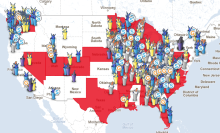
We have updated and expanded our interactive Community Owned Network Map [Non-interactive screen shot above]. The map continues to track the FTTH, cable networks, and partial fiber networks owned by local governments in the U.S. Now it also tracks dark fiber networks, publicly owned stimulus funded networks, and which networks are already advertising and/or delivering gigabit services. We are presently tracking networks in 342 communities, including:

  • 89 communities with a publicly owned FTTH network reaching most or all of the community.
  •  74 communities with a publicly owned cable network reaching most or all of the community.
  • 179 communities with some publicly owned fiber service available to parts of the community.
  • 35 communities in 10 states with a publicly owned network offering at least 1 Gigabit services.

Visit the map here.

Community Broadband Bits 8 - Jim Moorehead of Mendocino County, California

The eighth podcast in our Community Broadband Bits series is a discussion with Jim Moorehead, the Chair of the Executive Committee of the Broadband Alliance of Mendocino County in California. Mendocino is a large, rural county in the northern part of the state that has been left behind by major incumbent providers including AT&T, Comcast, and Verizon. We talk about what steps they have taken to solve their problems and discuss the frustrating state of broadband mapping -- state and federal officials readily accept the dramatic exaggeration of incumbent footprints where broadband is available. We want your feedback and suggestions for the show - please e-mail us or leave a comment below. Also, feel free to suggest other guests, topics, or questions you want us to address. This show is 26 minutes long and can be played below on this page or subscribe via iTunes or via the tool of your choice using this feed. Search for us in iTunes and leave a positive comment! Listen to previous episodes here. You can download this Mp3 file directly from here. Read the transcript of this episode here. Find more episodes in our podcast index. Thanks to Fit and the Conniptions for the music, licensed using Creative Commons.

Broadband Mapping Done Better - North Carolina

E-NC has released the map they built with the stimulus mapping grant. Unlike Connected Nation (the nonprofit creating similar maps for many other states), E-NC does not have a board dominated by incumbent providers and therefore is independent of the biases that lead many to question the results Connected Nation's efforts. The layer transparency sliders make it much easier to figure out how many services are available in the same geographic areas. Unfortunately, they do not display pricing data or actual experienced speeds. We continue to question just how useful a map is that does not show pricing data. Price is a key hurdle that prevents people from subscribing -- particularly in low income rural areas. Nonetheless, E-NC continues to be an excellent organization that helps communities get better broadband.