
legislation

Content tagged with "legislation"

Related Topics
Displaying 11 - 20 of 408

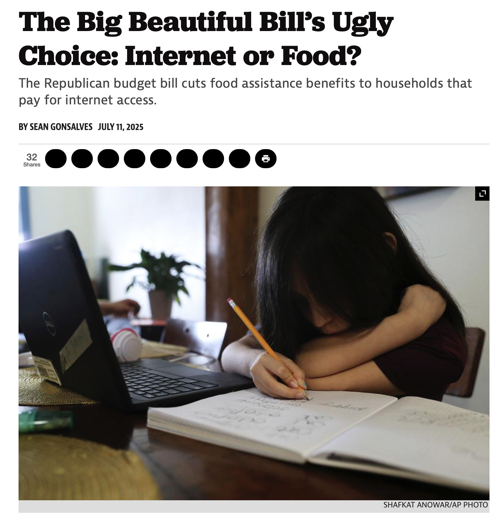
The Big Beautiful Bill’s Ugly Choice: Internet or Food?

Today, The American Prospect published some of our original reporting on the One Big Beautiful Bill Act that was signed into law on Independence Day. In it, our Associate Director for Communications Sean Gonsalves writes:

"Sold to voters as a way to cut 'waste, fraud, and abuse,' a more honest assessment of the One Big Beautiful Bill Act (OBBBA) is that it’s just a Big Brazen Bid to shred the social safety net.

Naturally, the looming cuts to Medicaid and what they will mean for rural hospitals in particular has received the most press.

But there are numerous other ways those in need of government assistance will be further pressed into poverty, including through a particularly narrow-minded Sophie’s Choice: internet access or food?

Image
Screenshot of article in the American Prospect

Last year, GOP leaders blocked bipartisan efforts to fund an extension of the Affordable Connectivity Program (ACP), which offered 23 million eligible households a $30-per-month voucher to help pay for internet service. As if letting the ACP die wasn’t a big enough blow, OBBBA not only increases the paperwork burden required to qualify for Supplemental Nutrition Assistance Program (SNAP) benefits, it completely removes internet service costs as an eligible deduction.

California’s Affordable Broadband Bill At Risk Of Being Destroyed By Lobbying

California lawmakers’ efforts to pass a new law mandating affordable broadband access is at risk of being destroyed by industry lobbying. California insiders say the changes are so dramatic they may wind up making broadband affordability in the state worse – undermining years of digital equity activism and discarding a rare opportunity to bridge the digital divide.

The California Affordable Home Internet Act (AB 353), introduced by Assemblymember Tasha Boerner last January, would require that broadband providers in the state provide broadband at no more than $15 per month for low-income households participating in a qualified public assistance program.

The original legislation mandated that state residents should be able to receive $15 for all ISPs for broadband at speeds of 100 megabit per second (Mbps) downstream, 20 Mbps upstream. The proposal mirrored similar efforts by New York State which opened the door to other state efforts after the Supreme Court recently refused to hear a telecom industry challenge.

Image
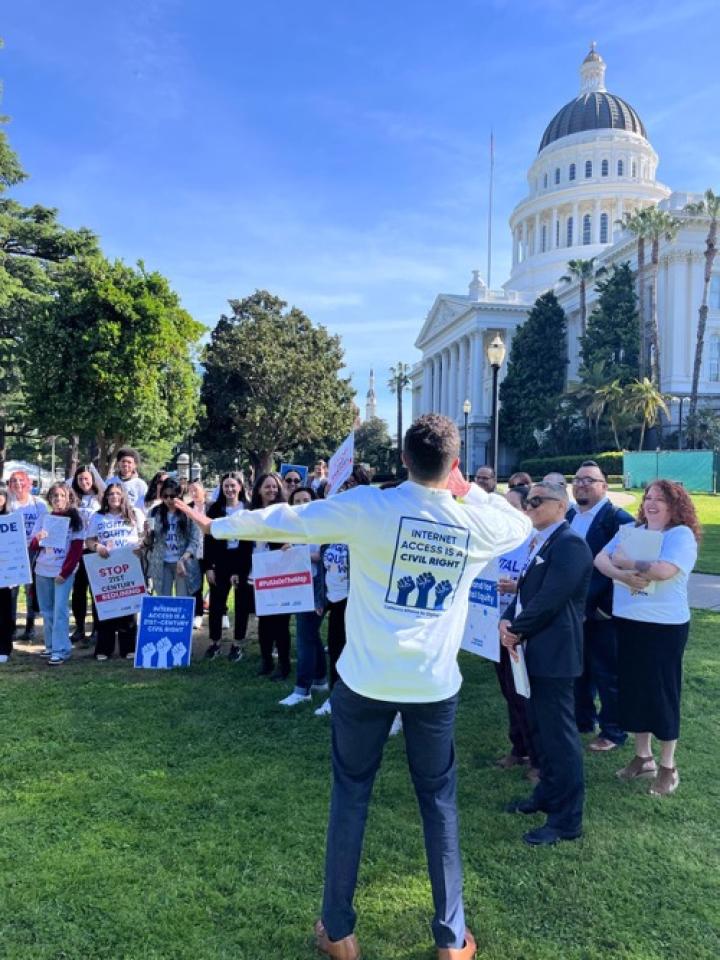
Several dozen digital equity advocates hold a rally on the lawn of the California statehouse

“I want to get something fair and reasonable that helps those who need it most,” Boerner said in a press release. “AB 353 will fill the gap and ensure our children can turn in their homework, families can get access to telehealth, and apply for jobs online.”

On June 4 a vote moved the legislation through the state Assembly and on to the state senate by a 52-17 margin.

Massachusetts Lawmakers Hold Hearing Today on Affordable Broadband Bill

Legislation that would require ISPs operating in Massachusetts to offer qualifying low-income households high-speed Internet service for $15 per month is set to have its first legislative hearing.

The hearing is slated to run from 11 am to 1 pm ET today before the Massachusetts Legislature’s Joint Committee on Telecommunications, Utilities, and Energy. Committee members will hear testimony on multiple bills, including two companion pieces of legislation known as An Act Preserving Broadband Service for Low-income Consumers – S.2318 (filed by State Sen. Pavel Payano) and H.3527 (filed by State Rep. Rita Mendes).

The proceedings can be viewed here.

Inspired by New York Law

The hearing in Massachusetts comes as similar legislation is being considered by state lawmakers in Vermont and California – all three of which are modeled on New York’s Affordable Broadband Act which, after numerous legal challenges, went into effect in the Empire State in January of this year after the US Supreme Court declined to intervene and overturn a U.S. Appellate Court ruling that upheld the law.

Like the New York law, the bill being proposed in Massachusetts requires ISPs operating in Massachusetts to offer qualifying low-income households high-speed Internet service for $15 per month.

However, the Massachusetts bill set the minimum speed at 100 Megabits per second (Mbps) download to mirror the increased FCC definition for minimum broadband speeds that had been raised from the previous benchmark of 25/3 Mbps, which was the federal standard when the New York law was written.

Massachusetts Low-Income Broadband Bill Gets Pushback

*In partnership with Broadband Breakfast, we occasionally republish each other's content. The following story by Broadband Breakfast Reporter Blake Ledbetter was originally published here.

A New England ISP trade group is pushing back against a Massachusetts bill that seeks to cap broadband rates for low-income households.

The Massachusetts bill mandates that all state-based ISPs create and promote an affordable broadband plan or risk a civil penalty of up to $1,000 per violation.

The requirement would apply to wireline, fixed wireless, and satellite providers, both private and public. If passed, the bill would require ISPs to offer a 100 Mbps download speed plan for $15 a month “inclusive of any recurring taxes and fees.”

“NECTA is concerned on any state effort to establish rate regulation over broadband products and service,” said Anna Lucey, spokeswoman for the New England Connectivity and Telecommunications Association, a group which includes Comcast and Charter.

She said NECTA members already offer low-income broadband programs that include significantly reduced rates for qualifying households in the state.

“The rate regulation proposed in this bill is not only unnecessary but would be counterproductive—introducing significant inefficiencies, imposing substantial additional compliance costs and uncertainty for ISPs, and ultimately distracting from the shared goal of connecting as many Massachusetts residents as possible to robust and affordable broadband services,” she added.

The bill, sponsored by Sen. Pavel Payano (D) and Rep. Rita Mendes (D), could also run into trouble with the Federal Communications Commission if Chairman Brendan Carr intends to restrict states that interfere with the agency’s light-touch approach to broadband regulation.

The bill was offered as a response to the end of the federal Affordable Connectivity Program (ACP) in May 2024, which served 368,000 families in the state.

*The Massachusetts law mirrors a similar bill now in effect in New York.

Consider Affordable Broadband State-By-State - Episode 635 of the Community Broadband Bits Podcast

In this special episode of the podcast, we revisit our live forum called "Consider Affordable Broadband State by State". Chris is joined by Sean Gonsalves and Shayna Englin to explore how states like New York, Massachusetts, and California are tackling broadband affordability with the Affordable Connectivity Program's expiration. 

They break down the legal and economic landscape of New York’s Affordable Broadband Act, discuss the political challenges of regulating Internet prices, and examine how state-led initiatives can push action around the country. Tune in for a deep dive into the policies shaping digital equity.

The previous live-stream is archived and can be viewed here.

This show is 35 minutes long and can be played on this page or via Apple Podcasts or the tool of your choice using this feed.

Transcript below.

We want your feedback and suggestions for the show-please e-mail us or leave a comment below.

Listen to other episodes or view all episodes in our index. See other podcasts from the Institute for Local Self-Reliance.

Thanks to Arne Huseby for the music. The song is Warm Duck Shuffle and is licensed under a Creative Commons Attribution (3.0) license

California Lawmaker Files Affordable Broadband Legislation Similar to New York Law

With New York’s Affordable Broadband Act (ABA) now in effect, lawmakers in other states are filing similar legislation that requires large Internet Service Providers to offer low-cost plans for financially-strapped households in their respective states.

In Massachusetts, State Sen. Pavel Payano filed a bill earlier this month similar to New York’s law that seeks to establish a $15/month plan for low-income households in the Bay State.

Image

Then, earlier this week, California Assemblymember Tasha Boerner introduced Assembly Bill 353 that would mandate ISPs “make affordable home Internet plans available to California residents,” Boerner’s office said in a press release.

“Right now, families are struggling to afford essential services, like the Internet,” Boerner said in a press statement.

Speaking to why passing an affordable broadband law was important, Boerner put it in plain terms, noting that “households in our state don’t have support to pay for a basic home Internet service plan. We are talking about kids not being able to do homework at home, parents having to go to libraries to apply for jobs, and people not having access to do basic things, like telehealth.”

Special Event: ILSR To Host Live Forum on Advancing Affordable Broadband State By State

As states consider filing or supporting legislation similar to New York’s Affordable Broadband Act that requires large broadband providers to offer a low-cost plan for low-income households, ILSR’s Community Broadband Networks Initiative is hosting a special live forum focused on what New York lawmakers did with the law and the ripple effects it has created.

Consider Affordable Broadband State-By-State” will be held live on Monday February 3rd from 3:30 to 4 pm ET on ILSR’s YouTube channel, or below.

Image

The agenda will focus on what New York’s affordable broadband law includes and what other states may want to consider in crafting similar legislation.

The livestream will be free to any interested participants. It can be viewed here.

Bring your questions as the live forum will hold space for Q&A.

Ahead of the live stream, you can read our analysis and our fact sheets on the law here and here.
 

In Our View: States Should Consider Adopting Their Own Affordable Broadband Law in a New York Minute

Now that the lengthy legal beef has been settled and New York’s Affordable Broadband Act (ABA) is set to take effect this month, it marks a potentially pivotal moment in a national effort to address one of the biggest barriers to broadband adoption: 

Affordability.

The first-in-the-nation law requiring large Internet Service Providers (ISPs) operating in New York to offer a $15/month plan for qualifying low-income households stands to benefit the approximately 1.7 million New Yorkers who had been enrolled in the federal Affordable Connectivity Program (ACP) Congress allowed to expire last spring.

With a new administration entering the White House – supported by GOP Congressional leaders who blocked previous ACP renewal efforts – the newly enacted ABA “paints a path that other states will look at,” as New Street Research analyst Blair Levin recently noted.

Image
US Supreme Court building

“In a world where the federal government is subsidizing low-income households for $30 a month, states did not need to take action to address low-income broadband affordability,” Levin added. But now, without the ACP benefit, “states may try to assist low-income households to keep them connected.”

Colorado Passes New Broadband Laws, Takes Aim At Landlord Monopolies

The Colorado legislature has passed several new broadband bills that should aid affordable broadband deployment in the state. According to a state announcement, the new bills do everything from expanding the leeway the state has in spending broadband funding, to providing some tax breaks to providers heavily invested in rural deployment.

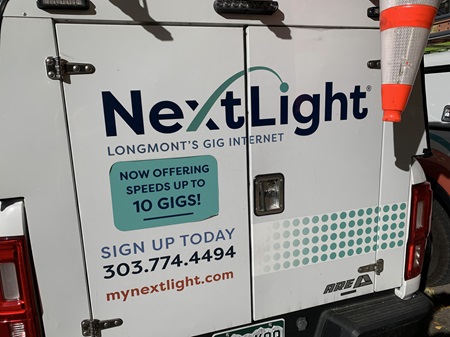
Colorado has been a key player in the municipal broadband space, and is home to several major municipal broadband deployments (from Longmont’s Nextlight to Fort Collins’ Connexion) that have been proven inspirational to municipalities across the country.

Several of the new laws should prove helpful to municipal broadband operations and private sector ISPs alike.

Image
Longmont Nextlight Truck

HB 24-1334, for example, dictates that a multi-dwelling unit (MDU) building owner can’t deny a broadband provider access to the property to install broadband infrastructure. Muni operations in places like Dryden, New York have told ILSR repeatedly that they often face difficulty accessing MDU properties.

New York State Is Trying To Make It Easier For Municipal Broadband To Succeed

In March, Charter Communications tried (and failed) to include a poison bill in New York State’s budget bill that would have hamstrung community broadband. In stark contrast, a New York legislator this month introduced new legislation he says would make it easier than ever for New York state municipal broadband projects to thrive.

State Senator Jeremy Cooney of Rochester has introduced the Broadband Deployment Assistance Act of 2024 (S9134), which would streamline the permitting process for municipal broadband projects by "amending the general municipal law, in relation to requiring substantially similar permits for broadband deployment to be processed together at the same time and on an expedited basis."

“With a quicker timeline and more efficient process for local governments, we can create affordable options for New Yorkers that empower them to take control of their digital destiny,” Cooney wrote in an editorial published at Syracuse.com.

Image
New York State Seal

Cooney says he was motivated by a lack of broadband competition in New York State. New York is dominated by Charter Communications, which was almost kicked out of the state in 2019 for poor service and  misleading regulators about broadband deployment conditions affixed to its 2016 purchase of Time Warner Cable.