
FCC

Content tagged with "FCC"

Displaying 251 - 260 of 650

Building a New Path Toward Tribal Connectivity - Community Broadband Bits Podcast 362
Matt Rantanen, director of technology at the Southern California Tribal Chairmen’s Association and director of the Tribal Digital Village Network, has been working for years to get tribal communities connected to broadband. In his conversation with Christopher, he talks about his experience with creative wireless solutions, the potential of the Educational Broadband Service (EBS) to get folks connected, and shifting attitudes around the importance of broadband.

“We’re trying to help solve that rural connectivity problem. America’s got a lot of talented people that live outside the city centers, and they just don’t have access to the resources that they need — and a lot of those people are on reservations. So it’s really important to get those people connected.”

Matt’s newest venture, Arcadian InfraCom, is creating new, diverse fiber paths thanks to innovative partnerships with tribal communities. Phase 1 of their plan, scheduled to be completed in 2022, will connect Salt Lake City to Phoenix and Phoenix to Denver, with add/drop locations within the Navajo Nation and throughout Utah, Colorado, and Arizona.

We talked to Matt previously on Community Broadband Bits episode 76 and on an episode of our Community Connections series. Check out our other stories on tribal lands connectivity here.

This show is 34 minutes long and can be played on this page or via Apple Podcasts or the tool of your choice using this feed

Transcript below. 

We want your feedback and suggestions for the show-please e-mail us or leave a comment below.

Listen to other episodes here or view all episodes in our index. See other podcasts from the Institute for Local Self-Reliance here.

Thanks to Arne Huseby for the music. The song is Warm Duck Shuffle and is licensed under a Creative Commons Attribution (3.0) license.

Why Your Internet Sucks: Patriot Act with Hasan Minhaj Boos Comcast, Cheers Muni Broadband

In the most recent episode of his weekly Netflix show Patriot Act, comedian and former Daily Show correspondent Hasan Minhaj answers the question we’ve all asked ourselves: “Why does my Internet service provider suck so much?” To figure it out, the show, which features research from the Community Broadband Networks initiative, takes a deep dive into Internet access inequality, lobbying telecom monopolies, inept federal regulators, municipal broadband networks, and more.

Minhaj, citing our Profiles of Monopoly report, points to monopoly broadband providers as one of the main reasons for slow speeds, poor service, and uneven access. He calls out Comcast in particular:

“Now look, all of these companies are terrible, but Comcast deserves a special place in Hell . . . In fact, Comcast has been called “America’s Most Hated Company” . . . The emotions are real. People hate Comcast.”

Later, he notes that the federal government shares responsibility for the sad state of affairs:

“The most frustrating part about the broadband cartel is that the government isn’t just letting this happen; it’s helping it happen. They are protecting broadband monopoly power over the public good, and most of the blame falls on one agency: the Federal Communications Commission, or the FCC.”

In the episode, Minhaj also explains how the FCC’s data collection methods vastly overstate broadband coverage, calling Form 477, which the agency uses to collect deployment data from providers, the “government version of ‘grade your own quiz.’”

As a counterpoint, Minhaj highlights how communities across the country, like Chattanooga, Tennessee, are building their own broadband networks to get around monopoly providers and sluggish regulators:

“Small cities are going DIY, and they’re setting up their own Internet. It’s become known as municipal broadband, and it is phenomenal. It turns out, when cities create their own Internet, then their own broadband customers get faster speeds, lower prices, and better customer service — you know, all the things that violate Comcast company policy.”

Municipal broadband, he says, is creating competition and faster, more affordable Internet access:

Talking Rural Broadband, the Internet, and Media with Dr. Christopher Ali - Broadband Bits Podcast 355

The Austin, Texas, 2019 Broadband Communities Summit was about a month ago, but we’re still enjoying the experience by sharing Christopher’s onsite podcast interviews. This week, he and University of Virginia Assistant Professor Christopher Ali have an insightful conversation about rural broadband, media, and the Internet — and we get to listen in.

Dr. Ali works in the University Department of Media Studies and has recently published a piece in the New York Times titled, “We Need A National Rural Broadband Plan.” In the interview, he and Christopher discuss the op-ed along with Dr. Ali’s suggestions for ways to improve federal involvement in expanding rural connectivity. In addition to structural issues of federal agencies that affect the efficiency of rural expansion, Dr. Ali discusses the advantages he sees from a single-entity approach.

The two also get into a range of other topics, such as the importance of broadband to help deliver a range of media, especially in rural areas where local media outlets are disappearing.

Read Dr. Ali's op-ed here and order his book, Media Localism: The Politics of Place from the University of illinois Press to learn more.

This show is 28 minutes long and can be played on this page or via Apple Podcasts or the tool of your choice using this feed

Transcript below. 

We want your feedback and suggestions for the show-please e-mail us or leave a comment below.

Listen to other episodes here or view all episodes in our index. See other podcasts from the Institute for Local Self-Reliance here.

Thanks to Arne Huseby for the music. The song is Warm Duck Shuffle and is licensed under a Creative Commons Attribution (3.0) license.

Broadcast TV Dispute Hinders Co-op Fiber Project in East Tennessee

Plans for Holston Electric Cooperative to offer television service as part of its Fiber-to-the-Home (FTTH) network deployment are on pause following allegations from the east Tennessee co-op that broadcasting company Nexstar Media Group refused to engage in “good faith” negotiations over retransmission consent agreements.

Holston Electric Cooperative established its broadband subsidiary, HolstonConnect, in late 2017 after a state law change removed restrictions on rural electric co-ops. Currently, HolstonConnect is in phase one of its FTTH project, which will bring high-quality Internet access to underserved communities in Rogersville, Surgoinsville, and nearby areas. Subsequent deployments will connect the remainder of the cooperative’s service territory, partially aided by federal funding from last year’s Connect America Fund phase II reverse auction.

From the start, the co-op planned to offer a “triple play” of broadband, voice, and video services. However, failure to come to an agreement with Nexstar, one of the nation’s largest station operators, over access to essential local channels has delayed the delivery of television services to HolstonConnect subscribers. In early March, Holston filed a complaint against Nexstar with the Federal Communications Commission (FCC), arguing that the broadcasting company demanded exorbitant fees and unfair station tying arrangements during negotiations with the co-op.

“Failure to Negotiate in Good Faith”

To carry popular television programming, networks must sign cable retransmission consent agreements with regional station operators. The FCC requires that these companies behave in “good faith” and make tangible efforts to engage in negotiations.

FCC Considers Retroactive Rule Change for Viasat - Community Broadband Bits Podcast 349

Over the past few years, Partner Jonathan Chambers of Conexon has become our “go-to guy” for FCC conversations. This week, he joins us to talk about a recent issue that revolves around the Connect America Fund Phase II auction and one of the grant recipients, Viasat.

With former experience working at the FCC in the Office of Strategic Planning and Policy Analysis, Jonathan has insight we try to tap into every time a thorny issue arises. Satellite Internet access provider Viasat was one of the top winners of federal funding, winning more than $122 million. Questions remain, however, if they will be able to deliver services that meet the requirements and deliver what they promised. Apparently, Viasat is unsure if their chosen satellite technology will be able to meet the testing thresholds and have asked the FCC to retroactively adjust the requirements to ensure their services pass muster.

The FCC has yet to decline this request, which raises direct and indirect issue with the CAF II program, the FCC’s administration of the program, and Viasat. In this interview, Jonathan and Christopher discuss the issue in more detail and use the matter as a springboard to more thoroughly talk about the role of federal, state, and local government in developing rural broadband. Jonathan and Christopher ponder ways for local residents to have more of a voice in how broadband is funded and deployed in their communities and how ways to improve the process.

For a list of the CAF II winning bidders, check out the August 2018 FCC press release. You can also learn if your area is in a region where Viasat has won a bid by checking out the CAF II Auction Results map.

To learn more about voice service and the CAF II requirements, check out Community Broadband Bits episode 321, in which Jonathan described in detail testing and minimum standards.

You can also review Viasat’s original Petition and Reply in Support of their Petition in which they ask the FCC to reconsider the third-party mean opinion score (MOS); the issue is a matter of public record. We also encourage you to spend some time reviewing other filings from Viasat and also from Hughes relating to CAF II decisions.

This show is 39 minutes long and can be played on this page or via Apple Podcasts or the tool of your choice using this feed

Transcript below. 

We want your feedback and suggestions for the show-please e-mail us or leave a comment below.

Listen to other episodes here or view all episodes in our index. See other podcasts from the Institute for Local Self-Reliance here.

Thanks to Arne Huseby for the music. The song is Warm Duck Shuffle and is licensed under a Creative Commons Attribution (3.0) license.
Applying for ReConnect Funds? Check Out This New Mapping Tool

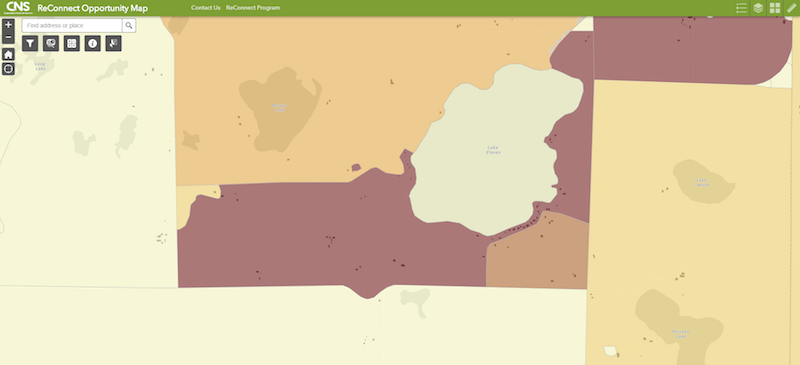
The federal government shutdown continues to drag on, but people heading up rural broadband projects are not waiting until it’s over to investigate federal funding sources. Tools like the ReConnect Opportunity Map from Cooperative Network Services (CNS) will help reduce some of the uncertainty and time required to prepare an application for this and other funding opportunities.

The GIS tool focuses on the ReConnect grant program’s criteria, which will allow users to quickly identify census blocks across the U.S. that are eligible for funding. CNS has also added special color-coding to display density of households and included information about those census blocks to help complete the applications. Examining density of households per road mile allows planners to more quickly prepare an application and establish a cost estimate. The map digs down even further to give information on housing units, which will help with refining deployment costs.

The tool also allows users to define deployment areas on the map and run reports that include census block identifiers, households, and populations per mile. Even if the specific identified area doesn’t qualify for ReConnect funding, the information can be used for other purposes, such as for a potential project that might qualify for other funding or might be of interest to an Internet access provider looking to expand in the area.

Check out this sample screenshot and the explanation below:

CNStool-screengrab_0.png

View a larger version of the screenshot.

This image of an area in Minnesota indicates census blocks that do not currently have broadband speeds over 10 Megabits per second (Mbps) download and 1 Mbps upload. The blocks are color-coded based on the number of housing structures per road mile (darker = more housing units per road mile). Small dark spots are structures. The number of households per road mile shading allows users to quickly identify areas that may make the most sense to target since road miles generally equate to fiber construction corridor miles.

More Than ReConnect

Predictions for 2019, Year in Review for 2018 - Community Broadband Bits Podcast 337

We left our crystal ball, tarot cards, and astrology charts at home, but that won’t stop us from trying to predict what will happen in 2019 for this week’s annual predictions podcast. Each year, we reflect on the important events related to publicly owned broadband networks and local connectivity that occurred during the year and share our impressions for what we expect to see in the next twelve months. As usual, the discussion is spirited and revealing.

This year we saw the departures of Research Associate Hannah Trostle and Communications Manager Nick Stumo-Langer as both decided to head off to grad school. This year, you’ll hear our new Communications Specialist Jess Del Fiacco and Research Associate Katie Kienbaum keeping those seats warm. Hannah and Nick take time out of their schedules to offer some predictions of their own at the end of the show.

In addition to recaps of last year's predictions for state legislation, cooperative efforts, and preemption, we get into our expectations for what we expect to see from large, national incumbent ISPs, local private and member owned providers, and governments. We discuss federal funding, local organizing efforts and issues that drive them, concentration of power, our predictions for digital equity, efforts in big cities, open access, rural initiatives, and more. This podcast is packed with good stuff!

This show is 45 minutes long and can be played on this page or via Apple Podcasts or the tool of your choice using this feed

Transcript below. 

We want your feedback and suggestions for the show-please e-mail us or leave a comment below.

Listen to other episodes here or view all episodes in our index. See other podcasts from the Institute for Local Self-Reliance here.

Thanks to Arne Huseby for the music. The song is Warm Duck Shuffle and is licensed under a Creative Commons Attribution (3.0) license.

A Holiday Favorite: The Grinch Who Stole Network Neutrality

As our readers begin their holiday celebrations, some may remember our spin on the classic Christmas tale, "How The Grinch Stole Christmas" by Dr. Seuss. Although several states have passed or are considering legislation to combat Grinchy-Pai and the other FCC Commissioners who erroneously repealed federal network neutrality protections in 2017, their decision has still left millions unprotected.

We decided to share the poem again this year in the hopes that, perhaps, it will be the last time! Enjoy!


The Grinch Who Stole Network Neutrality

A holiday poem in the style of "How The Grinch Stole Christmas" by Dr. Seuss.


Every American online liked network neutrality a lot

But the FCC’s Grinchy Pai, former lawyer for Verizon, did not!


Pai hated net neutrality! He despised it, he dreaded it!

And on December 14th, he and his cronies, they shredded it.


It could be, perhaps, that he wanted more dough.

ISPs could make more with lanes fast and lanes slow.


But whatever the reason, cash or prestige,

His choice pissed off subscribers by many degrees.


Americans cried out in anger and dismay!

“We like net neutrality! Don’t take it away!”


“It’s good for free speech and new businesses too! Selling, reporting, and artistic debut!

We need it for school kids who have tests to take.

We need it for far away doctors with prognoses to make.

We need it so businesses can hit the ground running.

We need it for working from home, for homework, for funning.

We need it to save money. To get good Internet service.

We don’t want ISPs to decide what to serve us.”


candy-cane-for-christmas.jpg

“You have market protection,” he said with a snort.

But ILSR elves proved there was nothing of the sort.


O'Rielly Gets Defensive When Experts Call Him Out

When he spoke at the “Free Speech America” Gala in October, did FCC Commissioner Mike O’Rielly think he would still be explaining himself almost two months later? After trying and failing to justify his false claim that munis violate the First Amendment, he’s once again on the defensive. He's getting no help from the big national ISPs he's trying to support.

“Flirting With A Perverse Form of Socialism"

In October, O’Rielly’s accused municipal networks, including Chattanooga’s EPB Fiber Optics, of violating the First Amendment by limiting subscribers free speech. Journalists and organizations who know better were quick to correct him. In a December 13, 2018, blog post, he lashed out at his critics and tried to defend or explain his earlier comments, but once again missed the mark.

In his newest commentary, O’Rielly dramatically describes local decisions to invest in broadband infrastructure as “flirting with a perverse form of socialism.” He goes on to state that publicly owned networks deter private entities from entering the market. He’s correct if we only consider the large, corporate ISPs that refuse to compete with anyone on order to preserve the characteristics monopolies created through concentration of power: shoddy customer service, unchecked rates, and lackluster Internet access.

If we look at private ISPs more interested in serving the local community than in boosting share prices, however, we see some healthy competition. As in the case of Grant County, Washington, where more than a dozen ISPs offer services via the Grant County PUD open access network, if a private provider doesn't perform to subscriber standards, there are others to try.

Des Moines Register Runs Op Ed on Satellite, FCC Stats, and Risks to Iowans

When considering Iowa, what comes to mind? Open fields? Livestock? High-quality Internet access? According to the FCC, if you live in Iowa, your broadband problems are over. Of course, as ILSR Research Associate Katie Kienbaum points out in her recent piece in the Des Moines Register, the reality in the Hawkeye State is quite different than the FCC’s flawed stats report. The reason is the FCC’s infatuation with satellite Internet access — a view that has some real consequences for Iowa and its people. Read the piece in its entirety here or at the Des Moines Register:


FCC says satellite connectivity is good enough for rural Iowans. It’s not.

Everyone in Iowa has access to broadband, according to the federal government. In fact, two-thirds of Iowans can supposedly subscribe to at least three different broadband providers.

Surprised?

You should be. The hundreds of thousands of rural Iowans who struggle to get good connectivity are.

The sizable disconnect between federal statistics and reality is a result of the Federal Communications Commission (FCC) classifying satellite Internet access as high-speed broadband. Since every census block in Iowa has access to satellite connectivity, everyone is officially considered served.

However, by accepting satellite Internet access as “good enough,” the federal government is dooming rural Iowans to second-rate connectivity, effectively shutting them out of the modern economy.

Anyone stuck with Internet access from a satellite provider will tell you that it’s not true broadband. Speeds are much slower than cable or fiber, and high latency, or signal transmission time, makes it practically impossible to use for video or phone calls. On rainy days, you might not get service at all. This poor quality isn’t even reflected in the price. Satellite providers often charge more than other types of Internet access providers, while forcing subscribers to decipher complicated data plans and sign on to long contracts.