
affordability

Content tagged with "affordability"

Related Topics
Displaying 51 - 60 of 282

The USF Survives Supreme Court, But Massive Challenges Remain

The FCC’s Universal Service Fund (USF) has survived a Supreme Court challenge by a right wing activist nonprofit, but the program – which for decades has helped extend broadband to underserved rural homes and schools – still faces a precarious immediate future.

It is a peculiar political story, given that the rural regions that overwhelmingly vote for Republicans are now seeing Republicans try to dismantle a program that has been crucial for rural investment and development.

The FCC established the fund in 1997 in compliance with the Telecommunications Act of 1996. Historically a program with broad, bipartisan support, the USF leverages around $8 billion annually to expand broadband access to rural communities, libraries, and schools. The program is primarily paid for by consumers via a small levy on traditional phone lines.

In 2023, a right wing activist nonprofit named “Consumer’s Research” sued the government over the USF, claiming that the FCC lacked the constitutional authority to levy a fee on consumers’ bills. The lawsuit claimed that the USF depended on what amounted to an “unconstitutional tax” on consumers to fund operations.

California’s Affordable Broadband Bill At Risk Of Being Destroyed By Lobbying

California lawmakers’ efforts to pass a new law mandating affordable broadband access is at risk of being destroyed by industry lobbying. California insiders say the changes are so dramatic they may wind up making broadband affordability in the state worse – undermining years of digital equity activism and discarding a rare opportunity to bridge the digital divide.

The California Affordable Home Internet Act (AB 353), introduced by Assemblymember Tasha Boerner last January, would require that broadband providers in the state provide broadband at no more than $15 per month for low-income households participating in a qualified public assistance program.

The original legislation mandated that state residents should be able to receive $15 for all ISPs for broadband at speeds of 100 megabit per second (Mbps) downstream, 20 Mbps upstream. The proposal mirrored similar efforts by New York State which opened the door to other state efforts after the Supreme Court recently refused to hear a telecom industry challenge.

Image
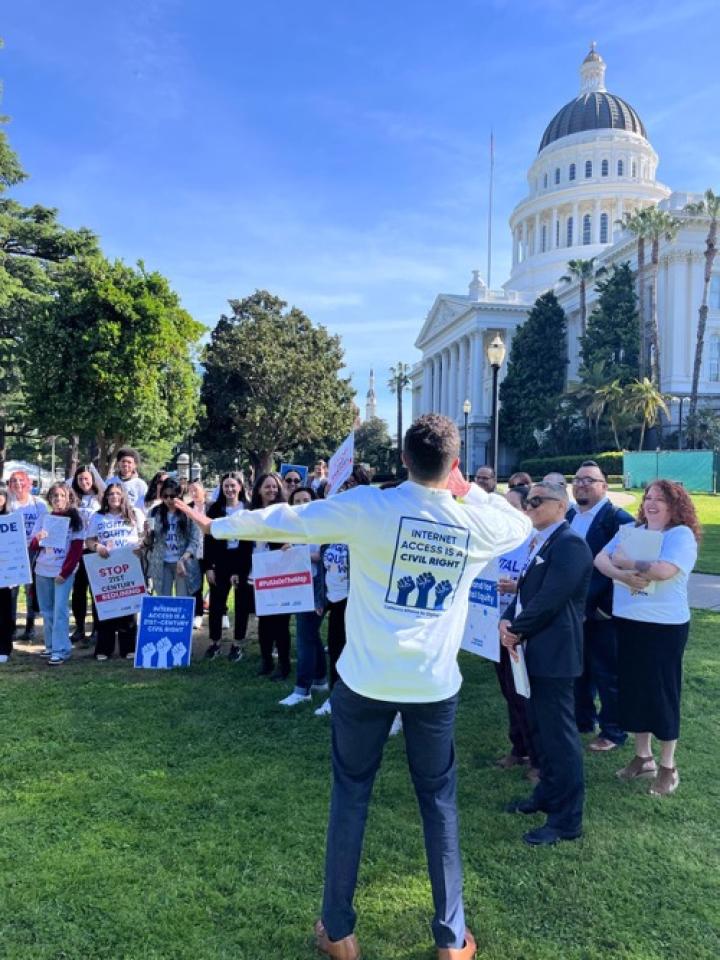
Several dozen digital equity advocates hold a rally on the lawn of the California statehouse

“I want to get something fair and reasonable that helps those who need it most,” Boerner said in a press release. “AB 353 will fill the gap and ensure our children can turn in their homework, families can get access to telehealth, and apply for jobs online.”

On June 4 a vote moved the legislation through the state Assembly and on to the state senate by a 52-17 margin.

Baltimore Issues RFP For Plan To Expand Affordable Broadband

Baltimore city leaders have issued a request for proposals (RFP) for a partner willing to help the city’s ongoing efforts to expand affordable broadband access to marginalized city residents.

According to the RFP, the city’s latest efforts would help bring affordable, high-speed Internet to over 4,100 new housing units spread across eight different public housing communities.

“The RFP is part of Baltimore's Broadband Access Initiative, a citywide effort aligned with our broader Digital Inclusion Strategy to close the digital divide – starting with communities that have been historically underserved,” Baltimore Communications Manager Rafael McFadden says of the effort.

Data indicates that Baltimore, population 565,000, sees some of the highest rates of digital disconnectivity in the nation. Over 96,000 Baltimore households lack wireline Internet service, and 75,000 city residents lack access to a desktop or laptop computer.

Image
Coversheet of Baltimore Digital Equity plan cover sheet.png

Baltimore has used American Rescue Plan Act (ARPA) funds to create a $5 million Digital Equity Fund grant program, which is driving partnerships with local nonprofits to expand access and improve local digital literacy. The city’s digital equity report, released last March, details the progress the city has made in bridging the digital divide over the last two years.

In addition to numerous other initiatives, the city says it continues to expand its public Wi-Fi network, FreeBmoreWiFi.

Clallam County, WA Launches $22 Million Fiber Expansion Plan

Clallam County, Washington and Astound Broadband have begun construction on a major new joint partnership that will bring affordable fiber access to more than 1,500 homes across the largely rural Northwestern part of The Evergreen State.

In a joint announcement, Astound states that it will be deploying more than 100 miles of fiber across long-neglected Clallam County, starting with a 15-mile deployment along the State Route 112 Highway corridor, beginning just west of Port Angeles.

The deployment is a joint collaboration between The Public Utility District (PUD) No. 1 of Clallam County, Astound Broadband, and the Northwest Open Access Network (NOANet), a nonprofit coalition developed by regional Washington Communications Utility Districts (CUD) to bring more reliable, affordable fiber access to neglected rural Washington communities.

Image
Clallam County WA map

Clallam county uses the NOANet fiber optic system for real-time metering, energy management, load control, and networking among remote utility facilities, though they’re keen to leverage the open access network to help provide last mile residential service.

The new $22 million fiber investment is being funded by a combination of a $16 million grant from the the Washington State Broadband Office made possible by the American Rescue Project Act (ARPA), $4.5 million from the Washington State Department of Commerce Public Works Board Broadband Program, and $1.7 million in funding from Clallam County.

The expansion will provide last mile fiber access to at least 1,500 new local residents, but will also prioritize bringing fiber to fire houses, schools, libraries, medical clinics, and other key anchor institutions in the county of 78,000.

Oakland Unveils Ambitious Plan to Build City-Owned Open Access Network

Just 40 miles north of the heart of Silicon Valley, the City of Oakland has its sights set on implementing an ambitious Broadband Master Plan.

Dubbed the OaklandConnect project – unanimously approved on May 20 by the Oakland City Council – the plan calls for the construction of a city-owned open access fiber network to expand affordable broadband connectivity to over 33,000 households that city surveys indicate are languishing without home Internet service.

While Oakland is served by Comcast and AT&T mostly (with a smattering of Sonic and T-Mobile hotspots), the service in many areas is substandard, expensive, or both – in a city where surveys indicate affordability as the primary reason so many do not have home Internet service.

Image
Oakland fiber map

Once the East Bay city of 436,000 completes network construction, it would be one of the largest publicly-owned open access networks serving a major metro area in the nation – and may serve as inspiration for other large cities to follow suit with a model that’s been proven to bring affordable local Internet choice in monopoly-dominated markets.  

“Cruel” E-Rate Rollback Harms Broadband Expansion Plans

Congressional Republicans are moving forward on a plan to kill a popular Federal Communications Commission (FCC) program providing free Wi-Fi to schoolchildren. Critics of the repeal say it’s a “cruel” effort that will undermine initiatives to bridge the affordability and access gap for families long stuck on the wrong side of the digital divide.

The effort, spearheaded by Texas Republican Senator Ted Cruz, leverages the Congressional Review Act to roll back FCC changes to E-Rate, a government program that helps subsidize deployment of broadband access to rural communities, libraries, and schools.

Accelerated by the remote education boom of pandemic lockdowns, communities country wide had petitioned the FCC to expand the program. The goal: allowing rural schools to leverage E-Rate funding to provide free mobile Wi-Fi hotspots to families that either couldn’t afford broadband – or found broadband entirely out of reach.

Image
Man tests WiFi on school buses

So in July 2024 the FCC voted to expand the program. Historically, E-Rate could only be used to improve access on school or library grounds. The expansion allowed schools to provide limited access to free Wi-Fi hotspots via school buses or other alternatives. The expansion did not involve an increase in the E-Rate budget or any new taxes on U.S. residents. It recognized that the concept of “school” had eclipsed the 20th century definition of a room in a community building.

“I believe every library and every school library in this country should be able to loan out Wi-Fi hotspots to help keep their patrons and kids connected,” former FCC boss Jessica Rosenwocel said when the reforms were announced. “It is 2024 in the United States. This should be our baseline. We can use the E-Rate program to make it happen.”

Longmont NextLight’s Affordability Program Picks Up Federal Slack For Low Income Locals

Since it first broke ground in 2014, Longmont, Colorado’s city-owned NextLight fiber network has won numerous awards and inspired countless communities nationwide. But the network, which recently expanded access to more than 28,000 area residents, is also trailblazing in another area: ensuring that fiber is affordable to low income, marginalized populations.

NextLight unveiled its locally-funded Internet Assistance Program (IAP) last year. The program provides low-income residents with a $25 discount off of NextLight’s already affordable fiber pricing. As a result, locals can receive symmetrical 100 megabit per second (Mbps) service for as little as $14.95 a month, and symmetrical 1 gigabit per second (Gbps) fiber for $45.

To apply, households must qualify for any of a number of existing federal programs, including the FCC’s Lifeline, Head Start, Medicaid-MSP or SLMP, Veterans or survivor’s pension, Section 8, WIC, food stamps, Federal Pell Grants, Supplemental Security Income (SSI), SVVSD Education Benefit, Temporary Assistance for Needy Families (TANF), or Food Distribution Program on Indian Reservations (FDPIR).

IAP was created to offset the collapse of the Federal Communications Commission's (FCC) Affordable Connectivity Program (ACP), which provided a $30 per month discount off of the broadband bills of low-income Americans. The program was summarily discontinued after Republicans in Congress refused to fund a program extension.

According to Longmont officials, not only is their IAP program available to a much broader qualification base, with more than 1000 subscribers now enrolled, the program is currently helping 14 percent more city subscribers than the FCC’s ACP did at its peak.

Crews Begin Work On Ft. Bragg, California’s Long-Awaited Muni-Fiber Network

Construction crews have begun work on Fort Bragg’s long-awaited municipal fiber network, which will ultimately bring affordable fiber to the California city of 7,000.

The total cost of the project is estimated to be $17 million. Of that, $10 million will be paid for by a Last Mile Federal Funding Account (FFA) grant from the California Public Utilities Commission (CPUC), awarded in February to help fund the construction of a Middle Mile Broadband Network (MMBN) that will run directly through the heart of Ft. Bragg.

The remaining project costs will be paid for by a $7 million, 20-year loan at 4.85 percent from EverBank, recently approved by the Fort Bragg city council.

“This project is a cornerstone for the future of Fort Bragg,” City Manager Isaac Whippy said of the milestone. “Reliable, high-speed internet is no longer a luxury – it’s a necessity. With this investment, we’re closing the digital divide and making Fort Bragg a more connected, competitive, and inclusive community.”

According to a city announcement, Ft. Bragg’s citywide fiber network, 170 miles north of San Francisco, is being designed with a centralized data hub and 15 Distribution Areas (DAs). Using horizontal directional drilling, crews will install conduit and fiber underground – primarily beneath sidewalks and alleys – connecting to a fiber terminal located near the edge of the city’s right-of-way at each property.

Grays Harbor PUD Gets To Work On Western WA Fiber Expansion

Grays Harbor PUD, a wholesale telecom utility in Washington state, says it’s getting to work leveraging a $7 million grant from the Washington State Broadband Office to expand affordable fiber access in the South Elma, Porter, and Cedarville areas of the Evergreen State.

Grays Harbor PUD was one of 16 Washington utilities chosen by the Washington State Broadband Office to receive grant funding during awards first announced back in 2023.

The $6.9 million grant is helping the PUD run fiber along State Route 12, using existing utility poles to expand the service possibilities for customers in South Elma, Porter, Cedarville, and surrounding areas. Once complete, the PUD is expected to lease fiber access to roughly a dozen Internet service providers, serving more than 500 new locations.

Image
Greys Harbor PUD HQ building

The construction is being built in partnership with Paramount Communications, and officials are warning locals to expect some construction delays as crews get to work across the impacted parts of Grays Harbor County on the western side of Washington state.

“The Grays Harbor PUD appreciates your patience and understanding as we complete this project,” Grays Harbor PUD Telecom Business Coordinator Sara Travers says in an announcement. “Our teams are committed to working safely and efficiently to bring improved broadband services to your area.”