
Indiana Cooperatives are once again at the front of the pack as the state prepares to dramatically expand affordable fiber access on the back of $483 million in Broadband, Equity, Access, and Deployment (BEAD) broadband grants.
The first round of bead funding is expected to connect an estimated 123,000 Indiana households and businesses that currently have either substandard Internet access, or no access at all. All told, the state’s BEAD deployment plan is slated to expand affordable fiber access to 91 of Indiana's 92 counties.
Last June, the Decatur County Rural Electric Membership Corporation (DCREMC) was the first of the state’s 24 BEAD grant awardees to sign a contract with the Indiana Broadband Office.
The cooperative’s $7.1 million BEAD award will help extend fiber service to roughly 2,800 additional homes and businesses across the rural and sparsely populated communities across Decatur County, including Greensburg, Napoleon, Millhousen, and St. Paul. Most of the construction is expected to be finished before year’s end.
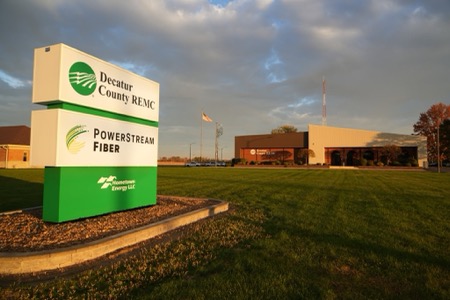
Decatur County REMC expanded into fiber Internet access in January of 2025 under the Power Stream Fiber brand. Power Stream Fiber currently offers three tiers of service: a symmetrical 500 megabit per second (Mbps) offering for $65 a month; a symmetrical 1 gigabit per second (Gbps) tier for $80 a month; and a symmetrical 2 Gbps service option for $110 a month.
Much of the expansion is being built thanks to previous state subsidy programs like Indiana’s Next Level Connections, which awarded Decatur County REMC a $4.6 million grant to expand fiber to 1,400 locations, 565 of which previously had no connection to the Internet. The provider also received $500,000 via American Rescue Plan Act (ARPA) funds.
Decatur County REMC is one of more than 250 of the country’s 900 electrical cooperatives that have expanded into residential and business fiber broadband service offerings. Such cooperatives often leverage generations-old experience at rural electrification to inform efforts to bring fiber to neighborhoods long-neglected by large private telecom monopolies.
Indiana’s $483 million in BEAD funding is nearly half of the state’s original $868 million promised allotment, which was shrunk by unpopular Trump administration changes to BEAD program criteria primarily aimed at narrowing the definition of unserved locations, stripping affordability requirements, and driving millions of dollars in subsidies away from fiber to Elon Musk and Jeff Bezos’ more costly (and more congested) low Earth orbit (LEO) satellite broadband networks.
Many cooperatives have expressed frustration at the changes, noting they’ve created new delays, clawed back funding to cooperatives and municipalities, and in some cases introduced annoying new bureaucracies that make deployment in some areas untenable.
The Indiana residents still in line to receive affordable next-generation fiber via Indiana’s shrunken BEAD allotment tell local Indiana public media they’re very excited to join the world of modern connectivity.
“We're not going to know what to do to have decent internet,” Burns City resident Theresa Abney told the outlet. “Everybody's looking forward to it coming this way.”