
Wi-Fi

Content tagged with "Wi-Fi"

Wi-Fi
Displaying 131 - 140 of 164

OTI Helps Build a Wireless Network in DC Neighborhood

The Open Technology Initiative's Dispatches from the Digital Frontier blog originally published this story by Preston Rhea about his experience working with some neighbors to build their own wireless network in Mount Pleasant in Washington, DC. We hope it inspires others.

If you are not yet familiar with Mount Pleasant, here’s a chance to learn about one of DC’s most vibrant neighborhoods. It’s a diverse area not far from downtown DC, featuring a main street lined with locally-owned businesses. Many of these shops and restaurants are owned and run by the area’s large Latino community, which has long been central to shaping the neighborhood’s character. However, over the past decade rising housing prices have pushed many in the Latino community east towards Georgia Avenue.

In May, I moved to Mount Pleasant and started to learn about the area. In order to encourage community-building and local empowerment and to increase local information-sharing and opportunities for civic engagement, I decided to use skills and ideas garnered from my work at the Open Technology Initiative to organize a community wireless network. Despite my excitement to get started, I didn’t want to rush in without first connecting with the people, the histories, networks, skill sets, and local knowledge already present in the community.

My first step was technical: with the help of my OTI colleagues, I specified the hardware for the network and prepared the technology for installation. The first-stage plan was to install a few “nodes” (wireless access points) in order to establish the form and structure of the mesh network - open, interoperable, unfiltered, and decentralized. Then, at the Mount Pleasant Farmers Market, I handed out fliers directing people to an online survey gauging their interest in organizing a community wireless network in the neighborhood. I also posted a few of the fliers in local businesses on Mount Pleasant Street. But I needed to go deeper in order to really connect with the existing social networks of people and projects.
San Jose Hopes 3rd Time is the Charm for Muni Wi-Fi

In an attempt to regain some of its Silicon Valley shine, San Jose, California is taking another run at municipal Wi-Fi. The city hopes that by covering a 1.5 square mile block of downtown with fast, robust wireless Internet access, it will become more attractive to the technology entrepreneurs who have, in recent years, been more likely to set up shop in other parts of the valley.

San Jose has twice attempted to offer free public Wi-Fi through privately owned and operated networks. In 2004, Global Netoptex deployed hotspots that never really worked. In 2006, MetroFi tried offering advertising-supported wireless, but was unable to generate enough revenue to cover costs. Just two years later, after failed attempts to sell its networks to the cities in which they operated (including Santa Clara, Cupertino, and Portland, Oregon) MetroFi went out of business.

This time, the City is investing its own funds in a network that will both serve the City’s own communications needs and offer free public access. San Jose is paying approximately $100,000 in start-up costs, and is committing to $22,000 in annual operating expenses. The City’s CIO, Vijay Sammeta, says the City is getting “a sweetheart deal” in exchange for its willingness to be a testing ground for software and firmware updates. Applications will include wireless parking meters and digital pay-to-park signs. The City expects cost savings from moving from other wireless connections to the Wi-Fi network will balance out the annual operating expense.

Santa Clara Prepares to Re-Launch Free Wi-Fi Network

Silicon Valley Power, the muni electric utilty owned by Santa Clara is preparing to launch a citywide Wi-Fi network later this year according to the Santa Clara Weekly. The city took over the failed MetroFi attempt at citywide wireless broadband and has apparently expanded it.
That system never reached the entire city and was limited to outdoor use. Santa Clara FreeWiFi will work citywide, indoors as well as outdoors. A new, high-density design will provide up to 40 access points per square mile - compared with less than 30 access points for the MetroFi system.
I share Esme Vos' reaction regarding its likely difficulties in actually functioning inside but the Santa Clara Free Wifi website strongly recommends that anyone who is planning to use it inside use a Wi-Fi- booster, which can be found at most tech stores. Silicon Valley Power, as we previously noted, has an extensive fiber-optic system that is already uses for its power management. That will provide the necessary backhaul to the wireless access points. This will undoubtedly be a nice amenity for those living or traveling in Santa Clara but it is unlikely to suffice for those who need reliable and high capacity connections to the Internet. It will be interesting to see who is ultimately paying for the Internet access charges as well as how the economics work out. The network will be helpful for remote meter readings -- perhaps the savings there will entirely pay for the public's usage of the network. Ponca City has been taking this approach for some time now and it seems to work for them.

Personal Telco Project Video in Portland

A few years ago, I had the opportunity to meet some of the folks from the Personal Telco Project in Portland, Oregon. They have been around for a long time and do excellent work. This is how they describe themselves:
The Personal Telco Project is a 501(c)(3) non-profit organization located in Portland, Oregon dedicated to the idea that people have a central role in how their networks are operated. We do that by building our own networks that we share with our communities, and by helping to educate others in how they can too. To date, we have done this using Wi-Fi technology. We began in 2000 by turning our own houses and apartments into wireless hotspots (or "nodes"), and then set about building networks in public locations such as parks and coffee shops. There are currently about 100 active nodes participating in our project. We would like to see people and businesses in every corner and on every block of the city participating.
They have been involved in the discussion in Portland over how the City can ensure all residents and businesses have access to affordable, reliable, and fast connections to the Internet. I was just reminded of them by a video that discusses their work and some of the reasons communities need to build their own networks (below). They also have a YouTube channel with more videos about community broadband.

DC-Net Provides Access to Community of Hope

A story from Washington, DC, seems appropriate for Thanksgiving. DC's Community of Hope provides healthcare and housing to people in difficult situations. It needs Internet access for its medical work but also for computer labs where people can search for jobs and students can do homework. DC-Net is now providing their access:
“Internet service has been a critical requirement for our programs for some time,” said Victoria Roberts, Community of Hope’s Deputy Director. “Through DC-CAN we are now able to get seven times more bandwidth for the same cost we previously paid, and the fiber network ensures that connection is truly reliable, which has been challenging in the neighborhoods we work in.”
DC-Net is going beyond just providing access to their locations by setting up Wi-Fi access points for the neighborhood to use as well. DC-Net was created as a muni-owned fiber-optic network connecting schools, muni buildings, and libraries but has gone on to connect some federal agencies. The network has proved incredibly reliable -- far beyond what was provided by the incumbent or other national carriers. And now it is finding ways of delivering services to the people who may need them the most but have the least ability to pay.

Community Fiber in Virginia Offers Wi-Fi to Festival Folks

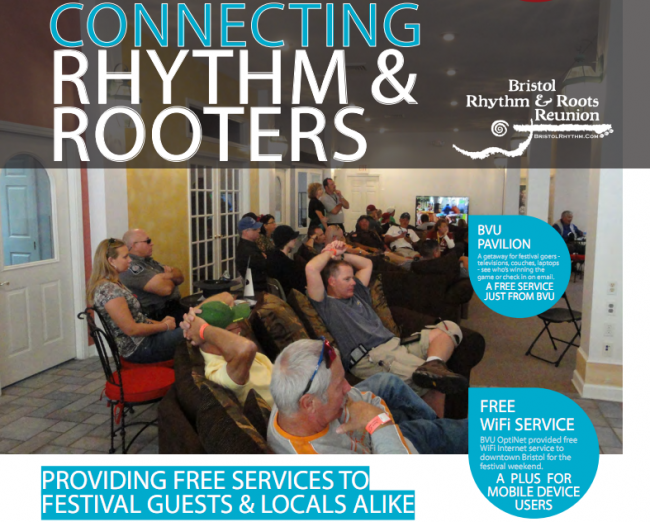
Bristol, Virginia, holds a unique place in the heart of community broadband advocates because it was the first muni broadband network to provide triple-play services over a full fiber-optic network (OptiNet). It is well known among NASCAR aficionados for the Bristol Motor Speedway as well. What I didn't know, prior to my visit to Bristol this week, is that it is also home to a music festival celebrating the community's important contributions to country music. The second page of the Fall Newsletter from Bristol Virginia Utilities [pdf] discusses how BVU's OptiNet has built a Wi-Fi network downtown to offer free connectivity to festival-goers. But it doesn't end there - they also provided laptops and HDTV to those who wanted to hang out. From the newsletter: BVU offers Wi-Fi at Music Festival
At the 2011 Bristol Rhythm & Roots Festival, BVU set up the “BVU Pavilion,” a temporary technology hotspot. The pavilion offered free WiFi Internet, public laptops, as well as high-definition televisions and seating to festival guests throughout the entire weekend. In addition to the BVU Pavilion, housed in downtown Bristol VA, BVU also installed equipment to provide WiFi Internet access throughout the twin city’s downtown areas. The access was a huge plus for users of mobile devices such as smart phones. Users could download festival applications like artist schedules, stage maps and more. “As our second year providing this service, we knew people would be looking for us again. This is simply a gift to our city,” explains Gail Childress of BVU. “We are avid supporters of making our community a great place to live and visit. This complimentary service is just one way that we can say ‘Welcome’ to our visitors and ‘Thank you’ to our full-time residents.” “BVU has been great to work with,” says Leah Ross, Executive Director for Rhythm & Roots. “This allows our fans to check their email, log onto Facebook or Twitter, blog about the festival or just surf the Internet. It’s really a win-win for everyone.” Rhythm & Roots guests who prefer to use their own laptops or devices found available space within the pavilion to sit and log on.

Riverside: Municipal Wi-Fi is Alive in California

Riverside, California, an innovative city of 300,000 in the eastern part of Los Angeles has been a broadband pioneer even though it sits in the shadow of tech centers like nearby Santa Barbara.   Riverside’s accomplishment as a city catching up with the information age was evident when it was selected as one of the top 7 Intelligent Communities Award in 2011 by New York-based Intelligent Community Forum.  

“It’s an honor to be selected as one of the top 7 cities in the world.  It comes down to a couple factors, what communities are doing with broadband, but... includes digital inclusion, innovation, knowledge workforce (of folks within your community) and marketing advocacy... We rank very high in all those categories.” - City CIO Steve Reneker [Gigabit Nation Radio]

The cornerstone the city’s SmartRiverside initiative is a free public wireless network which covers 78% of the city’s 86 square miles.  Established in 2007 by AT&T (which also offers DSL services in Riverside), the maximum speed of the network is 768kbps, which at just under 1Mbps is decent enough to surf the web and check emails.  However the road to providing free Internet access and bridging the digital divide wasn’t so easy for Riverside.  

The City issued a RFP in 2006 for a provider to deploy a citywide Wi-Fi network, with the goal of making the Internet accessible to users who can’t afford higher cost plans.  The City met with respondents and a speed of 512kbps or about half a megabit was initially quoted as an entry-level speed that would complement existing services rather than compete against them.  The contract was awarded to AT&T who hired MetroFi to build the network and charge the city a service cost of about $500,000 a year.  MetroFi went bankrupt after completing only 25 square miles and Nokia Siemens took over but only completed up to the present level of coverage. 

In 2007, the wifi network launched and began bridging the digital divide. Through the City’s digital inclusion efforts, not only were modest-income families able to obtain low cost or free PCs but also have means to use them with an Internet connection.  

Charles County Library Implements Wifi with La Plata

The Southern Maryland Independent reports the Charles County Technology Council brought together local innovators in technology and environmental sustainability on September 10.   The event featured the county's public service innovations in the field as well as showcasing electric vehicles and solar energy technologies.  In addition, the newspaper noted the Charles County Public Library's (CCPL) downtown wireless network, in partnership with the town of La Plata, has been expanded with 15 wireless access points and exceeds 1,000 users per month.  The Library has also upgraded its public workstations to lower wattage computers, reducing both energy usage and heat output.

For over a year, the La Plata downtown wireless zone is available free to the general public.  The wifi project began in 2008 when the CCPL applied for an Innovation Grant from the Bill and Melinda Gates Foundation.  Though La Plata budgeted a matching $50,000, the grant was turned down but the partnership between the Town and Library continued.  In 2010, the Library agreed to assume administrative and technical maintenance while the Town used its budgeted funds to deploy equipment.  CCPL provides T1 backbone to wireless routers purchased from San Francisco-based Meraki.   Private owners agree to lend rooftop space for nodes at no cost.   In September 2010, the system went online and later expanded to include much of Downtown back to the Town Hall.  Last June, the system hit a milestone 1,000 unique users--La Plata's population is about 8,700.   The Town now looks to continue expanding the availability but also to move into utilities and municipal services.  [More information found in their powerpoint.]

Silicon Valley Power Does Dark Fiber and Wireless

Silicon Valley Power, a muni electric in Santa Clara, was smart when fibering-up its electrical plant. They overbuilt their needs and are using the additional capacity to benefit the community. One of the biggest beneficiaries are the schools and taxpayers that support them.
That brought to mind my recent conversation with Larry Owens, manager of customer services at Silicon Valley Power. The Santa Clara, Calif.-based municipal electric utility built fiber between its subsystems to increase the organization’s reliability. But Silicon Valley Power overbuilt that network, which enables it to lease dark fiber to the school district and service providers via its SVP Fiber entity. The electric company also purchased MetroFi, a free Wi-Fi services company that fell on hard times, to connect new smart energy meters to its offices. Those Wi-Fi assets also are being leveraged to deliver free outdoor Wi-Fi access to anyone within Santa Clara.
I remember reading about this network earlier this year in a Public Power Daily release:
The technology and added bandwidth capacity allow teachers to hold virtual field trips and will eventually allow students who are unable to attend school the opportunity to join their classrooms via a home computer, Silicon Valley Power said. Download speeds have made classrooms more efficient, the utility said. "Before the fiber network, the download process was very slow and sometimes wouldn't work at all when my class tried to use streaming video to add to our lessons," said Jennifer Rodriguez, who teaches a fourth- and fifth- grade combo class at Katherine Hughes Elementary School. "Now I can utilize instructional videos off the web and stream them quickly, making the lesson more interesting and the learning more fun for my students."

More Details from the Incredible Santa Monica City Net

Santa Monica's approach to building community owned broadband that puts the community first has been wildly successful. They have not focused on providing residential connections, and likely will not in the future, focusing instead on meeting their municipal needs and businesses to spur economic development. They can deliver up to 10Gbps to businesses that need it and they have connectivity throughout the City for whatever projects they choose to pursue. This includes free Wi-Fi in parks, controlling traffic signaling (prioritizing mass transit, for instance), and smart parking applications. On top of all that, their investments have saved more than a million dollars that would have been wasted on slower, less reliable connections provided by leased lines. In the matter of controlling traffic signals, Santa Monica wants all intersections with fiber-optics.
Arizona Avenue, the Mid-City area and the city's office district will all be getting makeovers if the City Council approves two contracts that will connect 40 signalized intersections to City Hall's centralized traffic control system. The work represents the fourth phase in a five-phase effort to connect all of Santa Monica's intersections using fiber optic cables.