
new york

Content tagged with "new york"

Displaying 1 - 10 of 126

New York Expands Its Historic Investment In Municipal Broadband

New York Governor Kathy Hochul has announced a dramatic expansion of the state’s Municipal Infrastructure Program (MIP), resulting in an additional $36 million cash infusion for the growing number of creative, community-owned and operated fiber expansion projects in the state.

According to a state announcement, the existing MIP program, launched in early 2024, has already funded more than $268 million in assorted open access fiber projects across the state. A state broadband office dashboard tracks all active municipal projects funded to date.

That includes efforts like the growing open access municipal fiber network in Dryden, New York, which has been steadily delivering affordable next-gen fiber to the long-underserved rural communities of Dryden and nearby Caroline (population 3,321).

New York State officials say the $268 million in MIP grant funding has funded active projects across 24 New York counties, resulting in more than 2,300 miles of new fiber optic infrastructure and 68 new wireless hubs serving more than 96,000 homes and businesses. Most of this funding was made possible by the 2021 federal American Rescue Plan Act (ARPA).

The MIP program is part of New York state’s billion dollar ConnectALL Initiative, and was specifically designed to support municipal broadband projects proven to be a viable, and increasingly popular, way to bring affordable, high-quality Internet service to long-neglected U.S. communities.

Meet the Municipal Networks that Launched in 2025

By any measure, 2025 was a tough year in the grand project to extend fast, affordable, reliable broadband access to every home in the United States. The Digital Equity Act was abruptly cancelled, BEAD was restructured, small- and large-scale outages were common, and prices from the monopolies rose yet again.

But good things happened, too. In 2025, we saw seven new municipal broadband networks across the country that were lit up for service. As is usual, it was a mixture of partnerships, business models, and construction approaches to meet the unique challenges of a patchwork broadband landscape.

A Bountiful 2025 for Municipal Broadband

In California, the Gateway Cities Fiber Optic Network launched (eventually covering 23 cities); it will eventually cover 72 community anchor institutions and almost 5,000 unserved locations across member cities with the help of state grants.

Experts: Withholding BEAD Funds Because of State Affordability Laws On Shaky Legal Ground

Legal analysts are questioning the recent assertion by the head of the National Telecommunications and Information Administration (NTIA).

NTIA administrator Arielle Roth said last week that the agency she oversees will withhold federal broadband deployment funds from states that have laws enforcing net neutrality or that have enacted affordable broadband legislation similar to New York’s Affordable Broadband Act.

As the assistant secretary overseeing the $42.5 billion Broadband Equity, Access, and Deployment (BEAD) program, Roth’s legal reasoning is striking.

All the more so given that the New York Affordable Broadband Act that requires Internet service providers in the Empire State to offer a low-cost broadband service plan to income-eligible households has been upheld as Constitutional – a case in which the Supreme Court twice declined to intervene and overturn.

Yet, last week in speaking before the conservative Hudson Institute, Roth offered remarks that have legal observers scratching their heads in bewilderment. During her speech, Roth said:

“Consistent with the law, which explicitly prohibits regulating the rates charged for broadband service, NTIA is making clear that states cannot impose rate regulation on the BEAD program. To protect the BEAD investment, we are clarifying that BEAD providers must be protected throughout their service area in a state, while the provider is still within its BEAD period of performance. Specifically, any state receiving BEAD funds must exempt BEAD providers throughout their state footprint from broadband-specific economic regulations, such as price regulation and net neutrality.”

The stakes are high for broadband affordability advocates across the nation. 

Federal Reserve Study Offers Broadband Affordability Advocates ‘Novel New Measure’

Studies consistently show that the primary reason millions of households do not have home Internet service boils down to affordability.

Research by EducationSuperHighway indicates that of the estimated 28.2 million households in the U.S. that do not have high-speed Internet service, 18 million of those households (home to 48 million Americans) are not online because the cost of service is simply too expensive.

But now, thanks to a recently published study by the Federal Reserve Bank of New York, broadband affordability advocates may be able to more accurately measure the elusive nature of affordable broadband costs.

The study also examines how to better pinpoint contributing factors like the state of local infrastructure and how lower-performing broadband access technologies powerfully influence low-income households' decision to sometimes choose cellular service-only over home Internet service.

Image
A cornerstone is engraved with: Federal Reserve Bank of New York

Broadband Affordability: Assessing the Cost of Broadband for Low-and-Moderate Income Communities in Cities” provides a research-driven lens on how to measure broadband affordability neighborhood by neighborhood, city to city.

“While national and state-level analyses have helped highlight the digital divide,” the study’s author Ambika Nair writes, “measures of broadband affordability at the community level are limited.”

Big Apple Connect, Pole Attachments, and DEA Lawsuits | Episode 122 of the Connect This! Show

Connect This! Show

Edit: We encountered a technical issue with the streaming platform for the show; it resolves around 1:20.

Catch the latest episode of the Connect This! Show, with co-hosts Christopher Mitchell (ILSR) and Travis Carter joined by regular guests Kim McKinley (Tak Broadband) and Doug Dawson (CCG Consulting) and special guest Angela Siefer to talk about all the recent broadband news that's fit to print. On the docket today:

Join us live on October 10th at 2pm ET, or listen afterwards wherever you get your podcasts.

Email us at [email protected] with feedback and ideas for the show.

Subscribe to the show using this feed or find it on the Connect This! page, and watch on LinkedIn, on YouTube Live, on Facebook live, or below.

Affordability Law Whodunnit Gets Less Mysterious, But Murkiness Remains

The mystery of who and what killed the California Affordable Home Internet Act is coming into view.

As a California lawmaker hinted when the bill was abruptly withdrawn in June, the evidence seems to be pointing to the new leadership now directing the National Telecommunications and Information Administration (NTIA) – the agency administering the $42.5 billion federal BEAD program to expand Internet access.

In a recently released FAQ published by the NTIA this week, a corroborating clue has emerged.

And what may be the smoking gun is a bullet buried on page 48, under section 3.29, after the question: "May an Eligible Entity (states) require a specific rate for the low-cost service option (LCSO) when required by state law?”

NTIA's answer:

“No. The IIJA prohibits NTIA or the Assistant Secretary from engaging in rate regulation. Because the Assistant Secretary must approve the LCSO in the Final Proposal, the rate contained may not be the result of rate regulation. The RPN (Restructuring Policy Notice) addressed this fundamental flaw in the BEAD NOFO. The RPN eliminated BEAD NOFO requirements dictating price and other terms for the required low-cost service option.”

“Per the RPN, states may not apply state laws to reimpose LCSO requirements removed by the RPN. More specifically, the RPN ‘prohibits Eligible Entities from explicitly or implicitly setting the LCSO rate a subgrantee must offer’ (BEAD Restructuring Policy Notice, p.7). Violation would result in rejection of the Final (BEAD) Proposal (emphasis added).”

Syracuse, NY Community Broadband Network Steadily Expands

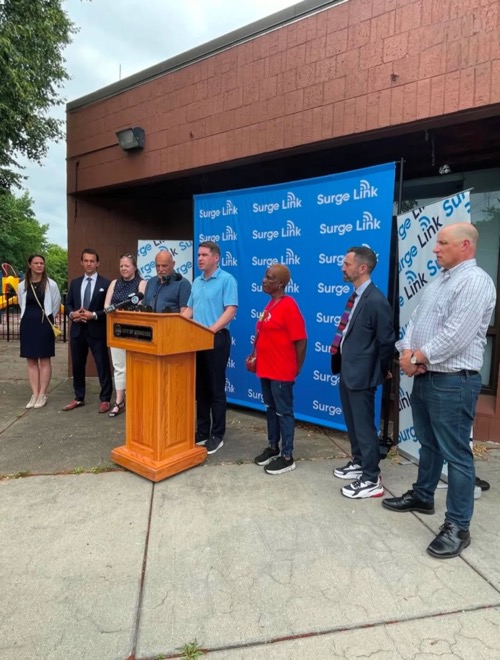
Syracuse, NY officials say the city’s community-owned broadband network Surge Link continues to dramatically expand two years after the network first launched, bringing affordable broadband access to the city of 145,000 – with a particular eye on helping the city’s disadvantaged.

A recent update from the city states that the network now serves more than 9,200 households in Syracuse, located in central upstate New York. The latest expansion brought the service into the city’s Valley, Skunk City, Washington Square, Northside, Prospect Hill and Hawley-Green neighborhoods in early July.

The Surge Link initiative is part of a broader $15 million investment into fixed-wireless access broadband infrastructure into a city traditionally left underserved by giant regional telecoms.

A lack of competition between dominant regional monopolies Charter (Spectrum) and Verizon has resulted in spotty access, high prices, and slow speeds.

Image
Syracuse Mayor Ben Walsh speaks at podium in front of community center at Surge Link launch party

The lion’s share of Surge Link’s latest expansion was made possible by a $10.8 million grant from the New York State ConnectALL initiative, a multi-layered billion-dollar project to dramatically boost high speed Internet access across the state leveraging a series of new grant programs, education initiatives, broadband mapping improvements, and digital equity proposals.

Whodunit Brewing in California: What Killed California’s Affordable Broadband Law?

Last week, a California Assemblymember who had sponsored legislation for a broadband affordability law abruptly withdrew the legislation. 

But what really killed the broadband affordability bill in California? Was it opposition to the proposed legislation from within the state or pressure from the Trump administration?

The Bill Was Advancing Until…

Modeled on New York’s Affordable Broadband Act (ABA), the California Affordable Home Internet Act was first introduced in January. It aimed to require Internet service providers that operate in the Golden State to offer a $15 per month broadband service plan for income-eligible households.

Image
CA Assembly member Tasha Boerner smiles at camera wearing a light blue sleeveless dress with ruffles

The proposed legislation was introduced as AB 353 by Assemblymember Tasha Boerner and was initially supported by the California Alliance for Digital Equity (CADE).

Over the intervening months, CADE and proponents of the bill offered resources and recommendations on how the bill could be made more effective than the ABA, hoping to avoid the pitfalls that advocates were seeing with the rollout and implementation of New York’s law.

On June 4, the California bill advanced through the state Assembly and moved on to the state senate by a 52-17 margin.

California's Affordable Broadband Play and Wi-Fi Under Threat | Episode 116 of the Connect This! Show

Connect This! Show

Catch the latest episode of the Connect This! Show, with co-hosts Christopher Mitchell (ILSR) and Travis Carter (USI Fiber) joined by regular guests Kim McKinley (TAK Broadband), Doug Dawson (CCG Consulting) and special guest Shayna Englin (California Community Foundation) to talk about all the recent broadband news that's fit to print. Topics include:

Join us live on June 20th at 2pm ET, or listen afterwards wherever you get your podcasts.

Email us at [email protected] with feedback and ideas for the show.

Subscribe to the show using this feed or find it on the Connect This! page, and watch on LinkedIn, on YouTube Live, on Facebook live, or below.

Longmont NextLight’s Affordability Program Picks Up Federal Slack For Low Income Locals

Since it first broke ground in 2014, Longmont, Colorado’s city-owned NextLight fiber network has won numerous awards and inspired countless communities nationwide. But the network, which recently expanded access to more than 28,000 area residents, is also trailblazing in another area: ensuring that fiber is affordable to low income, marginalized populations.

NextLight unveiled its locally-funded Internet Assistance Program (IAP) last year. The program provides low-income residents with a $25 discount off of NextLight’s already affordable fiber pricing. As a result, locals can receive symmetrical 100 megabit per second (Mbps) service for as little as $14.95 a month, and symmetrical 1 gigabit per second (Gbps) fiber for $45.

To apply, households must qualify for any of a number of existing federal programs, including the FCC’s Lifeline, Head Start, Medicaid-MSP or SLMP, Veterans or survivor’s pension, Section 8, WIC, food stamps, Federal Pell Grants, Supplemental Security Income (SSI), SVVSD Education Benefit, Temporary Assistance for Needy Families (TANF), or Food Distribution Program on Indian Reservations (FDPIR).

IAP was created to offset the collapse of the Federal Communications Commission's (FCC) Affordable Connectivity Program (ACP), which provided a $30 per month discount off of the broadband bills of low-income Americans. The program was summarily discontinued after Republicans in Congress refused to fund a program extension.

According to Longmont officials, not only is their IAP program available to a much broader qualification base, with more than 1000 subscribers now enrolled, the program is currently helping 14 percent more city subscribers than the FCC’s ACP did at its peak.