
Two dozen California cities are making progress bringing affordable fiber to 16,500 new locations in the Golden State. The collaborative middle mile project, dubbed the Gateway Cities Council of Governments' (GCCOG) Gateway Cities Fiber Optic Network Project, could revolutionize connectivity for a broad swath of Californians long stuck on the wrong side of the digital divide.
While the project should be transformative, questions remain if the project will reach the full potential of its original 2021 vision after some significant revisions were made to California’s expansion plans in the summer of 2023.
The $104 million broadband infrastructure project is leveraging money from the California Department of Technology’s Middle Mile Broadband Initiative and the California Public Utilities Commission’s Last Mile Federal Funding Account Grant Program (FFA).
Both are part of a broader $6 billion California “Broadband For All” initiative aimed at boosting broadband competition and driving down broadband access costs statewide. The initiative in turn was enabled by 2021 federal infrastructure and COVID relief legislation resulting in a generational flood of historic broadband subsidies.
All told, the $104 million Gateway Cities Fiber Optic Network Project aims to connect 24 cities, 4,254 unserved locations, and as many as 16,500 locations with 74 miles of next-generation gigabit-capable fiber. The network will also bring faster fiber connectivity to 72 anchor institutions and public safety entities scattered across Southeast California.
“The project commenced in September 2025 and has successfully installed approximately 35,005 feet of fiber throughout 6 cities and the county,” GCCOG officials tell ILSR, noting that the build is in partnership with HP Communications and American Dark Fiber. “This project will extend fiber connectivity to 24 cities by December 2026.”

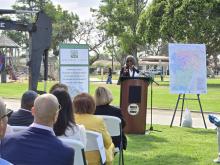
The project saw its formal unveiling last June in Compton, with construction occurring in five phases and hopefully completed by the end of next year. The Compton event appears to be a direct nod to concerns by activists that California subsidy efforts had been hijacked by private interests in a nontransparent way that undermined real digital equity reforms.
“Low-income communities are behind technologically – and business as usual has left communities in several areas of California with a digital divide,” COG President Vilma Cuellar-Stallings said at the project unveiling. “We are grateful that CDT and the CPUC worked with the cities in Southeast Los Angeles County to narrow our digital divide.”
According to a November construction update video, the California cities of Lakewood and La Mirado are the next in line to see construction during the months of November and December.
The project’s original master plan planned to deliver broadband speeds up to 10 gigabits per second (Gbps) to partner communities and residents. Upon completion of the network, each local government is responsible for how to get that high-quality internet into their respective communities, and final pricing and speed ties should be unveiled sometime next year once localized last mile solutions have been finalized.
A Belated Fix For The Sins Of Decades’ Past
California’s massive investment project comes in the wake of a generation’s worth of digital discrimination and redlining when it comes not just to affordable, next-generation broadband access, but all of the societal advantages that access brings.
Studies have repeatedly found that not only are marginalized, minority communities often neglected when it comes to reliable fiber upgrades, they routinely pay more money for slower broadband access than those in less diverse, more affluent neighborhoods.

One recent study by digital equity organization Digital Equity LA found that residents in higher poverty neighborhoods (which tend to be mostly made up of people of color) pay anywhere from $10 to $40 more per month than mostly white, higher-income neighborhoods for the exact same service.
While digital rights activists welcomed the massive infusion of federal subsidies, they repeatedly expressed concerns during the project’s foundational stage, noting that development conversations weren’t transparent, didn’t adequately weigh the input of the public, and were routinely dominated by entrenched, large telecom monopolies.
In the summer of 2023, digital equity activists raised the alarm that many of the promises in the original 2021 government announcement had been scaled back, with marginalized and minority communities among the first on the cutting block, while more affluent communities suddenly saw renewed prioritization.
As a result of the cuts California communities like East Oakland and South Central Los Angeles saw planned state fiber investment drop by 56 percent and 77 percent respectively. In East Oakland, 28 miles of planned fiber running along I-580, I-980 and State Route 185 was reduced to a single strand of fiber that will no longer cut through the flatlands of East Oakland.
All told, activists say state leaders cut broadband investment in these regions by around $28 million, and failed to transparently document their decision making process.

Even with the cuts, there should be an overall net improvement in California broadband access and investment, with communities like Compton among the first beneficiaries.
“This project redefines how cities connect and collaborate,” said Compton Mayor Emma Sharif of the June launch. “By providing equitable access to high-speed internet, we are paving the way for economic development, enhanced municipal services, telehealth, telework, and opportunities for distance learning.”
In California, 15 percent of households, or about 2 million residents, don’t have access to high speed internet. Significantly more lack access to affordable broadband access due to telecom sector consolidation, unchecked monopoly power, and the lack of meaningful competition that results.
Digital equity activists are heartened by the arrival of affordable fiber to long-neglected cities like Compton. But they remain wary about the project’s stunted potential in the wake of budget cuts and lobbyist-driven revisions.
"We are thrilled to see this project breaking ground, as there is a critical need to bring internet connectivity to the historically underinvested communities in Southeast Los Angeles,” Natalie Gonzalez, Director of Digital Equity LA, told ILSR.
“We applaud the enduring commitment of city leaders and digital equity advocates who continue to demand better access in their communities, and continue to hold CDT accountable to delivering a Middle-Mile network that enables competition and access to fast, reliable, and affordable Internet for all Californians."
Watch the Project progress video below:
Header image of Compton project announcement courtesy of Gateway Cities Council of Governments' Facebook page
Inline image of Entering Compton traffic island courtesy of Wikimedia Commons, CC BY-SA 2.0, Attribution-ShareAlike 2.0 Generic
Inline project fiber map courtesy of Gateway Cities Council of Governments’ Broadband Master Plan