
FTTH

Content tagged with "FTTH"

Fiber to the Home
Displaying 1191 - 1200 of 1320

Monticello FiberNet Attempts to Adapt Business Plan

Monticello, a small community of 13,000 about 40 miles northwest of Minneapolis, built one of the most advanced broadband networks in the midwest and delivers some of the fastest connections available in the state at incredibly competitive rates. The Twin Cities metro area, stuck mostly with Comcast and Qwest, cannot compare in capacity or value. Monticello is fairly rare in the publicly owned FTTH region because it does not have a public power utility and services on the network are provided by a third party, Hiawatha Broadband Communications -- a Minnesota company with an excellent reputation and track record. Unfortunately, Monticello's network suffered costly delays due to a frivolous lawsuit filed by the incumbent phone company in a bid to bleed the publicly owned network while it suddenly invested in its own second generation network (that it previously maintained was totally unnecessary for a small town like Monticello). Monticello lost a full year on the project, which has hurt its finances significantly. More unexpectedly, it has become the only community in North America where all residents have a choice between FTTH networks. They also have Charter in the mix. Add to this the economic downturn that hit just after they financed the network in 2007 -- the population growth has been much lower than forecast. The predictable result? Much lower prices, lots of community savings, and a publicly owned network that is behind its projections. The local paper recently ran a story about the project, "FiberNet struggles in a sea of red. Should you read the full piece, please be aware that the inaptly named "Freedom Foundation" has no credibility, existing solely to defend massive corporations like cable and telephone companies. For those who wonder why incumbents filed absurd lawsuits that have a vanishingly small chance of winning, note this discussion from the story:
“It stopped us from really building the system by about a year,” said Finance Director Tom Kelly, “which put our revenue collections about a year behind.

Despite Delays, Dunnellon Builds Muni Fiber in Florida

Dunnellon, a small town in Marion County south of Gainesville, decided to invest in a community fiber network to spur growth and diversify its income stream. Though citizens did not want to cut government services, they have not been pleased at property tax increases. 364 days ago, we published a story discussing their financing. The town itself is quite small, with 1,733 residents but the network will be serving areas in the County as well. Though AT&T and Comcast offer services in the area, they have big gaps in coverage and apparently the cable television packages are antiquated (only 50 channels???). An article last year noted Dunnellon's Internet connections will range from 10Mbps to 125Mbps. They hope to sign up 1,647 subscribers within 6 months of launch -- the network is named Greenlight (not sure if they were aware that the city of Wilson, NC, already operates a triple-play FTTH network called Greenlight). They hoped to launch 6 months ago. Bill Thompson's "Dunnellon dreams of a connectied future," offers a comprehensive look at the promise and the challenges Dunnellon faces. Dunnellon's city manager comes from Valparaiso, which had a city-owned cable network that upgraded to FTTH. Unfortunately, Dunnellon is in the hard position of building a network from scratch. logo-valp-net.jpg Building a new network requires a massive up-front capital investment - in this case the city will have spent $4.4 million to connect the first connection. Good thing they aren't all that expensive! The article identifies two main sources of the delays: difficulty in getting on the poles owned by Progress Energy and long delays in receiving the fiber-optic cable they ordered (stimulus projects have hogged the supply). Rather than taking 12 weeks, they had to wait 30. Delays cause problems:

The installation delay has put the city in a pinch with its lender, Regions Bank.

Big Broadband Breaks Ground in Illinois

The Champaign-Urbana "Big Broadband" stimulus project as broken ground. This will be an interesting project, as it is connecting a community that was intimately involved in shaping the Internet as we know it today via the University there.
Tuesday's ceremony was the kickoff to the construction phase of a huge, multi-agency, multimillion-dollar project to deliver that broadband access to 2,500 homes and businesses and 137 community buildings. The agencies, the cities of Champaign and Urbana and the University of Illinois, were notified 18 months ago that they were to be the recipients of a $22.5 million federal stimulus grant to build the Internet infrastructure. That was paired with a $3 million grant from the state of Illinois and hundreds of thousands dollars more from the local agencies. After spending the intervening months planning the network, officials gathered in Douglass Park on Tuesday with shovels and hard hats in hand. Construction crews will be burying 278 miles' worth of fiber throughout Champaign-Urbana during the next months, and organizers hope to be delivering Internet and cable service to eligible businesses and homes within the next year.
Urbana Logo The goal is ultimately to connect everyone -- residents and businesses -- with the best network possible, allowing independent ISPs to offer services. However, this approach is somewhat new, with a lot of diverse stakeholders trying to work together so it will undoubtedly be a project to watch and learn from. Follow the project and learn more about it on their site.

Fibrant Buys More Set-Top Boxes

Salisbury's Fibrant network, a muni FTTH network in North Carolina that is approaching its one year anniversary, has decided to celebrate by ordering 5,000 set-top boxes. Because the order was so large and only available from a single vendor due to software issues, City Council had to approve the deal.
The city will order 5,000 additional set-top boxes for Fibrant at the discounted price of $721,572… Fibrant’s original inventory of 5,000 set-top boxes purchased in March 2010 is running low, Behmer said. The city’s new broadband utility, which sells Internet, cable TV and phone services to Salisbury residents, has about 1,200 customers and averages about three set-top boxes per home, he said.
This is a reminder of the economics of these networks. Each set-top box costs something like $150. Household that subscribes for television service average 3 set-stop boxes, meaning that the cost of those boxes alone is about $450 of loss to Fibrant before the subscriber pays a dime to Fibrant. This is why muni networks take so long to break even. The additional install costs like the equipment on the side of the house and the labor to set everything up grow quickly -- often to between $1200-$1500 per subscriber. It takes years to pay down those costs, plus the interest of borrowing to build the network. So when you hear that a community network is running in the red in year 3, you should say, "Duh." Infrastructure often takes a long time to pay off, which is one of the main reasons the private sector does such a poor job of providing it.

Redwood County, Minnesota, Latest to Study FTTH

Minnesota, land of 10,000 lakes, may soon also be the land of Countywide rural FTTH. Yet another County is doing a feasibility study to figure out how it can bring fast, affordable, and reliable broadband access to all of its citizens.
Redwood County’s Economic Development Authority (EDA) opted to move forward with a broadband feasibility study that would determine just what the county would need to do in order to get fiber to every premises. … The study, which is being conducted by the Blandin Foundation through what is known as the Robust Broad-band Networks Feasibility Grant Program. The grant, which includes up to $40,000 for the county as it addresses the needs of every community and farm site from one end of the county to the other, requires matching funds, which are available through the county EDA.
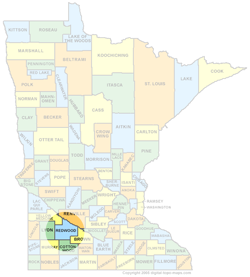
Redwood County Redwood County is in an interesting area, just north of the Windom area muni FTTH networks and west of the proposed project in Sibley and Renville counties. This study comes not long after Todd County started a feasibility study as well (the the latest on that). And though we haven't discussed it much on MuniNetworks.org, Lac qui Parle County to the northwest is working with a rural telephone cooperative to bring FTTH to many in their border as well. And then beyond them, we have Cook County going FTTH with their electric coop and Lake County going its own way, both with the assistance of the broadband stimulus awards. Minnesota could very well become the state with the most impressive rural connections. Unfortunately, thus far we have seen no assistance from the state in this matter, but perhaps the Dayton Administration will chart a new course.

EC Fiber is Officially Live in Vermont

This has been a great month for communities building their own high capacity broadband networks in New England. Wired West in rural Massachusetts has formalized its coop of communities. Just last Friday, we wrote about the East Central Vermont Community Fiber network in beta. As of last night, EC Fiber is out of beta and officially live! Those interested can sign up at MyECFiber.net. Last night, they issued this press release:
SOUTH ROYALTON – Having completed its beta testing, and with the Phase I project nearly complete, ECFiber began connecting its first customers today. Eight customers have been beta-testing the system for the past two weeks, getting sustained 5Mbps symmetrical service. The Barnard General Store, one of the beta sites, has been offering the experience to customers via WI-FI, and has been finding folks on their doorstep at all hours, trying out the system. ecfiber-construction.png “It’s been amazing,” says Kim Furlong, one of the store’s proprietors. “Because so much more of what we do is online, it is truly a joy to reap the reward of high-speed internet. Dial-up, and even satellite, is such a time-robber. Fiber is very different – you can be more efficient, and that is exciting. At the same time, I have some trepidation. People are going to relocate here more permanently because of what is available, and that is probably going to change the fabric of the community.” According to Project Coordinator Leslie Nulty, 15 new accounts were opened within the first 24 hours after the doorstep delivery of information packets. Barnard Academy, another beta site, is also very excited about the service. They are planning an open house and community celebration of ECFiber’s arrival in mid-October. Barnard was chosen for the Phase I project because of its proximity to the central office and its large number of unserved users. Pre-registrations topped 90% before the project started. Phase II, to build out the rest of the town of Barnard, is in the planning stages, with an informational meeting set for Thursday night at 7PM at the Barnard Town Hall.

Learning from Burlington Telecom: Some Lessons for Community Networks

Image
In little more than a year, Burlington Telecom went from being a hopeful star of the community fiber network movement to an albatross around its neck. The controversies surrounding it have encouraged cable and telephone companies to use it as Exhibit A in their case against communities going into the telecommunications business. However, most of those criticizing Burlington Telecom have very little understanding of what went wrong and how it happened. Examining what actually happened helps to explain how these problems may be avoided, as the vast majority of existing community networks have already done. [Download the full report] In 2007, ILSR issued a case study on Burlington Telecom. The report argued that Burlington Telecom was a model for how communities could build their own next‐generation fiber‐to-the‐home broadband networks. This report revisits and updates that report, analyzes Burlington Telecom’s situation (for better and for worse), and extracts useful lessons for other communities pursuing community fiber networks. In preparation for this report, ILSR examined many documents, including those available due to the investigation of Vermont’s Department of Public Service. We interviewed many people from Burlington, including former BT employees, citizens active around the project, and City Council members. We discussed Burlington’s situation with a number of others intimately involved in community broadband networks around the country and posed questions directly to a representative of BT. This report catalogs many of the problems Burlington Telecom encountered as well as potential solutions for other communities may have to deal with them. It also discusses some of the benefits from Burlington Telecom in order to offer a complete picture of BT's contribution to the community. This is the most comprehensive discussion of Burlington Telecom available.

Open Access nDanville Network Goes Residential

The open access fiber-optic network in Danville, Virginia, is officially going FTTH. We have long watched nDanville's progress and are excited to see the network expanding into residential access after significantly improving telecom services to businesses and schools. Last year, City Council debated and ultimately rejected a more ambitious plan to expand the network more rapidly. But the utility has secured permission for a smaller project area this year, allowing it to expand without incurring debt. This project will be financed out of the reserves they have built up from net telecom revenues over the years. That's right, they have been running in the black and are reinvesting those funds into connecting more of the community. The utility has $250,000 to use for the build, allowing them to connect some 250 homes (maybe double that if they can stretch the funds) in this phase. If things go as well as they have historically, they will roll through the community in this fashion, undoubtedly increasing their capacity as the model proves itself. Additionally, as new developments are built, they will likely be connected due to the extremely low cost in so-called greenfields. They have one provider lined up to offer video services on their open access network (the utility provides no services themselves) but as they gain subscribers, more service providers will begin offering services. This network is creating jobs directly (by expanding the physical infrastructure) but is also encouraging many more jobs indirectly -- the local service provider is expanding and local businesses are doing better than they would if mired in the duopoly so many other communities find themselves.

Layton and Centerville Start Seeing UTOPIA Benefits

When the UTOPIA network buildout stalled in 2007, some communities were left entirely unserved by a network they helped to create. But now at least two of those towns are finally getting connected to one of the nation's fastest networks where they can choose among many service providers, a rarity in the duopolistic world of US broadband. The broadband stimulus programs is giving UTOPIA a new lease on life, expanding the middle mile capacity it needs to then connect more residents and businesses. And the community anchor institutions -- schools, libraries, city halls, and more -- will finally have robust reliable connections.
“We’d love to have it,” said Cris Hogan, executive vice president of Hogan & Associates Construction in Centerville. “It’s much faster, with more capabilities, and we’re hoping less expense.” As a commercial builder, Hogan’s company frequently transfers detailed documents and plans to subcontractors electronically. Under current bandwidth conditions, that process can be time consuming, he said. Hogan’s wait for screaming-fast Internet could soon be over. “No one in Centerville has Utopia right now but they’re getting close with the stimulus,” said Blaine Lutz, the city’s finance director. His workplace, Centerville City Hall, should be hooked up by October.
The current expansion will connect 141 anchor institutions in the two communities as well as many more in Payson, Orem, Murray, Midvale, West Valley City, and Perry. As of now, residents generally have to pay a steep upfront $3,000 connection fee for the physical connection, but local governments are investigating different options to allow residents to connect to the network affordably, as Brigham City did with a special assessment area. As for the capacity of the network and value offering, it crushes Comcast.