
affordability

Content tagged with "affordability"

Related Topics
Displaying 221 - 230 of 276

NY Gov. Proposes ‘Largest Ever Investment’ in Broadband

Community broadband advocates in New York rang in the new year celebrating Gov. Kathy Hochul’s announcement of a proposed $1 billion investment to beef up broadband in the Empire State. If state lawmakers move to enact the initiative, it would be what the Governor’s office describes as “the largest ever investment in New York's 21st century infrastructure.”

During her State of the State speech, Gov. Hochul unveiled the ConnectAll Initiative, which aims to “deliver affordable broadband to millions of New Yorkers and transform the state's digital infrastructure through new investments,” with municipal broadband as a centerpiece of the plan.

In announcing the new initiative – which would be funded with a combination of up to $300 million in state funds, $345 million in federal funds, with the rest to eventually come from the recently passed Infrastructure Investment and Jobs Act – Gov. Hochul said:

The pandemic exposed how without broadband Internet, New Yorkers can be disconnected from school, work, and families. The ConnectALL Initiative will empower local municipalities and state agencies to set up nation-leading broadband infrastructure statewide, ensuring that every New Yorker has access to the Internet when they need it.

Six-Part Strategy

Image

The plan not only creates a new ConnectALL Office, it directs the office to work in conjunction with other state agencies in overseeing the major components of the effort, following a six-part strategy that includes:

Treasury Simplifies, Improves Rules for Rescue Plan Aid for Broadband Networks

Communities across the United States got an unexpected gift from the Biden Administration last week in the form of additional flexibility to use Rescue Plan funds for needed broadband investments, particularly those focused on low-income neighborhoods in urban areas. 

When Congress developed and passed the American Rescue Plan Act, it tasked the Treasury Department with writing the rules for some key programs, including the State & Local Fiscal Recovery Funds (SLFRF). That program is distributing $350 billion to local and state governments, which can use it for a variety of purposes that include broadband infrastructure and digital inclusion efforts.

Treasury released an Interim Final Rule in May, 2021, detailing how local governments would be allowed to invest in broadband. I promptly freaked out, at the restrictions and complications that I (and others) feared would result in local governments backing away from needed broadband investments due to fears of being out of compliance with the rule. 

After we worked with numerous local leaders and the National League of Cities to explain the problems we saw in the proposed rule, Treasury released updated guidance in the form of a Q&A document to explain how local governments would be able to build and partner for needed networks. 

Given the many challenges the Biden Administration has had to deal with, we did not expect significant new changes to the Rescue Plan rules around the SLFRF. But after many months of deliberations, the Treasury Department has resolved all of the concerns that we identified as areas of concern in May. 

As we explain below, local governments have wide latitude to use SLFRF funds for a variety of needed broadband infrastructure investments, especially to resolve affordability challenges.

Summary and TL;DR


Harlingen, Texas Looks to Build Bridge Just North of the Border

While a national debate rages over immigration and the border wall, just 30 miles north of the U.S.-Mexico border, Harlingen city officials are coming together to plan the building of a bridge – across the digital divide deep in the heart of the Rio Grande Valley.

When Harlingen (pop. 75,000) was founded at the turn of the 20th century, it established itself as a prominent commerce and transportation hub – the “Capital of the Rio Grande Valley” at “the crossroads of South Texas.” Over the years, thanks to its fertile delta soil, the cultivation of citrus fruit, grain, and cotton became a major part of the local economy. Today, however, the biggest industry in the second most populous city in Cameron County is healthcare.

As attractive as Harlingen has become to residents and visitors – with its extensive park system and tropical bird-watcher’s paradise (the city happens to be located where two primary avian flyways converge) – one thing the city lacks is adequate access to broadband, which is particularly acute among households with school-aged children.

Pandemic Spurs City into Action

That realization was the impetus behind a recent city commission vote to move forward with a feasibility study to determine how the city might build a broadband network and whether it should rely on fiber, fixed wireless, or a mix of deployment technologies to modernize Harlingen’s telecommunications infrastructure.

“What brought this to our attention was of course the pandemic,” City Manager Gabriel Gonzalez told Valley Central News. “When the school district had to go to virtual learning, we found out that there were students and some families that did not have access to (the) Internet.”

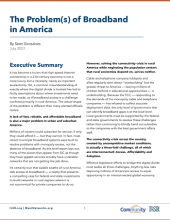
The Problem(s) of Broadband in America

Image

As the Biden Administration is working with Senate Republicans and Democrats on a proposed infrastructure deal which now includes a $65 billion federal investment to expand broadband access, the details of how that money should be spent and where those investments should be targeted have yet to be decided.

In a new policy brief, the Institute for Local Self-Reliance looks to provide clarity for policy-makers by exploring the real challenges of America’s connectivity crisis. The brief aims to clear up a common misunderstanding of exactly where the digital divide is located.

Digital Divide is Not Urban Vs. Rural, It’s Both

It does so by explaining why high-speed Internet access is not a challenge confined primarily within rural America. A lack of fast, reliable, and affordable broadband is also a major problem in urban and suburban America.

As the brief details, millions of citizens could subscribe for service right now, if only they could afford it — but they cannot. In fact, most recent municipal broadband systems were built to resolve problems with monopoly excess, not the absence of broadband. Many of the places that appear from the DC as though they have gigabit services actually have unreliable networks that are not getting the job done.

The Case for Prioritizing Local Community Efforts

The brief further elaborates on how America’s connectivity crisis has been created by uncompetitive market conditions, a dilemma that actually presents three interconnected challenges: Access, Affordability and Adoption. 

Finally, the brief makes the case for why the federal and state governments should support local governments in resolving these challenges, rather than continuing to blindly hand out subsidies to the companies with the best government affairs' staff.

Read The Problem(s) of Broadband in America here [pdf].

Empire State Climbs Toward Expanded Connectivity

From New York City to Newfield in Upstate New York, local officials in the Empire State have kicked off projects to connect the unconnected to high-speed Internet service.

The biggest of those projects is underway in New York City as Mayor Bill de Blasio recently delivered an early Christmas present for city dwellers who want to see a term-limit set on the digital divide in the Big Apple.

America’s most populous metropolis (est. pop. 8.6 million) is investing $157 million to build publicly owned, open access broadband infrastructure that will lay the groundwork local officials say will enable high-speed wireless Internet access for up to 1.6 million city residents over the next 36 months.

Even as the city is on track to bring free or low-cost Internet service to 40,000 residents living in 18 New York City Housing Authority (NYCHA) developments by the end of the year, this latest initiative aims to expand the city’s existing fiber infrastructure while drawing on minority and women-owned Internet Service Providers to help deliver “fast, reliable, and affordable connectivity options to an additional 70,000 NYCHA residents and 150,000 residents in the surrounding communities by early 2022,” the Mayor’s Office explained in a press release announcing the initiative.

“Broadband isn’t a luxury, it’s a necessity,” de Blasio said. “We are closing the digital divide and bringing our city into the 21st century by reaching communities most in need.” 

New York City Chief Technology Officer John Paul Farmer characterized the effort as evidence that city officials are “transforming the broadband marketplace.” 

No matter your zip code, every New Yorker deserves an equal opportunity to participate in building our shared future. The New York City Internet Master Plan has enabled the Big Apple’s unprecedented progress in promoting digital equity and making that idealistic vision a practical reality. New York City’s bold new approach delivers cross-sector partnerships, incorporates cutting-edge technologies, upgrades performance, and ensures affordability for residents and businesses.

Mobilizing ‘NYC Internet Master Plan’

ATMC Assures All Members Are Served By Fiber

The Atlantic Telephone Membership Cooperative (ATMC) has worked to meet the communications needs of its members since its inception by the citizens of rural Brunswick County, North Carolina who were without telephone service in 1955. Nowadays, ATMC believes meeting members’ communications needs means ensuring all co-op members have access to gigabit fiber Internet service. 

High-speed Internet access is currently available throughout 100 percent of the co-op’s service area in southeastern North Carolina. Most co-op members have access to fiber Internet service already, except for those living in ATMC’s Brunswick County service territory, where ATMC originally began offering Internet services.

Brunswick County is the last county ATMC needs to upgrade to fiber, in order to complete an overarching goal of delivering fiber-to-the-home Internet service to all existing members. The co-op recently announced it will soon start a project to replace all of its copper and coaxial wires in Brunswick County with fiber optic cables. It will cost $100 million dollars and take eight years to complete, but at the end of the project, all of the cooperative’s members in Brunswick County currently served by legacy infrastructure will be upgraded to fiber, offering even faster Internet access speeds and far greater reliability.

In the meantime, ATMC has increased the maximum broadband speed delivered to co-op members in Brunswick County from 200 megabits per second (Mbps) to 600 Mbps, a company press release states. Over 22,000 customers had their download speeds doubled without an increase in price.

“The project is slated to start in January 2022,” according to an ATMC press release announcing the project. “By constructing in the most densely populated communities first, the cooperative estimates that it can convert as many as 75 percent of homes and businesses to the new fiber optic network within the first 60 months.”

A Community Guide to Federal Broadband Funding Opportunities

Update, 1/22/22: Common Sense Media has released an easy-to-read, comprehensive guide to federal broadband funding opportunities. Read it here.

In response to the Covid-19 pandemic, Congress and the Biden Administration passed two federal stimulus relief packages with historic levels of funding for programs devoted to advancing digital equity – the American Rescue Plan Act (ARPA) and the Consolidated Appropriations Act (CAA). 

In early August, legislators in the U.S. Senate passed the Infrastructure Investment and Jobs Act, a $1.2 trillion infrastructure package which continues many of the federal programs started by previous relief packages and includes $65 billion more for expanding high-speed Internet infrastructure and connectivity. Members of Congress returned from their summer break on September 20th and U.S. House Representatives are expected to vote on the infrastructure relief bill, which enjoys bipartisan support, on September 30th.

This guide consolidates the different funding opportunities made available through various relief packages to assist communities interested in accessing federal funds to expand broadband infrastructure and digital inclusion services. It updates ILSR’s Community Guide to Broadband Funding released in April of 2021, which describes programs established under ARPA and CAA in more detail, provides additional resources and answers FAQs.

Important upcoming deadlines are bolded throughout this guide. 

Infrastructure Investment and Jobs Act – Pending 

Washtenaw County Takes Another Step Toward Countywide Broadband Equity

As communities across the country are working to bring more affordable, reliable Internet access to their residents, one county in Michigan is gearing up to reach every household within its bounds. On Wednesday night, the Washtenaw County Board of Commissioners held a Ways and Means meeting and unanimously approved a resolution obligating state funding, including American Rescue Plan funds, to several initiatives, with $14.6 million dollars being allocated to broadband infrastructure. 

Although some communities in the county have made progress in recent years in improving connectivity, thousands of households have been left with broadband at basic speeds. While many are slated to receive service via the recent wins by Mercury Broadband (a Kansas-based ISP, focused on connecting rural America) and Midwest Energy and Communications (MEC, a Michigan electric cooperative) from the 2020 Rural Digital Opportunity Fund (RDOF) auction, there are still 17 townships scattered across the county with more than 3,000 households that remained unserved. 

Back in May, the Washtenaw County Broadband Task Force put out a Request for Proposal (RFP) to plug the remaining holes, with the Task Force signalling its general happiness with the responses in the recent meeting. The allocation on Wednesday, if it receives final approval in the near future, will be used to fund the project proposals the Broadband Task Force is currently negotiating with four ISPs: Midwest Energy and Communications, Washtenaw Fiber, Comcast and Charter-Spectrum. 

This vote brings the Washtenaw County Broadband Task Force one step closer to its goal of countywide broadband equity. Its $14.6 million dollar plan will either be approved or vetoed by the County Board of Commissioners on Sept. 15. 

The Journey to Countywide Broadband Equity

The Washtenaw County Broadband Subcommittee was formed in 2017 to assess the county’s broadband coverage and make recommendations about how to achieve “countywide broadband equity” by 2022. 

Moreno Valley Considers Extending Public Fiber and Wireless Networks

Nestled in Southern California’s Inland Empire is the city of Moreno Valley which goes by the maxim: "People, Pride, Progress!” Now, city officials are looking to live up to the motto by moving forward with a plan to expand Internet access to residents by utilizing 35 miles of fiber assets and 11,000 city utility poles to extend public Wi-Fi access to as many homes as possible.

Home to over 213,000 residents, the city of Moreno Valley is in the beginning stages of developing a Master Plan to extend its existing fiber and wireless networks. The goal of the plan, being completed by Magellan Advisors, is to leverage city-owned assets to expand Internet access and lower the cost of connectivity for public-sector organizations, businesses, and community anchor institutions.

The Master Plan calls for a focus on expanding Moreno Valley’s municipal network in a way that would promote economic development; support education, healthcare, and public safety in the city, and generally improve quality of life for residents living in an increasingly interconnected world. 

Moreno Valley and Magellan, a national consulting firm, are currently in the first phase of assessing the feasibility of the project and developing the Master Plan, which is anticipated to be complete by the end of the year.

Phase 1 of the plan consists of conducting an inventory of broadband assets, interviewing city staff and other major stakeholders (such as larger hospitals, school districts and warehousing groups), conducting online surveys to understand current broadband availability, and putting together a cost-benefit analysis.  

“Putting that whole picture together is what Magellan Advisors is helping us do. They’re taking a look at everything we have - what’s connected, what’s almost connected but not quite. They’re going to develop a Master Plan and give [the city] suggestions as to what we could do, so we can place assets more intentionally,” Steve Hargis, the city’s Chief Information Officer told ILSR in a recent interview.

Cuyahoga County, Ohio Soliciting Sustainable Internet Access and Digital Inclusion Solutions with RFP Due Sep 8th

Cuyahoga County, Ohio (pop. 1.23 million), encompassing Cleveland and the surrounding area along the bottom edge of Lake Erie, has released a new Request for Proposals (RFP) as part of its ongoing effort to "expand affordable, high-speed broadband services to those lacking Internet access." Sustainable solutions are the focus of the RFP, with particular emphasis given to economically disadvantaged communities and approaches that can not only offer low-cost or free options but convince households to sign up for service.

Proposals are due September 8th at 11am ET.

The RFP is just the latest effort as part of the Office of Innovation and Performance's effort to closing the digital divide in the city and surrounding area. It notes that:

Cuyahoga County is one of the worst-connected communities in the U.S., with 19 percent of households in the County without any type of Internet service, including mobile data plans. About 32 percent of households in the County do not have a broadband connection at home, and 69 percent of these households have annual incomes below $35,000.