

Resource: Useful Flyers in Georgia Legislation

After AT&T began pushing a bill in Georgia to revoke local authority to decide to build a publicly owned broadband network, the Georgia Municipal Assocation (GMA) and the SouthEast Assocation of Telecommunications Officers and Advisors began reaching out to Georgia's legislators to explain how the private sector has left serious gaps in broadband coverage, which stopped the bill. Below are two flyers they report being particularly helpful.
GMA, SEATOA, and the Institute for Local Self-Reliance are among the vast majority that believe communities should decide locally if a community network makes sense to bring next-generation connections to local businesses and residents.
Georgia is a conservative state and AT&T had enlisted the support of the Senate Majority Leader in pushing their anti-competition broadband bill. Unfortunately for AT&T, their CEO was too candid on calls with Wall Street, contradicting AT&T's lobbyist talking points in Georgia.
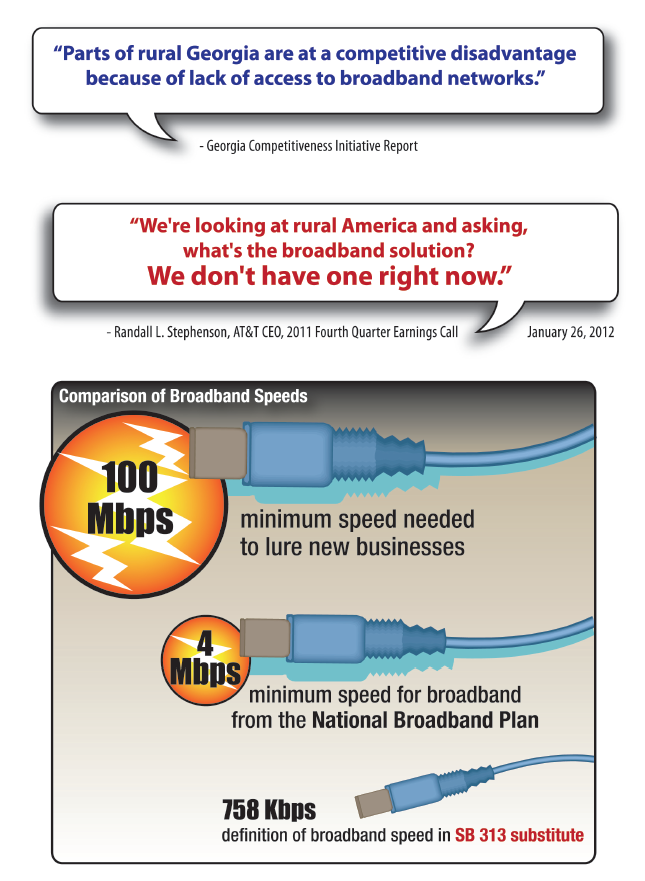 Note, that AT&T was originally trying to define broadband at the absurd 200kbps level but a substitute bill would have bumped it up to a still-too-low 768kbps, which is referenced above.
The other flyer that apparently made a difference with legislators is here:
Note, that AT&T was originally trying to define broadband at the absurd 200kbps level but a substitute bill would have bumped it up to a still-too-low 768kbps, which is referenced above.
The other flyer that apparently made a difference with legislators is here:
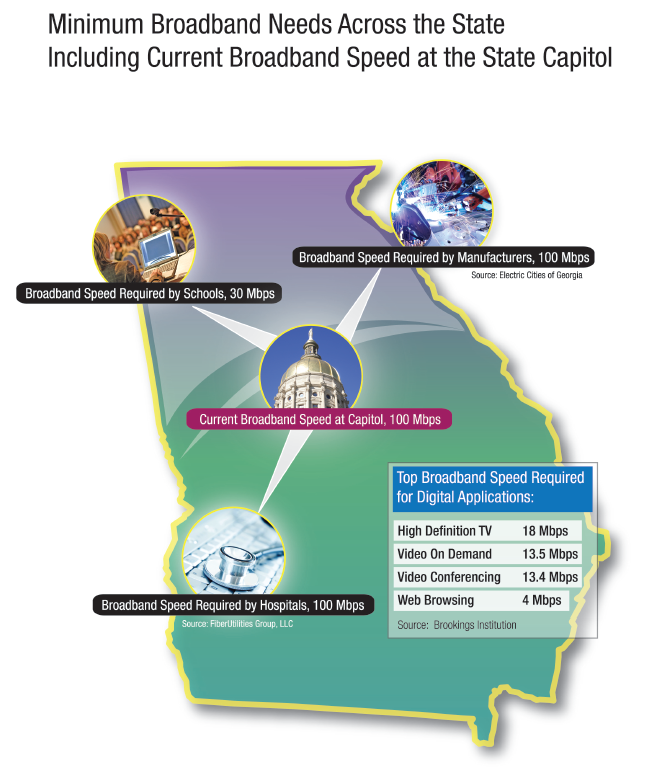 Rememeber that elected officials often think of broadband in binary terms. You have it or you don't. In their mind, if you have options aside from dial-up, the problem is solved. These are people that often do not know what is needed to attract economic development, work efficiently from home, or successfully compete remote education courses.
Note, that AT&T was originally trying to define broadband at the absurd 200kbps level but a substitute bill would have bumped it up to a still-too-low 768kbps, which is referenced above.
The other flyer that apparently made a difference with legislators is here:
Rememeber that elected officials often think of broadband in binary terms. You have it or you don't. In their mind, if you have options aside from dial-up, the problem is solved. These are people that often do not know what is needed to attract economic development, work efficiently from home, or successfully compete remote education courses.