
rural

Content tagged with "rural"

Related Topics
Displaying 141 - 150 of 1068

Watch This Webinar on 9/29 - Repairing Broken Broadband Policy: A Conversation with Dr. Christopher Ali

A week from today, the Schools, Health, and Libraries Broadband Coalition (SHLB) is hosting a fireside chat on Tuesday, September 29th at 12-12:30p ET with SHLB Executive Director John Windhausen and Christopher Ali.

Ali is an Associate Professor of Media Studies at the University of Virginia, and recently released a new book through MIT press called Farm Fresh Broadband: The Politics of Rural Connectivity.

From the description:

Before the pandemic-driven surge of public investment in broadband networks, the federal government had subsidized rural broadband by approximately $6 billion a year. So why does the rural-urban digital divide persist? Why are we looking to the new infrastructure bill to solve a problem that should have been solved a decade ago? Author of "Farm Fresh Broadband" Dr. Christopher Ali argues that rural broadband policy is both broken and incomplete, proposing a new national broadband plan. Join SHLB Coalition Executive Director John Windhausen for a virtual fireside chat with Dr. Ali, to pick his brain on where the U.S. is going wrong and how to course correct rural broadband policy moving forward. And of course, they’ll discuss where community anchor institutions fit into it all.

ILSR spoke with Ali on Episode 134 of the Building Local Power podcast, which you can listen to here.

Register for the event here.

Building Connections and Capacity in Indian Country at the First Tribal Wireless Bootcamp

Earlier this summer, a small group of people gathered in the southern California desert for the first Tribal Wireless Bootcamp. Organized by a loose collection of people with a long history of building and encouraging nontraditional broadband networks, the focus was on building, maintaining, and troubleshooting wireless networks in Indian Country.

To avoid any pretense of journalistic integrity, I will just say upfront that it was awesome. Not just in the sense that it was a good time, but in the sense that it was overwhelming and hard to fully grasp. For some of us, it was the first time in more than a year we had been in a group of people of any size, let alone people outside our immediate social circle.

Some of the attendees were already operating networks and others were new to it but everyone shared strategies, whether about software or how to organize people in historically marginalized communities - taking lessons from the Bronx and applying them to Tribal lands.

Ultimately, we achieved the multiple objectives set out from the beginning - to share strategies on building physical networks while actually building a social support network for this work that would endure after the weekend ended. Each of the Tribes involved received a set of 2.5 GHz radios that would not only allow for a high-capacity link, but would standardize the participants so they could better help each other to troubleshoot and improve their networks.

Conception

Many rural areas lack decent broadband Internet access, but the lack of availability in Tribal reservations is extreme. No one even knows what the statistic is, but like many statistics that the Federal Communications Commission publishes, everyone knows it is a gross overstatement. For decades, Tribes have been overlooked, ignored, and defrauded by telecommunications companies seeking to extract wealth from their people and land, with some notable exceptions of companies that have worked hard to connect Indigenous communities. Many Tribal leaders have concluded they need to build their own networks to ensure high-quality Internet access to secure many of the modern benefits the rest of us take for granted.

Rethinking Rural Connectivity with Christopher Ali - Episode 473 of the Community Broadband Bits Podcast

This week, we are spotlighting episode 134 of Building Local Power, an ILSR podcast hosted by our Communication’s Manager, Jess Del Fiasco. On this episode, Jess is joined by the Community Broadband Networks Initiative’s Senior Researcher Ry Marcatillio-McCracken and Senior Reporter, Editor and Researcher Sean Gonsalves to interview Christopher Ali about his new book, Farm Fresh Broadband: The Politics of Rural Connectivity. 

Christopher Ali is an Associate Professor in the Department of Media Studies at the University of Virginia where he is currently focusing on broadband policy and deployment across the country. 

The four discuss Chistopher’s motivation for and methodology in writing the book, how better broadband access can spur economic development in rural areas, and how communities are finding solutions in situations where the federal government’s efforts to improve rural broadband infrastructure have fallen short. 

This show is 40 minutes long and can be played on this page or via Apple Podcasts or the tool of your choice using this feed

Transcript below. 

We want your feedback and suggestions for the show-please e-mail us or leave a comment below.

Listen to other episodes here or view all episodes in our index. See other podcasts from the Institute for Local Self-Reliance here.

Thanks to Arne Huseby for the music. The song is Warm Duck Shuffle and is licensed under a Creative Commons Attribution (3.0) license.

Nonprofit Directing Efforts to Improve Internet Access for Six Counties in Southern Pennsylvania

Nonprofit Alleghenies Broadband is leading a cohesive effort across a six-county region in south-central Pennsylvania to bring high-speed Internet access to areas that are unserved or underserved by reliable networks.

Part of its work is a recently completed Request for Proposals (RFP) in search of forming a series of public-private partnerships to help identify target areas and offer robust solutions to bring new infrastructure to the businesses and residents who need it most. As that process continues to unfold, however, the nonprofit is already working with city and county leaders to pursue a range of wireline and fixed wireless options that will result in better service and publicly owned infrastructure. 

A Regional Approach

Formed in October 2020, Alleghenies Broadband is part of the Southern Alleghenies Planning & Development Commission. By coordinating efforts in six counties (Bedford, Blair, Cambria, Fulton, Huntingdon, and Somerset, collectively representing about 500,000 residents), it hopes to address the broadband gaps scattered across the region. Somerset, Fulton, and Huntingdon seem to be in the worst shape at present: while many residents have access to cable service, large swaths of the counties are stuck with DSL or satellite service only, leading to median download speeds of just 3.7-8 Megabits per second (Mbps) (see Fulton and Huntingdon coverage maps below, with satellite-only areas in grey). The remaining three counties also have significant gaps where no wireline access is available, representing thousands of households with poor or no service.

Minnesota Broadband: Land of 10,000 Connectivity Solutions

Image

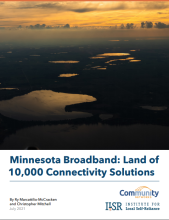
In a new report, the Institute for Local Self-Reliance showcases the diverse range of approaches communities and local Internet Service Providers (ISPs) have taken to expand affordable, high-quality Internet access in Minnesota. It includes a series of case studies that detail how communities are meeting the connectivity challenges of a broken marketplace shaped by large monopoly service providers. 

Download Minnesota Broadband: Land of 10,000 Connectivity Solutions [pdf] here.

The profiled projects include municipal networks, public-private partnerships, cooperatives, and private investment. They run from the most rural areas of the state to Minneapolis. Some examples include:

  • RS Fiber Cooperative, in south central Minnesota, which has brought fiber to local businesses and town residents. Rural residents benefit from RS Air, a fast wireless service available at affordable prices.
  • Arrowhead Electric Cooperative’s fiber network in Cook County, which succeeded beyond original projections. It provides fast and affordable Internet access to one of the most far-flung parts of the state.
  • St. Louis Park’s partnerships with both ISPs and the builders of large condominium complexes. One of the providers working with St. Louis Park is better known as the fastest ISP in Minneapolis, USI Fiber.
  • Christensen Communications, a 100+ year-old telephone company in south central Minnesota. The company demonstrated a strong commitment to its communities when the pandemic hit, and is now going above and beyond to build fiber with federal subsidies.
  • The Fond du Lac Band, in northern Minnesota, which built a fiber-to-the-home network that is rare in Indian Country.

Ry Marcattilio-McCracken, co-author of the report and Senior Researcher with ILSR’s Community Broadband Networks initiative, said of the report’s findings: 

Report: Minnesota Communities and Local Providers Build Diverse Solutions for Affordable, Reliable Internet Access

Our new report, Minnesota Broadband: Land of 10,000 Connectivity Solutions [pdf], showcases the diverse range of approaches communities and local Internet Service Providers (ISPs) have taken to expand affordable, high-quality Internet access in Minnesota. It includes a series of case studies that detail how communities are meeting the connectivity challenges of a broken marketplace shaped by large monopoly service providers. 

The profiled projects include municipal networks, public-private partnerships, cooperatives, and private investment. They run from the most rural areas of the state to Minneapolis. Some examples include:

  • RS Fiber Cooperative, in south central Minnesota, which has brought fiber to local businesses and town residents. Rural residents benefit from RS Air, a fast wireless service available at affordable prices.
  • Arrowhead Electric Cooperative’s fiber network in Cook County, which succeeded beyond original projections. It provides fast and affordable Internet access to one of the most far-flung parts of the state.
  • St. Louis Park’s partnerships with both ISPs and the builders of large condominium complexes. One of the providers working with St. Louis Park is better known as the fastest ISP in Minneapolis, USI Fiber.
  • Christensen Communications, a 100+ year-old telephone company in south central Minnesota. The company demonstrated a strong commitment to its communities when the pandemic hit, and is now going above and beyond to build fiber with federal subsidies.
  • The Fond du Lac Band, in northern Minnesota, which built a fiber-to-the-home network that is rare in Indian Country.

Ry Marcattilio-McCracken, co-author of the report and Senior Researcher with ILSR’s Community Broadband Networks initiative, said of the report’s findings: 

Minnesota communities and local ISPs have found creative and sustainable ways to build future-proof networks across the state, despite a broken marketplace and state barriers that favor slow-moving, out-of-state monopoly providers clinging to outdated technology. Lawmakers must stand up for the cities and towns that sent them to the legislature, and remove the obstacles that prevent a more competitive market and local broadband solutions.

Tennessee Cooperative Connects Thousands of Residents Outside of Chattanooga

Since the passing of the Tennessee Broadband Accessibility Act (TBAA) in 2017, the state has poured more than $100 million into connecting its most rural communities, and more than 20 electric cooperatives throughout the state have spent the last four years making their way into the broadband business. 

Back in 2016 and 2017, Sequachee Valley Electric Cooperative (SVEC), along with many other electric cooperatives, advocated for the right to build fiber-to-the-home (FTTH) networks out to their memberships in the most rural parts of the state. When TBAA passed through the state legislature, removing major barriers for cooperatives to build out their own networks, SVEC got to work.

Today, 23 electric cooperatives in Tennessee have launched their own broadband projects, including SVEConnect, a broadband subsidiary of SVEC offering FTTH that has connected more than 4,400 members across Marion County. 

From Electrification to Connectivity

SVEC was formed in 1939 to address the broad gaps in access to electricity throughout the rural areas surrounding Chattanooga, Tennessee in Bledsoe, Grundy, Marion and Sequatchie counties. When the cooperative was first established, the nonprofit’s leaders would frequent community events at churches and neighborhood gatherings, keeping their fingers on the pulse of community needs. The cooperative began offering an essential service: electricity.

Wireless Communication Alliance to Host Virtual Event on Broadband in Underserved Rural Areas

With an estimated 22 percent of Americans in rural areas and 28 percent of indigenous Americans on Tribal lands living without access to broadband that meets the federal minimum definition of 25/3 Mbps, the Wireless Communication Alliance is bringing together a panel of experts to explore how broadband deployment will transform rural America and Native Nations in the years ahead.

On Tuesday July 27, the Wireless Communication Alliance will host the virtual event – Broadband in Underserved Rural Areas 2021. It will feature a panel discussion and Q & A session, which is open to the public, that will cover present challenges, the various technologies being deployed, and the promise of what high-speed Internet connectivity can deliver.

Our own Chris Mitchell will be one of four feature panelists. The other panelists are: Richard Bernhardt, National Spectrum Adviser with the Wireless Internet Service Providers Association (WISPA); Samantha Schartman-Cycyk, Executive Director of the Marconi Society; and Chris Frost, Director of Technology and Infrastructure at Cruzio.

The panel discussion will be moderated by Mohammad (Mo) Shakouri, Chairman of the WiMAX Forum, Director of the Community Broadband Initiative at Joint Venture Silicon Valley, and Founder and CEO of Microsanj.

Participants must register in advance of the event and will then be sent a confirmation email along with a Zoom invite. As an added bonus, the Wireless Communication Alliance will raffle off a Steampunk Retro Rocket Lamp.  

The hour-and-a-half long event will start at 1 p.m. PST on July 27.

Recent Developments in Vermont and New Hampshire and the Real Broadband Challenges in America - Episode 465 of the Community Broadband Bits Podcast

This week on the Community Broadband Bits podcast, Christopher Mitchell chats with Sean Gonsalves, ILSR's Community Broadband Senior Reporter, Editor and Researcher to catch up on some of the most interesting broadband stories in recent weeks.

The two begin by discussing a recent story by Jericho Casper, ILSR Researcher and Writer, reporting more than 20 communities in New Hampshire are entering into public-private partnerships to get their residents more connected. Gonsalves also talks about his recent feature story about Northeast Kingdom Communication Union District (CUD) in Vermont and the state's unique approach to achieving universal broadband access by 2024. 

Chris and Sean end by talking candidly about the real problems with broadband in America, and the challenges we face in urban environments as well as rural swaths of the country. They talk about the real value of supporting community-owned models, and the benefits of injecting competition into a broken marketplace.

This show is 30 minutes long and can be played on this page or via Apple Podcasts or the tool of your choice using this feed

Transcript below. 

We want your feedback and suggestions for the show-please e-mail us or leave a comment below.

Listen to other episodes here or view all episodes in our index. See other podcasts from the Institute for Local Self-Reliance here.

Thanks to Arne Huseby for the music. The song is Warm Duck Shuffle and is licensed under a Creative Commons Attribution (3.0) license.

Fiber for All the Kingdom’s Residents: A Promising Model for Connecting Rural Vermont

Internet connectivity in Vermont’s Northeast Kingdom is, well, downright medieval by modern telecommunication standards. With the exception of a handful of homes in the more densely populated communities of St. Johnsbury and Newport, the only choice for most folks living in the rural environs of the Northeast Kingdom is between DSL and satellite.

That’s all changing now thanks to one of the state’s nascent Communication Union Districts (CUD), enabled by a 2015 Vermont law that allows two or more towns to join together as a municipal entity to build communication infrastructure. These local governmental bodies were formed to help the state reach its goal of having universal access to broadband by 2024.

In the Realm of Broadband, Fiber is King 

Formed in March of 2020, the NEK CUD has already raised $743,000 through a variety of grant programs, and, over the past year, has forged a partnership with Kingdom Fiber using COVID-relief funding to connect nearly 100 homes in the towns of Albany, Craftsbury, Greensboro, Hardwick, and Irasburg.

Now, the NEK CUD, known as NEK Community Broadband, has taken another major step on the path to bringing fiber connectivity to all residents and businesses in the 55 towns that comprise the district. Last week, the NEK CUD approved a $120 million business plan that will deploy about 2,800 miles of fiber across the region, passing 33,000 premises, according to NEK Community Broadband Chairman Evan Carlson.

“It’s mostly DSL here with 49 percent of addresses (in the Northeast Kingdom) not having access to anything 25/3 Mbps (Megabits per second) or above,” Carlson told us in a recent interview.

“I had HughesNet at one point and I was paying $150 a month. But now I have StarLink. It’s not perfect but…,” Carlson began to say, as his connection froze for about 10 seconds.

Hark! FTTH Cometh to the REAP Zone