
middle mile

Content tagged with "middle mile"

Displaying 1 - 10 of 145

Antelope Valley, California Eyes $24 Million Fiber Expansion

Antelope Valley, California officials are hoping to leverage California’s historic recent round of broadband grant programs to deliver affordable fiber access to a significant swath of long-underserved southern California desert communities.

According to Antelope Valley officials, they’ve applied for a $24.3 million California Advanced Services Fund (CASF) Broadband Infrastructure grant to help them deliver symmetrical 10 Gigabit Passive Optical Network (XGS-PON) technology to 988 total households, most of which would be seeing affordable fiber access for the first time ever.

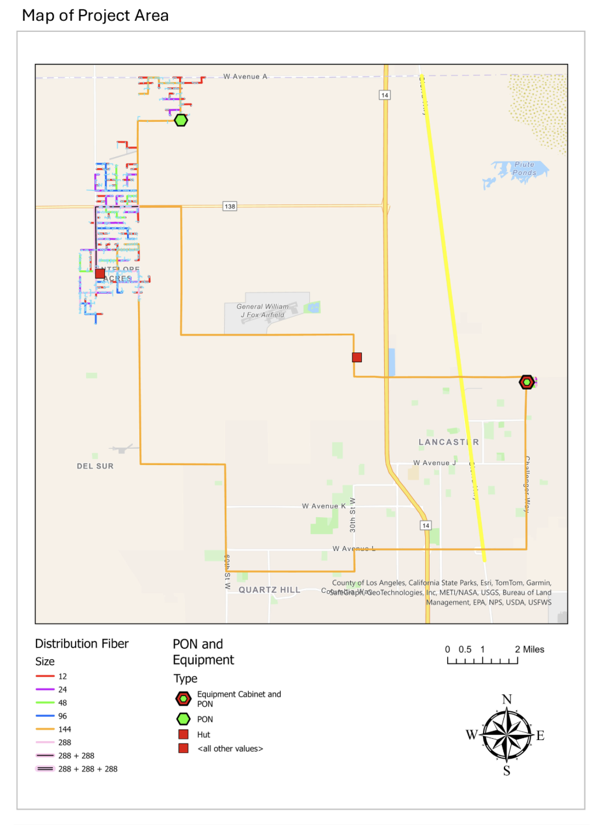
A breakdown of the project included in the application submitted by the Antelope Valley Union High School District to the California Public Utilities Commission (CPUC), indicates that the proposed project seeks to connect to the California State Middle Mile route at two points currently being negotiated in collaboration with state Middle Mile Authorities.

“The award will not be determined until approximately quarter two of next year,” Antelope Valley Union High School District Superintendent Greg Nehen tells ILSR.

Image
Antelope Valley fiber project map

The Antelope Valley Broadband Project would be constructed with 100 percent underground fiber installation, with all fiber-optic cables placed in buried conduit within public rights-of-way, using underground microducts, handholes, and splice enclosures. No aerial deployment is planned for this project, according to project leaders.

Sertex Will Build Lion’s Share Of Maine’s Massive Middle Mile Network

The Maine Connectivity Authority (MCA) has chosen Sertex Broadband Solutions to help build and manage a massive portion of the state’s 536-mile Maine Online Optical Statewide Enabling Network (MOOSE Net) middle mile fiber network.

According to the MCA, Sertex will engineer and construct a 450-mile segment of MOOSE NET on the back of a $30 million grant.

The effort is expected to dramatically improve broadband connectivity for 11,000 homes and businesses as well as 200 community anchor institutions, including rural Maine schools, libraries, and healthcare facilities.

The decision comes after the MCA, Maine’s quasi-governmental public agency in charge of broadband expansion and digital equity, issued a request for proposal (RFP) back in late 2024 looking for partners.

Image
NTIA logo

“Maine's low population density and rural geography make it difficult to attract the same investment that other states have seen over the past two decades, “ MCA President Andrew Butcher said. “We are excited to work with Sertex with their proven track record of delivering a network of this scale, and one that is so critical for our State. MOOSE Net will ensure that Maine has the broadband infrastructure that communities and businesses need to thrive and grow.”

In partnership with the Maine Department of Transportation and The University of Maine System, MCA secured a $30 million competitive grant from the National Telecommunications Information Administration's (NTIA) Enabling Middle Mile Broadband Infrastructure Program. The MCA middle mile proposal was one of 32 selected from a pool of more than 260 applications submitted to the NTIA.

Oakland Unveils Ambitious Plan to Build City-Owned Open Access Network

Just 40 miles north of the heart of Silicon Valley, the City of Oakland has its sights set on implementing an ambitious Broadband Master Plan.

Dubbed the OaklandConnect project – unanimously approved on May 20 by the Oakland City Council – the plan calls for the construction of a city-owned open access fiber network to expand affordable broadband connectivity to over 33,000 households that city surveys indicate are languishing without home Internet service.

While Oakland is served by Comcast and AT&T mostly (with a smattering of Sonic and T-Mobile hotspots), the service in many areas is substandard, expensive, or both – in a city where surveys indicate affordability as the primary reason so many do not have home Internet service.

Image
Oakland fiber map

Once the East Bay city of 436,000 completes network construction, it would be one of the largest publicly-owned open access networks serving a major metro area in the nation – and may serve as inspiration for other large cities to follow suit with a model that’s been proven to bring affordable local Internet choice in monopoly-dominated markets.  

Crews Begin Work On Ft. Bragg, California’s Long-Awaited Muni-Fiber Network

Construction crews have begun work on Fort Bragg’s long-awaited municipal fiber network, which will ultimately bring affordable fiber to the California city of 7,000.

The total cost of the project is estimated to be $17 million. Of that, $10 million will be paid for by a Last Mile Federal Funding Account (FFA) grant from the California Public Utilities Commission (CPUC), awarded in February to help fund the construction of a Middle Mile Broadband Network (MMBN) that will run directly through the heart of Ft. Bragg.

The remaining project costs will be paid for by a $7 million, 20-year loan at 4.85 percent from EverBank, recently approved by the Fort Bragg city council.

“This project is a cornerstone for the future of Fort Bragg,” City Manager Isaac Whippy said of the milestone. “Reliable, high-speed internet is no longer a luxury – it’s a necessity. With this investment, we’re closing the digital divide and making Fort Bragg a more connected, competitive, and inclusive community.”

According to a city announcement, Ft. Bragg’s citywide fiber network, 170 miles north of San Francisco, is being designed with a centralized data hub and 15 Distribution Areas (DAs). Using horizontal directional drilling, crews will install conduit and fiber underground – primarily beneath sidewalks and alleys – connecting to a fiber terminal located near the edge of the city’s right-of-way at each property.

Cold Springs Rancheria Joins Seven Tribes and More Than 20 Public Entities as California Broadband Funding Winners

As federal broadband funding sources face continued uncertainty, California’s massive last-mile grant program continues to plow ahead, looking increasingly like a vital lifeline for communities hoping to ensure that every individual has access to robust, reliable, and affordable Internet access.

Cold Springs Rancheria of Mono Indians was among the applicants celebrating a winning grant application in the California Public Utilities Commission’s (CPUC) latest Federal Funding Account (FFA) announcement.

The grant marks the eighth successful application by a Tribal nation in this program and another in a long list of community-focused projects led by public entities like municipalities.

Image
Cold Springs Rancheria Tribe logo

Cold Spring Rancheria’s application, for up to $1.5 million dollars, will bring much-needed connectivity to a total of 94 units, including 5 anchor institutions, on the Reservation in Fresno County with 100 percent of the households served by this project qualifying as low-income.

Many residents on the Reservation lack access to a terrestrial Internet service offering speeds anywhere near the definition of broadband (100 Mbps Upload/20 Mbps Download). Those that do have access to purported “broadband” speeds must rely on out-of-date DSL connections and, as a result, struggle with slow and spotty connections.

After working for several years to find a viable solution to these connectivity challenges, Tribal officials can now look forward to the fastest and most reliable Internet access via fiber-to-the-home technology.

The new, Tribally-owned broadband network will help the Tribe achieve universal access.

Carver County, Minnesota’s CarverLink Closes In On 100% Gigabit Fiber Coverage

Officials in Carver County Minnesota continue to make great progress expanding affordable fiber access to the county of 111,000 residents, thanks largely to their publicly-owned open access fiber network CarverLink and their partnership with Metronet.

Since its inception in 2013, Carver County has leveraged public and private collaborations and funding with the goal of making symmetrical gigabit (1 Gbps) fiber available to all locations county wide. With the looming completion of its most recent $10.5 million expansion, CarverLink Fiber Manager Randy Lehs told ISLR they’re getting very close to their ultimate goal.

The county currently has ownership and use of nearly 1,200 miles of fiber throughout Carver County and southern Minnesota connecting more than 280 last mile public and community support locations. Many of these markets have no connectivity; many others are stuck on dated, sluggish, patchy connectivity from regional monopolies.

CarverLink doesn’t provide fiber directly to residents and businesses. Instead it long-ago established a partnership with Metronet (formerly Jaguar Communications), to provide gigabit fiber service to businesses and local residential households. Winner of PCMag's “Fastest Major ISP for 2023” award, Metronet provides multi-gigabit fiber to 300+ communities across 17 states.

Image
Carver County map

“CarverLink also oversees the availability of dark fiber within our network that is available to qualified service providers or other entities using dark fiber for new opportunities–open access, open interconnect fiber,” Lehs said.  “And through our open access fiber, services are also available from Broadband-MN and Arvig.”

New ISP Halo Fiber Leveraging ARPA Grants To Help Bridge Alabama’s Digital Divide

A new provider named Halo Fiber is hoping to leverage hundreds of millions in recent Alabama middle mile broadband network grants to extend affordable fiber broadband to state residents long stuck on the wrong side of the digital divide.

The new provider says it’s not quite ready to reveal full launch details (including target markets, speeds, or pricing), but told ILSR it should enter its first four fiber markets later this year thanks in part to a flood of American Rescue Plan Act (ARPA) funding in the state.

“We will be releasing pricing and target markets early this summer in May or June,” Halo Co-founder and CEO Brian Snider told ILSR. “Speeds are still being finalized as well but they will be symmetrical from 250 up and down to multi gig options.”

Image
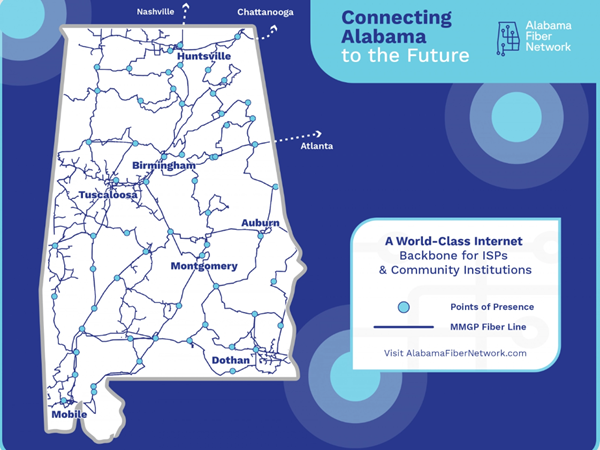
Alabama Fiber Network map

Halo says its primary focus will be to partner with public and private entities to build fast and affordable broadband networks, empower access to better education, telehealth, and economic opportunities, and ensure quality customer service in neglected markets.

“Ten years ago, myself and other members of the Halo team worked on an initiative that identified infrastructure gaps across the entire state,” Snider said in additional comments to BamaBuzz.

“We found that was a big gap in middle mile connectivity – especially in Alabama’s Black Belt where there was almost no high speed infrastructure,” he added.

Nearly a fifth of Alabama residents – or just over a million people – lack access to reliable high speed Internet.

Frontiers in Fiber Optic Sensing | Episode 107 of the Connect This! Show

Connect This! Show

Catch the latest episode of the Connect This! Show, with co-hosts Christopher Mitchell (ILSR) and Travis Carter (USI Fiber) joined by regular guests Kim McKinley (TAK Broadband) and Doug Dawson (CCG Consulting) along with special guest Paul Dickinson (Dura-line, Fiber Optic Sensing Association, and Aii) to talk about the future of fiber optic sensing to do everything from avoid fiber cuts from construction equipment to monitor traffic to detect pipeline leakages. They also hit a grab-bag of other topics, including:

Join us live on February 7th at 2pm ET, or listen afterwards wherever you get your podcasts.

Email us at [email protected] with feedback and ideas for the show.

Subscribe to the show using this feed or find it on the Connect This! page, and watch on LinkedIn, on YouTube Live, on Facebook live, or below.


This show was more technical than is usual, even for Connect This!. See transcript below. Some additional resources mentioned in the episode include:

Smarter Infrastructure through Distributed Fiber Optic Sensing with Paul Dickinson

Fiber Broadband Association Awards Concepts that Advance Subscriber Experience at Fiber Connect 2024

G.652.D vs G.657.A1 vs G.657.A2 Fiber Optic Cabling: What’s the Difference?

A New Class of Sensing Products for DAS – AcoustiSens® Wideband Vibration Sensor Fibers and Cables

AcoustiSens® Wideband Vibration Sensor Fiber

The Alliance for Innovation and Infrastructure

Common Ground Alliance

Fiber Deployment Cost Annual Report, 2024

Meet the crypto officers: How the internet is controlled by 14 people with seven secret keys

Open Access ErieNet Fiber Network Gets Underway In Western New York

Erie County, New York’s ErieNet broadband initiative is poised to begin construction in Buffalo, NY, after the Buffalo Common Council recently passed a resolution approving the Telecommunications License Agreement with ErieNet LDC. The approval is a major step toward bringing affordable next-gen broadband access to long-neglected parts of Western New York.

ErieNet is a nonprofit, local development corporation (LDC), launched in September 2022, designed to construct and manage a municipal-based open-access fiber optic backbone. ECC Technologies has been chosen to handle sales, marketing, and tech support operations for the network.

“Construction has already begun for ErieNet with underground conduit installations, and utility work necessary to make utility poles ready for ErieNet fiber optic cable attachments,” ECC Technologies’ VP Matthew Crider tells ISLR. “We expect segments of our network to come online beginning in March of 2025; and have the ErieNet 400+ mile open access network substantially built by the end of 2025.”

Image
ErieNet map

“Bringing high-quality broadband to Erie County begins in the City of Buffalo, and the Common Council’s approval opens up the way to make that happen,” Erie County Executive Mark Poloncarz said in a prepared statement.

Crider told ILSR that the current construction budget for the network is approximately $34 million, funded through American Rescue Plan Act (ARPA) broadband grants.

California Announces Another $207 Million In Last Mile Broadband Grants

California’s $2 billion Last Mile Federal Funding Account Grant Program (FFA) has announced another $207 million in new broadband grants across Amador, Los Angeles, and Solano Counties.

The FFA program, part of a broader $6 billion California “Broadband For All” initiative, is aimed at boosting broadband competition and driving down costs statewide.

According to the state’s announcement, $61 million in new grants were awarded by the California Public Utilities Commission (CPUC) for five Last Mile FFA broadband infrastructure grant projects in Amador and Solano Counties, bringing affordable fiber Internet access to approximately 10,000 Californians.

Image
Vallejo CA welcome sign

The CPUC award details indicate that the grants will be awarded to the Golden State Connect Authority (GSCA) and the City of Vallejo to help bring fiber access to 2,278 unserved locations in Amador and Solano counties.

The City of Vallejo will leverage $3.8 million in state grants to complete four different projects laying predominantly underground fiber, with the city retaining ownership of the finished network and Smart Fiber Networks providing last mile consumer-facing service.