
Community Broadband Media Roundup - August 19

Florida
Gainesville City Commission continues with broadband network analysis, backpedals on plastic bag ban by Ethan Magoc, WUFT
Illinois

Fast, affordable Internet access for all.
Florida
Gainesville City Commission continues with broadband network analysis, backpedals on plastic bag ban by Ethan Magoc, WUFT
Illinois

City Utilities (CU) in Springfield, Missouri, recently announced that over the next four years, they will expand the community’s fiber optic network. CenturyLink will lease dark fiber on the Springfield infrastructure in order to offer Fiber-to-the-Home (FTTH) Internet access to residents and businesses in Springfield and in areas beyond the city.

Earlier this year, Anacortes, Washington, shared an update on their plans for developing their Fiber-to-the-Home (FTTH) network. Their project has been moving along and now they’re seeking an Outside Plant Coordinator as they work on construction.

You are interested in Internet policy issues, but there aren't too many places that offer internships to suit your requirements. You feel the need to help build more resilient economies and encourage a more vibrant democracy and believe that your interest in technology is a great place to start. You love research and writing.

Central Alabama Electric Cooperative (CAEC) will join the increasing number of electric cooperatives that provide broadband access. They've been developing a plan to build a high-speed network and recently announced more details.

For years, Palo Alto residents have patiently waited for the city to move forward on building a citywide municipal Fiber-to-the-Premises (FTTP) network.

When we last shared news from Cleveland Heights, Ohio, community leaders were beginning to discuss the possibilities of a community network. Over the past 15 months, people in the city of around 46,000 have become committed to the idea of choosing the most effective path.
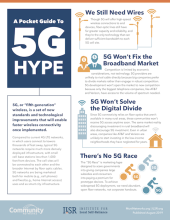
It’s difficult to separate 5G fantasy from reality as reported in traditional news sources. Misunderstandings surrounding the demands and capabilities of 5G has snowballed, creating an incorrect assumption that the technology will solve America’s many connectivity problems. It’s true that 5G is an improvement, but it has limitations. In A Pocket Guide to 5G Hype, we address the most repeated errors surrounding 5G and explain why the technology should be considered another tool, not an exclusive remedy.

Earlier this week, Presidential hopeful Elizabeth Warren released her Plan to Invest in Rural America, which contained a framework for improving broadband policy and expanding high-quality Internet access.

Update: As of May 25, 2021, only 17 states retained their municipal barriers. Arkansas and Washington have removed theirs.

In the Internet access industry, large corporations typically fight to maintain their positions as monopolies. Even if they have no intention of serving certain communities, big cable and telecom companies work to prevent others from gaining a foothold, fearful that they may someday lose subscribers.

In June, Indiana’s Hendricks Power Cooperative and Endeavor Communications Cooperative announced that they will be partnering to expand fiber optic connectivity in west central Indiana.
California
Most Internet service providers are gone. Sonic has survived — and thrived by Sophia Kunthara, San Francisco Chronicle
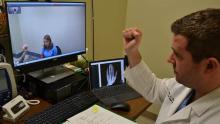
Thanks to NC Broadband Matters and Fiona Morgan for sharing this story that describes one family's need for telehealth applications and how changes in North Carolina state law could help boost infrastructure investment.
As you make plans for the fall, consider adding Lake Geneva, Wisconsin, to your list. From September 30th to October 2nd, broadband experts, advocates, and practitioners will be gathering there for the Great Lakes Connect Broadband Development Conference.

The South Bay Cities Council of Governments (SBCCOG), a group of 16 cities, has joined with Los Angeles County and will work with American Dark Fiber to develop a fiber optic network throughout the region.
Unclogging the Streets, Now and Tomorrow

Thanks to the Blandin on Broadband blog for bringing our attention to this story!
Alabama
Broadband mapping effort to ramp up in Alabama — ‘Absolutely essential’ by Sean Ross, Yellowhammer News
Arkansas
Chicopee has not only reached their crossroad, they’re building it. After debating the pros and cons, the city of around 60,000 people in western Massachusetts recently began to develop their Fiber-to-the-Home (FTTH) residential pilot project.