
Officials for the volunteer-run nonprofit NYC Mesh have been awarded a new $898,000 grant from New York State’s ConnectALL initiative that should help the project expand affordable wireless Internet access to the Big Apple’s most vulnerable populations.
The grant is one of $8.3 million in new grants recently awarded by New York State providing much-needed financial assistance to community or municipally run broadband connectivity initiatives through the Connectivity Innovation – Business Model Awards, which support organizations using “novel financing strategies” to serve low-income and rural communities.
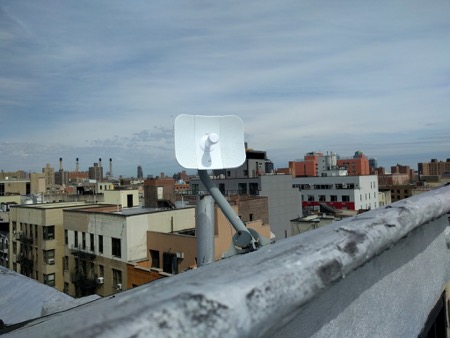
“It's mostly fixed wireless, though we'll rent dark fiber in a couple places if necessary,” NYC Mesh’s Ash Wolfson tells ILSR, adding that the expanded wireless links will leverage equipment from Ubiquiti (Airfiber and Wave), with hardware from Mikrotik (RB5009 and CCR2116) or Netpower (16P and CRS317) for routing and switching.
According to NYC Mesh officials, NYC Housing Preservation & Development will help the volunteer-run nonprofit in identifying priority neighborhoods underserved by traditional commercial ISPs, ultimately connecting at least 500 additional low income households to its affordable, community-run network.
“Our agency is excited to partner with NYC Mesh on expanding our Neighborhood Internet program model to Central Brooklyn, where nearly 25 percent of households lack Internet access,” Dave Seliger, NYC Housing Preservation & Development Chief Digital Equity Officer says of the expansion.
NYC Mesh was one of five organizations recognized under the Connectivity Innovation – Business Model Awards, alongside Connect Humanity, Computers 4 People, The New York Public Library, and People’s Choice Communications.
“More than ever before, fair and open access to the Internet is necessary for participation in modern society, enabling higher quality access to banking, healthcare, education, news, and much more,” NYC Mesh board member Matthew Boyd says of the effort. “This grant and our collaboration with NYC Housing Preservation & Development will allow us to more rapidly bring reliable, affordable, high-speed connectivity to those most in need in the city.”
Do It Yourself
NYC Mesh’s volunteer-run, open-source, broadband network was first launched in 2014, ultimately becoming the largest community-based mesh network in the Americas, and the second largest grassroots mesh network in the world.
The project was a direct response to the failure by large private-sector regional telecom monopolies like Verizon, Time Warner Cable, and Charter to deliver affordable, competitive, fast, and reliable broadband equitably across the city.
A December 2024 study by State Comptroller Thomas P. DiNapoli found that approximately one in four NYC residents lack home broadband access, and 46 percent of NYC families living below the federal poverty line lack home Internet access, largely due to high monthly costs.
Roughly 18 percent of city residents — or more than 1.5 million New Yorkers — have neither a home broadband connection nor a mobile data plan.
Up to 2 million NYC households were eligible for the FCC’s Affordable Connectivity Program (ACP), but only 500,000 applied, leaving $10 to $15 million per month in potential savings unclaimed. The ACP was discontinued by Republican lawmakers to save money, but later studies found the program generated billions in benefits well beyond its annual cost.
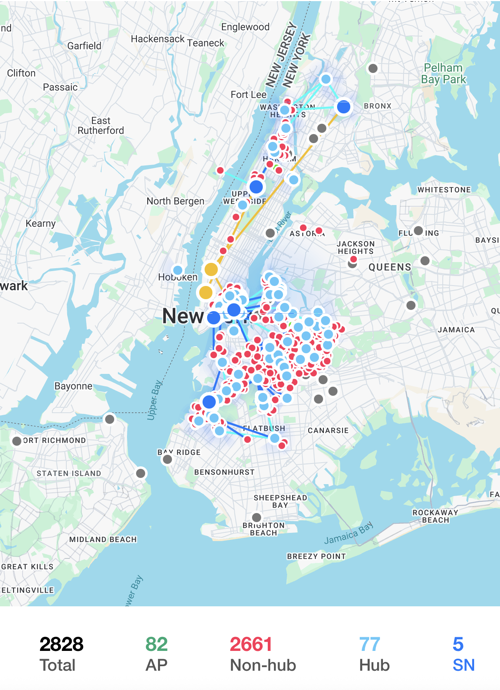
New NYC Mesh users purchase the hardware (usually around $240), and the group asks for a one-time $50 fee for installation and a pay-what-you-can monthly donation to keep the lights on. The organization’s stats page indicates that NYC Mesh has 1,819 active location installations, and over 2,000 active member nodes throughout the five boroughs.
“Over the past few years we've learned a lot about how to operate a network that's a real alternative to commercial providers,” Wolfson says. “We've worked closely with the city over the past few years to connect non-profit housing, and we've learned a lot about deploying infrastructure, how to leverage our volunteer base, and when to turn to contractors.”
“This will be our most ambitious expansion yet, so it will really test how well we've learned to do that. We're also still learning how to reconcile the more grassroots, volunteer driven side of the organization with the growth of large buildings that often mean lower engagement with residents and leaning more on contractors.”
With the Trump administration and federal lawmakers abandoning efforts to rein in broadband prices and protect affordable, equitable broadband access, such state and local efforts to bridge the digital divide have become more important than ever.
New York State’s latest round of subsidies also delivered $3.8 million to Genesee County to deploy a fixed wireless network to serve 21,575 locations across 450 square miles, and $500,000 to People’s Choice Communications to expand a worker-owned cooperative hybrid mesh and fiber network providing high-speed broadband for as little as $20 per month.
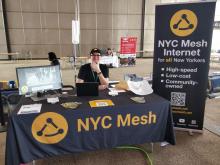
Header image of NYC Mesh at Maker Fair courtesy of NYC Mesh Facebook page
Inline image of NYC Mesh radio receiver install courtesy of NYC Mesh Facebook page
Inline image of NYC Mesh receiver on side of building courtesy of NYC Mesh Facebook page