

By
on

Monticello Minnesota may be located 40 miles outside Minneapolis, but it is the center of the planet when it comes to FTTH competition. We have tried and cannot identify another community localed on planet earth with two separate FTTH networks going head to head across the entire community.
We have long written about Monticello, most recently to look at hypocritical criticism of the project (which gives me an opportunity to note a similar dynamic in Lafayette, Louisiana). And we have covered the disappointing news that the network has not produced enough revenue to make full bond payments.
Short explanation for how Monticello came to be unique in having two FTTH networks: Monticello had poor Internet access from Charter and telephone company TDS. Each refused to invest after local businesses and elected officials implored for better networks. Monticello started building its own FTTH network (Monticello FiberNet) and TDS sued to stop the project while suddenly decided to upgrade its slow DSL to fiber. Lawsuit was tossed out and Monticello finished its network.
In most community fiber networks, the DSL provider seems to fade away because it cannot offer the fast speeds of fiber or cable, so the market basically remains a duopoly with the community network replacing the telephone company (which continues to offer cheap, slow DSL to a small number of customers). But in Monticello, Charter and TDS engaged in a price war, which has really hurt the City's ability to generate enough revenue to pay its debt.
Price wars are very hard on new market entrants because they have to amoritze the cost of their investment whereas the incumbents often have already done so. This means incumbents can almost always offer lower prices if they are determined to do so.
In many communities, we have lacked clear evidence of predatory pricing - that is pricing below the actual cost of service to run competitors out of business. This would violate federal law (if any agency bothered to enforce it). Charter gave us that evidence in Monticello.
Since then, the deals have remained amazing in Monticello, far surpassing what cable-funded crazy people in DC pretend is competition between DSL and cable in the majority of the country.
TDS is now offering a deal that far surpasses anything available in the Minneapolis/Saint Paul metro - over 190 channels (including DVR and HD), 50 Mbps Internet (50 down, 20 up I believe), and telephone for $70/month for one year with no contract. The price goes up after year one, but doesn't go back to full price until after year 2 ... at which point you will likely get another deal if there are still more than 2 high speed choices in the market.
 TDS is also regularly running full page advertisements regularly in the local newspaper. How many local newspapers would love to see regular big-ad buys like this one? If enough communities build networks, perhaps the resulting advertising bumps will help local newspapers stay in print!
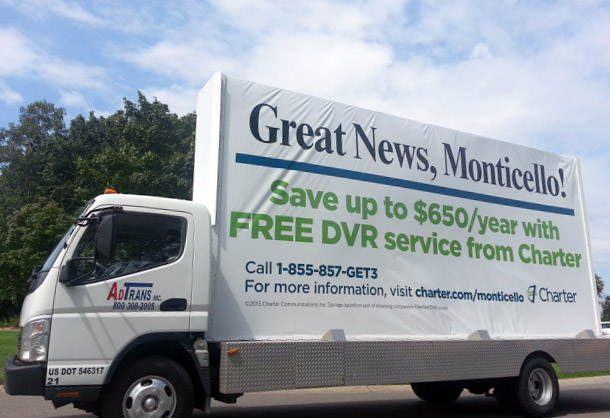
Charter has gone beyond newsprint and static billboards with a big truck advertising Monticello residents a free DVR that will save them $650/year (which is phrased in a way that makes you think they are charging WAYYYY too much for DVRs!).
TDS is also regularly running full page advertisements regularly in the local newspaper. How many local newspapers would love to see regular big-ad buys like this one? If enough communities build networks, perhaps the resulting advertising bumps will help local newspapers stay in print!
Charter has gone beyond newsprint and static billboards with a big truck advertising Monticello residents a free DVR that will save them $650/year (which is phrased in a way that makes you think they are charging WAYYYY too much for DVRs!).
 These advertising strategies are in addition to many door-to-door sales people from both TDS and Charter. Both are boosting local employment opportunities for these sales people far beyond what they would do absent Monticello FiberNet.
Existing Charter customers outside of Monticello might be interested in how cable promos in Monticello compare to in their communities where there is no real competition for the cable giant. Here is an 8 page glossy advertisement they have been using [pdf].
Charter is also going after small businesses with a 30 Mbps asymmetrical package for $55/month when bundled with business phone. I can only imagine how many businesses in areas without a real choice would like that deal.
These advertising strategies are in addition to many door-to-door sales people from both TDS and Charter. Both are boosting local employment opportunities for these sales people far beyond what they would do absent Monticello FiberNet.
Existing Charter customers outside of Monticello might be interested in how cable promos in Monticello compare to in their communities where there is no real competition for the cable giant. Here is an 8 page glossy advertisement they have been using [pdf].
Charter is also going after small businesses with a 30 Mbps asymmetrical package for $55/month when bundled with business phone. I can only imagine how many businesses in areas without a real choice would like that deal.

 However, the Monticello FiberNet business service is far superior, particularly as it is symmetrical and fast upstream makes a huge difference for local businesses. Business services from the city owned FiberNet starts 10 Mbps symmetrical at $41.95 and the list sheet tops out at 100 Mbps for $350/month.
Update: Fibernet Business Services prices have decreased on the faster Internet connections. 30 Mbps symmetrical is $99/month and 100 Mbps symmetrical is $199/month.
We don't have enough information to compare what it would cost a business to connect multiple sites with point to point gigabit links, but we would guess there could be more than $1,000 savings each month from such a service based on FiberNet pricing vs Charter or TDS.
Going through all these deals, a few things have become apparent.
First, DSL and cable are not engaged in real competition. Adding a third player really changes the market in ways that satellite and 4G wireless Internet do not.
Second, most of the competition from the big corporations is aimed at taking subscribers from rivals by temporarily lowering prices rather than attempting to keep their own subscribers happy with their services. Most of the deals are only available to new customers, incentivizing households to regularly switch providers, which is costly to all competitors (churn). Community owned networks by contrast tend not to offer these short term promo deals and invest in keeping existing subscribers happy.
Third, the strategy of TDS and Charter would not be possible if they were not cross-subsidizing from distant, non-competitive markets. They may not be losing money on all the customers that take these deals, but the increased marketing costs and extremely low priced deals are aimed at driving a competitor from the market, not at merely preserving market share. Their ability to cross-subsidize (and the initial frivolous lawsuit) have damaged Monticello's business plan to the point where it has had to transfer public funds from the liquor store and negotiate with bond holders over a significant haircut.
And finally, whatever this network may end up costing city taxpayers, it will likely be less than the savings from all of these lower prices and indirect benefits such as not losing employers that could not be competitive when only having last-generation Internet access from unreliable DSL. That doesn't help the City to make its debt payments, but it sure makes Monticello a better place to live.
However, the Monticello FiberNet business service is far superior, particularly as it is symmetrical and fast upstream makes a huge difference for local businesses. Business services from the city owned FiberNet starts 10 Mbps symmetrical at $41.95 and the list sheet tops out at 100 Mbps for $350/month.
Update: Fibernet Business Services prices have decreased on the faster Internet connections. 30 Mbps symmetrical is $99/month and 100 Mbps symmetrical is $199/month.
We don't have enough information to compare what it would cost a business to connect multiple sites with point to point gigabit links, but we would guess there could be more than $1,000 savings each month from such a service based on FiberNet pricing vs Charter or TDS.
Going through all these deals, a few things have become apparent.
First, DSL and cable are not engaged in real competition. Adding a third player really changes the market in ways that satellite and 4G wireless Internet do not.
Second, most of the competition from the big corporations is aimed at taking subscribers from rivals by temporarily lowering prices rather than attempting to keep their own subscribers happy with their services. Most of the deals are only available to new customers, incentivizing households to regularly switch providers, which is costly to all competitors (churn). Community owned networks by contrast tend not to offer these short term promo deals and invest in keeping existing subscribers happy.
Third, the strategy of TDS and Charter would not be possible if they were not cross-subsidizing from distant, non-competitive markets. They may not be losing money on all the customers that take these deals, but the increased marketing costs and extremely low priced deals are aimed at driving a competitor from the market, not at merely preserving market share. Their ability to cross-subsidize (and the initial frivolous lawsuit) have damaged Monticello's business plan to the point where it has had to transfer public funds from the liquor store and negotiate with bond holders over a significant haircut.
And finally, whatever this network may end up costing city taxpayers, it will likely be less than the savings from all of these lower prices and indirect benefits such as not losing employers that could not be competitive when only having last-generation Internet access from unreliable DSL. That doesn't help the City to make its debt payments, but it sure makes Monticello a better place to live.
TDS is also regularly running full page advertisements regularly in the local newspaper. How many local newspapers would love to see regular big-ad buys like this one? If enough communities build networks, perhaps the resulting advertising bumps will help local newspapers stay in print!
Charter has gone beyond newsprint and static billboards with a big truck advertising Monticello residents a free DVR that will save them $650/year (which is phrased in a way that makes you think they are charging WAYYYY too much for DVRs!).
These advertising strategies are in addition to many door-to-door sales people from both TDS and Charter. Both are boosting local employment opportunities for these sales people far beyond what they would do absent Monticello FiberNet.
Existing Charter customers outside of Monticello might be interested in how cable promos in Monticello compare to in their communities where there is no real competition for the cable giant. Here is an 8 page glossy advertisement they have been using [pdf].
Charter is also going after small businesses with a 30 Mbps asymmetrical package for $55/month when bundled with business phone. I can only imagine how many businesses in areas without a real choice would like that deal.
However, the Monticello FiberNet business service is far superior, particularly as it is symmetrical and fast upstream makes a huge difference for local businesses. Business services from the city owned FiberNet starts 10 Mbps symmetrical at $41.95 and the list sheet tops out at 100 Mbps for $350/month.
Update: Fibernet Business Services prices have decreased on the faster Internet connections. 30 Mbps symmetrical is $99/month and 100 Mbps symmetrical is $199/month.
We don't have enough information to compare what it would cost a business to connect multiple sites with point to point gigabit links, but we would guess there could be more than $1,000 savings each month from such a service based on FiberNet pricing vs Charter or TDS.
Going through all these deals, a few things have become apparent.
First, DSL and cable are not engaged in real competition. Adding a third player really changes the market in ways that satellite and 4G wireless Internet do not.
Second, most of the competition from the big corporations is aimed at taking subscribers from rivals by temporarily lowering prices rather than attempting to keep their own subscribers happy with their services. Most of the deals are only available to new customers, incentivizing households to regularly switch providers, which is costly to all competitors (churn). Community owned networks by contrast tend not to offer these short term promo deals and invest in keeping existing subscribers happy.
Third, the strategy of TDS and Charter would not be possible if they were not cross-subsidizing from distant, non-competitive markets. They may not be losing money on all the customers that take these deals, but the increased marketing costs and extremely low priced deals are aimed at driving a competitor from the market, not at merely preserving market share. Their ability to cross-subsidize (and the initial frivolous lawsuit) have damaged Monticello's business plan to the point where it has had to transfer public funds from the liquor store and negotiate with bond holders over a significant haircut.
And finally, whatever this network may end up costing city taxpayers, it will likely be less than the savings from all of these lower prices and indirect benefits such as not losing employers that could not be competitive when only having last-generation Internet access from unreliable DSL. That doesn't help the City to make its debt payments, but it sure makes Monticello a better place to live.Geoterm