
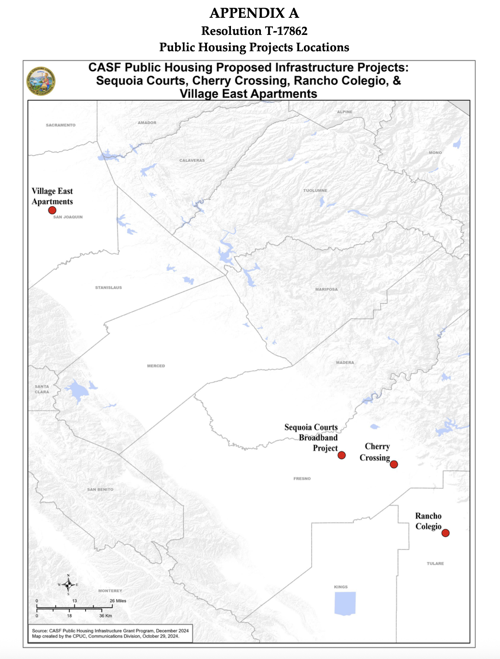
California community leaders, activists, and a coalition of partners gathered earlier this month to celebrate the launch of a new broadband infrastructure project at Sequoia Courts and Sequoia Courts Terrace in Fresno, bringing free high-speed Internet access to more than 350 residents.
The plan to bring broadband access to residents at no cost was made possible through a partnership with Fresno Housing, Fresno Coalition for Digital Inclusion (FCDI), United Way Fresno & Madera Counties, and Central Valley Community Foundation (CVCF). The Fresno Housing Authority will own and maintain the finished network.
The expansion, which leverages a hybrid fiber-wireless approach, was directly funded by California’s ambitious Broadband For All initiative, a $6 billion effort aimed at dramatically boosting broadband competition and access across the Golden State. Much of that effort was funded, in part, by the 2021 American Rescue Plan Act (ARPA).
The Fresno grant was for $471,000, with $1,000 or less per unit cost to build, according to details on the project included in a California Public Utilities Commission (CPUC) filing, which notes that the enterprise-grade wireless mesh network used in the project was more costly, but provided “flexibility and scalability for future expansion.”
“The Fresno project will be deploying fiber connected Wi-Fi build-outs to several public housing duplexes using single-mode fiber interconnections to each residential unit,” the CPUC filing indicates. “The residential duplexes, spanning over 17 acres, will be connected to Fresno’s fiber backhaul network via matching funds. The project will meet and is capable of exceeding 100 Mbps download/20 Mbps upload speed.”
Project funding pulled from localized grant accounts through the CPUC, Digital Divide Grant Program and the California Advanced Services Fund (CASF), which focus specifically on low-income urban and rural neighborhoods.
“This investment connects families to education, telehealth, workforce development, job opportunities, and critical community resources—all while saving residents up to $80 per month that can be redirected toward groceries, gas, transportation, utilities, and other household essentials,” local reform group Fresno Housing said of the launch.
Private market failure has resulted in a stark digital divide between affluent and marginalized communities across rural and urban communities alike. Data has consistently shown that lower income, marginalized communities often wind up paying significantly more money for notably slower service than their more affluent, less diverse counterparts.
One recent study by digital equity organization Digital Equity LA found that residents in higher poverty neighborhoods (which tend to be people of color) pay anywhere from $10 to $40 more per month than mostly white, higher-income neighborhoods for the exact same service.
These highly-localized efforts come in the wake of Republican Congressional leaders killing the federal Affordable Connectivity Program (ACP), which provided a $30 discount off of monthly Internet access for 23 million households. While Senate Republicans claimed they cut funding to save money, subsequent surveys showed the ACP generated significantly more financial benefits than it cost.
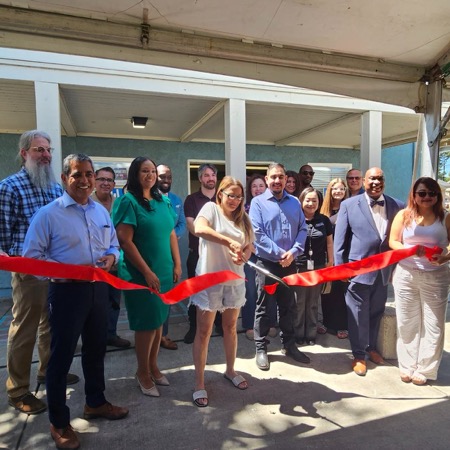
The Fresno ribbon-cutting celebration highlighted the completion of the physical network installation, with local students and families participating in live demonstrations to showcase the immediate, life-changing shift from unreliable mobile data to more reliable Internet access.
“With the network live, over 160 school-age children living in the complex can now access
free, quality internet for everyday education, healthcare, and work activities,” coalition leaders said of the milestone.
Inline image of ribbon cutting ceremony courtesy of Fresno Housing Facebook page
Inline map of project area courtesy of CPUC grant resolution