
mobile

Content tagged with "mobile"

Related Topics
Displaying 21 - 30 of 33

Straight Talk About 5G; Potential, Limitations, Hype - Community Broadband Bits Podcast 299

If we want to talk technical stuff on the Community Broadband Bits podcast, we know Eric Lampland is one of the best guys to call. Eric is Founder and Principal of Lookout Point Communications. Earlier this month, he and Christopher presented information about 5G at the Iowa Association of Municipal Utilities Telecommunications Conference. They took some time during the conference to sit down with the mics and have a conversation for episode 299 of the podcast.

There’s been scores of hype around the potential of 5G and, while the technology certainly opens up possibilities, Eric and Christopher explain why much of that hype is premature. 5G networks have been touted as an affordable answer to the pervasive problem of rural connectivity, but like other wireless technology, 5G has limitations. Eric breaks down the differences between evolutions of wireless technologies up to now and explains what needs they will fulfill and where we still have significant work to do.

Eric also helps us understand GPON and NG-PON2, the technology that much of Fiber-to-the-Home (FTTH) relies upon. He describes how the technology is evolving and how new possibilities will influence networking.

For information on 5G, we recommend you check out these resources from Next Century Cities:

Guest Blog: What Can Cities Do To Prepare for the Next Generation of Mobile Networks? by Tony Batalla, head of Information Technology for the city of San Leandro, California.

Next Century Cities Sends Mayoral Letter to FCC in Defense of Local Decision-Making, Releases New Market Research on 5G, Smart City Deployments - Read the full letter here.

Report: Status Of U.S. Small Cell Wireless/5G & Smart City Applications From The Community Perspective, by RVA, LLC Market Research & Consulting

Fact sheet on the RVA report.

This show is 33 minutes long and can be played on this page or via Apple Podcasts or the tool of your choice using this feed

Transcript below. 

We want your feedback and suggestions for the show-please e-mail us or leave a comment below.

Listen to other episodes here or view all episodes in our index. See other podcasts from the Institute for Local Self-Reliance here.

Thanks to Arne Huseby for the music. The song is Warm Duck Shuffle and is licensed under a Creative Commons Attribution (3.0) license.

FCC Ends Speculation On Broadband Speeds, Mobile Internet Access

On January 18th, the FCC ended months of speculation and released a fact sheet that included several key conclusions to be included in the 2018 Broadband Deployment Report. The most important is that the FCC continues to recognize that mobile Internet access is not a substitute for fixed access. The Commission has also decided to leave the definition of broadband at 25/3 Mbps (down/up).

Download the fact sheet here.

“Broadband” Will Not Slow Down

The Commission had proposed reverting to a slower definition of broadband from the current standard of 25 Megabits per second (Mbps) download and 3 Mbps upload. Under Tom Wheeler’s leadership, the FCC decided to update the standard to its current definition in January 2015, but current Chairman Ajit Pai and other Republican Commissioners suggested in last year’s Notice of Inquiry (NOI) that the FCC might effectively take us backward to a 10 Mbps/1 Mbps standard. 

The suggestion rankled better connectivity advocates and Internet users. Many recognized that lowering the standards would make it easier for the FCC to proclaim that the U.S. was making strong progress toward universal household deployment. The Commission would have been justified making such a conclusion under the standard because large sections of rural American receive DSL, fixed wireless, satellite, or mobile Internet access that would meet a lowered 10/1 standard.

Hundreds of thousands of people, organizations, and businesses filed comments opposing a slower standard. Many of them live in areas where 10/1 speeds are already available but who have been waiting for better options. Commissioners Rosenworcel and Clyburn also spoke out against the lowering broadband speeds. 

Commissioner Rosenworcel tweeted:

The Challenge of Mobile Only - Community Broadband Bits Podcast 287

With the Federal Communications Commission Republicans poised to redefine broadband to include slow, unreliable, and often bandwidth-capped mobile service, we talk with two high school students from southeast Ohio, Herron Linscott and Lilah Gagne, that have succeeded despite the lack of fixed broadband access in their homes. Soon the FCC may include those homes as having broadband though they clearly don't fit the description of what any sane person would call advanced telecommunications. 

We start off episode 287 of the Community Broadband Bits podcast with Next Century Cities Executive Director Deb Socia, who reminds us why mobile Internet access is not an adequate subsitute for fixed access. Next Century Cities has launched the Mobile Only Challenge - share MobileOnlyChallenge.com around - to highlight the challenges of relying solely on mobile Internet access. 

We then talk to Herron Linscott and Lilah Gagne about their experiences in southeast Ohio as high school students without home fixed Internet access. Both have had to schedule lots of time away from home in order to complete assignments and partake in extra-curricular activities and both offer a window into the importance of connectivity for the next generation. 

This show is 25 minutes long and can be played on this page or via Apple Podcasts or the tool of your choice using this feed

Transcript below. 

We want your feedback and suggestions for the show-please e-mail us or leave a comment below.

Listen to other episodes here or view all episodes in our index. See other podcasts from the Institute for Local Self-Reliance here.

Thanks to Arne Huseby for the music. The song is Warm Duck Shuffle and is licensed under a Creative Commons Attribution (3.0) license.

Join The January #MobileOnly Challenge

In addition to shredding network neutrality, the FCC is making it more difficult for us to obtain high-quality Internet access. Under the Obama administration, the FCC raised standards for broadband, but the new administration is set on driving us backward. Chairman Ajit Pai and the other Republicans in the FCC want to equate mobile Internet service with home connections. They also want to revert to a slower definition of broadband. We have to show them that their plan is ludicrous and shortsighted; the #MobileOnly Challenge is a start.

What Is The #MobileOnly Challenge?

It seems as if Pai and his chums aren’t aware of what it’s like to depend solely on a mobile connection, especially for people in places where mobile service is spotty or slow. In order to share the experience, the Institute for Local Self-Reliance, along with nine other organizations and FCC Commissioners Clyburn and Rosenworcel, are supporting the #MobileOnly Challenge.

For one day in January, participants will put away their laptops and use only their smartphones to access the Internet. During the day, they will report on their experience via social media with #MobileOnly in the tweet, FB post, Instagram post, or other notification about the experience.

The FCC expects to vote on the mobile Internet access and broadband definition question by February 2, 2018. Right now, the Commission defines broadband as 25 Mbps download and 3 Mbps upload; they want to redefine that speed to 10 Mbps/1 Mbps. January will be the time to let them know that we don’t want a slower Internet — we want an Internet for the future.

How Do I Do It?

Choose one day in January to take the challenge and on that day use ONLY your mobile device to access the Internet. During that day, share your experiences on social media using #MobileOnly. When your day is over, encourage your friends to also take the challenge. Don’t forget to contact @FCC during and after your challenge to let them know that mobile only is inadequate for Americans in the 21st century.

Get More Info, Spread The Word

Commenting On FCC Proceedings At ILSR

This fall, nonprofits and other organizations with an interest in constructive broadband policy have worked to help the new administration’s FCC through the public comment process. We’ve let readers know about opportunities to share their thoughts with the Commission and we’ve submitted comments separately and with other likeminded groups.

Modernizing the Form 477 Data Program

The Commission asked for comments on the method in which it collects data regarding where broadband is accessible. ISPs provide information to the FCC based on which census blocks they serve. We’ve often criticized this approach because it grossly overstates where coverage is available, especially in rural areas where census blocks tend to be large. 

Read our ideas for improvements to the Form 477 data collection, which include obtaining more detailed geographic information, minimum and maximum speeds, and pricing information.

Connect America Funding Phase II Bidding Procedures and Program

In order to help bring better connectivity to rural areas, the FCC distributes Connect America Funds (CAF) to entities such as companies and cooperatives to build broadband infrastructure. The process involves bids from these entities. The FCC is considering changes to the current process and bidding procedures, including what types of projects qualify for funding. The Commission asked for comment after proposing a long list of possible changes.

We recently spoke with Jon Chambers of Connexon, who provided more detail about the program and offered his thoughts on CAF and the possible changes.

Read our Reply Comments, that address issues we feel need attention, including the Carrier of Last Resort guarantee, more opportunities for rural cooperatives, and our concern that the FCC will attempt to equate subpar satellite and mobile broadband with high-quality connectivity. We filed our Reply Comments with Public Knowledge, Appalshop, and a long list of other organizations concerned about Internet access in rural America.

Garrett County Builds Better Connections By Combining Technologies in Rural Maryland - Community Broadband Bits Podcast 275

Maryland may be home to our nation’s bustling, urban capital, but on the other side of the state are the Appalachians and many rural communities that struggle with poor Internet access. One of those communities is Garrett County. Residents, businesses, and institutions have limped along for years using outdated connections.  Some people don’t have any access to the Internet; all that is changing.

In episode 275 of the Community Broadband Bits podcast, the county’s Natural Resources Business Specialist Cheryl DeBerry and county CIO Nathanial Watkins join Christopher to discuss the initiative that is changing the local connectivity landscape.

Cheryl, Nathaniel, and Christopher discuss the project that combines fiber, fixed wireless, and TV white space technologies in order to reach people and businesses across the county. They also talk about how a significant portion of people in the rural community simple can’t afford the high cost of satellite and how mobile Internet access just doesn’t cut it in a rural area like Garrett County. Cheryl describes how the project is an economic development initiative and Nathaniel shares more details about their need to combine technologies and the results.

This show is 23 minutes long and can be played on this page or via Apple Podcasts or the tool of your choice using this feed

Transcript below. 

We want your feedback and suggestions for the show-please e-mail us or leave a comment below.

Listen to other episodes here or view all episodes in our index. See other podcasts from the Institute for Local Self-Reliance here.

Thanks to Arne Huseby for the music. The song is Warm Duck Shuffle and is licensed under a Creative Commons Attribution (3.0) license.

Transcript: Community Broadband Bits Episode 271

This is the transcript for Episode 271 of the Community Broadband Bits Podcast. Research Associate Hannah Trostle takes over as host in order to quiz Christopher Mitchell on the latest developments in community networks. Listen to this episode here.


Christopher Mitchell: I can't believe we're freek'n talking about satellite again!

Lisa Gonzalez:This is Episode 271 of the community broadband bits podcast from the Institute for Local Self-Reliance. I'm Lisa Gonzalez. What do the FCC satellite internet access mobile broadband. Madison, Wisconsin, and utility poles in Louisville, Kentucky, have in common. They're all in the recent community broadband news and they're all in this week's podcast. In this episode, Research Associate Hannah Trostle boots Christopher from the host chair to interview him about some significant recent developments. For more details on these and other topics check out the appropriate tags at MuniNetworks.org. Now, here's Hannah and Christopher.

Hannah Trostle: Welcome to the Community Broadband Bits podcast. This is your host this week Hannah Trostle. Joining me is the normal host Christopher Mitchell.

Christopher Mitchell: I don't know how normal I am but thank you for having me on my show.

Hannah Trostle: Now we're going to kick you off, and I'm only going to do the podcast from now on.

Christopher Mitchell: I can't say I don't deserve it.

Hannah Trostle: Well you've been gone quite a bit. Where have you been?

Deploying In A Reasonable And Timely Fashion? Comment To The FCC

September 21st is the last day individuals and organizations have to submit initial comments on the FCC’s “Inquiry Concerning Deployment of Advanced Telecommunications Capability to All Americans in a Reasonable and Timely Fashion,” Docket 17-199. As of this writing, more than 1,400 filers have submitted comments but the gravity of the policies the FCC is reviewing should have more input from all over the country. So far, people and organizations that have commented are not happy with the ideas of dumbing down the definition of "broadband" and letting mobile and satellite Internet access satisfy connectivity needs in rural America. What do you think? Let the FCC know.

Time and Speeds

The FCC released the Notice of Inquiry (NOI) on August 7th, asking for comments from the public on a broad range of issues. Many experts and organizations quickly zeroed in on a few topics that many thought would never become matters that would ever need to be argued again. Due to the magnitude of the issues to be decided, 13 organizations that work on telecommunications and digital divide policy requested that the agency extend the comment period, originally set for September 7th. Thirty days was just not enough time to address the numerous issues in the NOI.

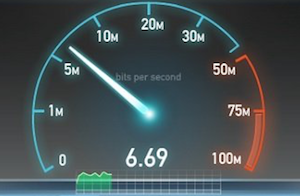
speed-test.png The agency proposed reversing a policy established by the Obama administration’s FCC which raised the definition of “broadband” to 25 Megabits per second (Mbps) download and 3 Mbps upload. The 2015 change better reflected our forward direction in technology. Chairman Ajit Pai’s leadership has questioned that move and is considering reversing course to a 10 Mbps download/1 Mbps upload definition, which reflects speeds more in line with DSL connections. The 10/1 benchmark is already considered obsolete by policy experts who see DSL connections already overly stressed by multi-device households.

Fiber For All and More - Community Broadband Bits Podcast 271

After a friendly coup in the offices of the Institute for Local Self-Reliance, Hannah has taken the podcast host chair from Christopher for episode 271 of the Community Broadband Bits. Hannah grills Christopher on where he has recently traveled, interesting lessons, and recent news around community broadband. (Christopher mentions a great event in Pittsfield - video available here.)

The conversation starts with a discussion of why recent travels strengthened our belief that full fiber-optic networks are the best approach for the vast majority of America in the long term. Christopher and Hannah discuss the future of low-latency networks and what is more cost-effective over decades rather than just over the first few years.

They go on to discuss their fears of the FCC legitimizing satellite and mobile wireless connectivity as good enough for carrier of last resort in rural regions. The show wraps up with a discussion about One Touch Make Ready in Louisville and Madison's RFP for a fiber network partner. 

This show is 26 minutes long and can be played on this page or via Apple Podcasts or the tool of your choice using this feed

Transcript below. 

We want your feedback and suggestions for the show-please e-mail us or leave a comment below.

Listen to other episodes here or view all episodes in our index. See other podcasts from the Institute for Local Self-Reliance here.

Thanks to Arne Huseby for the music. The song is Warm Duck Shuffle and is licensed under a Creative Commons Attribution (3.0) license.

Transcript: Community Broadband Bits Episode 239


Duffy Newman: The reason the carriers are using this type of technology is because they're trying to improve coverage but they're also looking at capacity.

Lisa Gonzalez: This is episode 239 of the Community Broadband Bits Podcast from the Institute for Local Self-Reliance. I'm Lisa Gonzalez. Last week, we talked to Lincoln, Nebraska, a community using its fiber and conduit resources to improve wireless service in the city, using small cell technology. In this episode, Christopher gets the perspective of an infrastructure company that works on small cell deployment with wireless carriers. Duffy Newman is the acquisitions manager and corporate development in strategy for Crown Castle. Chris and Duffy touch on the function of Crown Castle and Duffy offers more detail on how small cells work and the difference between the new small cell technology and the traditional mobile wireless systems.

Christopher Mitchell: Hey folks, this is Chris Mitchell, the most of Community Broadband Bits. I just wanted to ask you if you could do us a real big favor to help us spread this show around. That's to jump on iTunes or Stitcher, wherever you found this show, and to give us a rating. Give us a little review, particularly if you like it. If you don't like it so much, then maybe don't do that, but if you're enjoying the show, please give us a rating and help us to build the audience a bit. Thanks.

Lisa Gonzalez: Now, here's Christopher talking with Duffy Newman, acquisitions manager and corporate development and strategy for Crown Castle.

Christopher Mitchell: Welcome to another edition of the Community Broadband Bits Podcast. I'm Chris Mitchell at the Institute for Local Self-Reliance. Today, I'm speaking with Duffy Newman, the acquisitions manager and corporate development and strategy at Crown Castle. Welcome to the show, Duffy.

Duffy Newman: Thanks, Chris.