

Internet2 President Says Wisconsin Legislation is an Unnecessary Disaster

Internet 2 President H. David Lambert offers some sober words [pdf] to Wisconsin's Governor Walker regarding an 11th hour provision inserted into legislation by AT&T and its telco allies that will kill WiscNet, an essential telecommunications network serving libraries and schools throughout the state. We wanted to note it because it goes beyond WiscNet alone and reminds us that companies like AT&T simply have the wrong incentives to be solely trusted with the future of something as important as ensuring everyone has affordable, reliable, and fast access to the Internet.
Dear Governor Walker,
Today we write to ask for your leadership in removing sections 23-26 of the University Omnibus legislation.
For the United States to be a leader in the global economy, it is critical that government policy does not stifle innovation. One way to inadvertently undermine state and national economic competitiveness goals is to bar those who have been successful in the past from continuing to innovate while creating bureaucratic rules to limit who is eligible to provide services to the marketplace. And, without question, the University of Wisconsin's initiatives and Wisconsin's not for profit Wiscnet have been resounding successes that have changed the lives of citizens in Wisconsin and throughout the world.
Draft language Bars Innovation and Reduces Market Choice
The University of Wisconsin has long been recognized as one of the critical contributors responsible for the creation of the Internet. It was the University's faculty leaders who championed the idea of interlinked networks over distance and who prototyped those ideas in real-world settings that evolved into the Internet. Even as telephone providers steadfastly argued that the concept of the Internet would fail, faculty leaders at the University of Wisconsin built the large-scale innovation prototypes that led to the development of the global Internet.
It would be the height of irony if sections 23-26 of the University Omnibus legislation were passed, as those provisions would prohibit the University from being directly involved in proving out further developments of innovations in the Internet that it helped create.

 Whereas, without WiscNet, these institutions would be forced to seek internet services from private telecommunications providers.

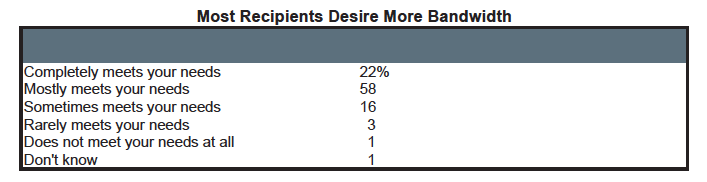 The question is why they want faster connections. Only 20% say their current connection completely meets their need to conduct online testing and assessment applications - with another 44% saying it "mostly" meets those needs.
 These gaps represent a tremendous opportunity for growth - communities should be building their own fiber-optic connections to connect these key institutions and ensure they will have affordable, fast, and reliable connections well into the future. By owning the network, these institutions will have greater control over future costs and their capacity to take advantage of even newer applications.
The FCC should favor locally owned networks to encourage self-reliance instead of never-ending subsidies to private carriers who have little incentive to lower prices and increase investment.
These gaps represent a tremendous opportunity for growth - communities should be building their own fiber-optic connections to connect these key institutions and ensure they will have affordable, fast, and reliable connections well into the future. By owning the network, these institutions will have greater control over future costs and their capacity to take advantage of even newer applications.
The FCC should favor locally owned networks to encourage self-reliance instead of never-ending subsidies to private carriers who have little incentive to lower prices and increase investment.
