
grant

Content tagged with "grant"

Displaying 11 - 20 of 209

Crews Begin Work On Ft. Bragg, California’s Long-Awaited Muni-Fiber Network
Construction crews have begun work on Fort Bragg’s long-awaited municipal fiber network, which will ultimately bring affordable fiber to the California city of 7,000.

The total cost of the project is estimated to be $17 million. Of that, $10 million will be paid for by a Last Mile Federal Funding Account (FFA) grant from the California Public Utilities Commission (CPUC), awarded in February to help fund the construction of a Middle Mile Broadband Network (MMBN) that will run directly through the heart of Ft. Bragg.

The remaining project costs will be paid for by a $7 million, 20-year loan at 4.85 percent from EverBank, recently approved by the Fort Bragg city council.

“This project is a cornerstone for the future of Fort Bragg,” City Manager Isaac Whippy said of the milestone. “Reliable, high-speed internet is no longer a luxury – it’s a necessity. With this investment, we’re closing the digital divide and making Fort Bragg a more connected, competitive, and inclusive community.”

According to a city announcement, Ft. Bragg’s citywide fiber network, 170 miles north of San Francisco, is being designed with a centralized data hub and 15 Distribution Areas (DAs). Using horizontal directional drilling, crews will install conduit and fiber underground – primarily beneath sidewalks and alleys – connecting to a fiber terminal located near the edge of the city’s right-of-way at each property.

Jemez Pueblo Tribe Seeks ‘Light,’ Fiber Knowledge To Advance Digital Sovereignty

For Angela Diahkah, what started as a self-described “side hustle” is now her full-time job.

Diahkah – or “Ange,” as she sometimes goes by – is five years into serving as Network Operations Supervisor and Digital Navigator Program Manager for JNET, the Tribally-owned broadband provider for the Pueblo of Jemez.

Just 50 miles northwest of Albuquerque, Angela leads the charge in building a new fiber network, the gold-standard of Internet connectivity, that once complete will serve her community (one of the 19 Pueblos in New Mexico).

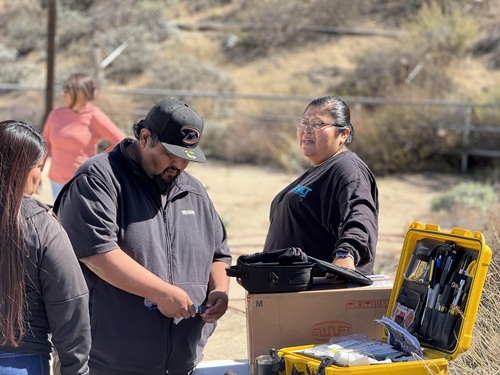
Last week, she was at the 17th Tribal Broadband Bootcamp (TBB) in Aguana, California in the hills above Temecula Valley, along with a half dozen JNET technicians-in-training and JNET Director Kevin Shendo. The 30 or so other TBB participants – representing broadband leaders from several other federally-recognized Tribes – were also there for the three-day immersive learning experience focused on building and operating Tribal Internet networks.

Held in different tribal regions several times a year since the initiative began in 2021, this most recent bootcamp was back at TBB co-founder Matthew Rantanen’s “RantanenTown Ranch.”

Image
Angela looks at her crew explore fiber splicing equipment on a table outdoors on RantenenTown Ranch in the desert-like foothills of Anguana, Califonia

“We're basically trying to find a light in a dark tunnel and just work with what’s best for us,” Angela told ILSR in describing why she and her JNET crew had come, just as they are in the early stages building out their own fiber-to-the-home network.

“We want to expose them to the network,” literally and figuratively, she said.

Waves in Baltimore Gets $2 Million To Deploy Fiber To More Apartment Complexes

The City of Baltimore is using $2 million of its American Rescue Plan Act (ARPA) funding to bring fiber to 12 new city apartment buildings. It’s the latest effort in the city’s attempt to bridge the digital divide and bring affordable Internet access to long-marginalized communities.

According to the formal announcement from the Baltimore Mayor’s Office, Mayor Brandon Scott and the Baltimore Office of Broadband and Digital Equity (OBDE) have awarded the $2 million grant to Waves, a nonprofit formerly known as Project Waves.

“This grant program is more than just wires and signals – it’s about unlocking opportunity,” Scott said of the announcement. “By partnering with Waves, we’re ensuring residents with the greatest need have a chance to learn, connect, and build a better future for themselves and their families.”

Image
Project Waves ribbon cutting

Waves was first launched in 2018 in direct response to the Trump FCC’s repeal of net neutrality and the general failures of federal telecom policy to address digital inequity. Project Waves (profiled by ILSR last year) initially used Point-to-Multipoint wireless connectivity to deliver free wireless broadband service to about 300 multi-dwelling unit (MDU) residents.

In the last few years, the organization has shifted to Hybrid Fiber Coaxial connectivity to provide more reliable connectivity by running fiber to the buildings and leveraging the existing wiring in the multi-dwelling units it serves, providing access to more than 1,000 local Baltimore residents, at no cost to residents.

LUS Fiber Brings Popular Broadband Service Into Church Point, Louisiana

Lafayette Utilities System’s LUS Fiber subsidiary is taking the show on the road. Louisiana’s only publicly-owned broadband provider says it’s expanding access into nearby Church Point, bringing affordable fiber access to the town of nearly 4,200 residents.

LUS Fiber was awarded a $21 million grant to expand fiber outside of Lafayette as part of the U.S. Department of Commerce’s National Telecommunications and Information Administration’s (NTIA) Broadband Infrastructure Program (BIP).

“This expansion not only improves the lives of our residents but also enhances opportunities for businesses, education, and healthcare in our town,” Church Point Mayor Ryan ‘Spanky’ Meche said in a prepared statement. “LUS Fiber’s work here is a tremendous step forward for our community.”

Image
LUS Fiber comes to church point celebration

The expansion is part of a series of new broadband deployments that should bring more than one million feet of new fiber options to numerous new Louisiana communities, including Ville Platte, Venice, Mamou, and Basile. Church Point residents are currently able to start scheduling installations via the LUS Fiber website.

The deployments technically began earlier this year, starting with Ville Platte, which data indicates, currently has the fifth-slowest average broadband speeds in the continental U.S.

Like most of America, much of Louisiana is dominated by a handful of regional telecom monopolies that see little competitive incentive to compete on speeds, coverage, prices, or quality customer service.

Montgomery County Maryland Recognized For Broadband Equity Efforts

Montgomery County Maryland has been awarded the “Best Municipal or Public Connectivity Program,” honored as a 2024 Broadband Nation Award winner for its ongoing efforts to expand affordable broadband access and help bridge the digital divide.

Montgomery County has worked extensively for years to connect municipal services and key anchor institutions, but more recently has begun leveraging that infrastructure to expand access to the most vulnerable. The county’s efforts have two key components:

FiberNet is a 650-mile municipal fiber communication network that provides broadband services to 558 County, State, municipal, educational, and anchor institutions.

MoCoNet is the County’s residential broadband network that provides free 300/300 megabit per second (Mbps) Internet service for residents at affordable housing locations. Originally providing a symmetrical 100 Mbps service, the network was recently upgraded to 300 Mbps, and is currently available to low-income housing communities.

Image
Montgomery County cow in field with tall buildings in background

Montgomery Connects Program Director Mitsuko Herrera tells ILSR that the county just received a $10 million grant from the State of Maryland to expand FiberNet and MoCoNet’s free 300 Mbps offering to 1,547 low-income and affordable housing units at seven properties operated by the County’s Housing Opportunities Commission.

The county’s also in the middle of upgrading its core fiber infrastructure to deliver significantly faster overall speeds.  

Indio, California Gets $9 Million Grant For Fiber Network

Indio, California has been awarded a $9 million state grant the city will use to expand affordable broadband access. The grant award was made possible by California’s $2 billion Last Mile Federal Funding Account Grant Program (FFA), part of a broader $6 billion California “Broadband For All” initiative aimed at bridging the digital divide in the Golden State.

According to Indio officials and the now-finalized CPUC award, Indio – an incorporated city located in Riverside County and home to 92,000 residents – will receive $8.9 million to deliver gigabit-capable fiber to 479 unserved locations and an estimated 3,632 unserved local residents.

“We are still in the design phase and should release an RFP within the next couple of months for the actual build,” Indio Director of Information Technology Ian Cozens told ILSR.

Image
Indio CA fiber map

With 75 percent of the project’s initial target area classified as low-income, city leaders say residents can expect static pricing for at least ten years. The city will also ensure there’s a low-cost option for low-income families left adrift after House and Senate Republicans blocked the funding renewal of the federal Affordable Connectivity Program (ACP).

City officials, however, do not intend to stop there. The plan is to build a citywide fiber network, the full cost of which is estimated to be $35.2 million.

Oakland Secures $15 Million Grant To Bring Broadband Into Underserved Neighborhoods

After two years enmeshed in the unglamorous work of coalition-building, speed test data collection, and pushing state leaders to invest in better telecommunication infrastructure across Oakland’s most disadvantaged neighborhoods, digital equity advocates in the East Bay city are finally seeing the fruits of their labor pay off.

The city was recently awarded a $15 million grant from the state’s $2 billion dollar Federal Funding Account, administered by the California Public Utilities Commission (CPUC).

The grant will fund the construction of a city-owned, open-access, hybrid middle mile/last mile fiber network – one of a half-dozen grant awards the CPUC approved in the first round of funding, most of which went to support community broadband initiatives.

Courtesy of federal Rescue Plan dollars, the infusion of cash will allow the city to deploy nearly 13 miles of new middle mile 144-count fiber, upgrade almost 12 miles of existing city-owned fiber, and add 9 miles of new last mile fiber connections. As the city’s network is built, it will be connected to the state’s new massive open access middle mile network now under construction.

The FFA grants are part of California’s larger Broadband For All initiative, a $6 billion effort aimed at seeding competition and expanding broadband access across the Golden State.

The Oakland project not only paves the way for the city to connect 14 community anchor institutions (CAIs) and nine public safety buildings, it will also expand high-speed Internet access to thousands of unserved and underserved addresses in West and East Oakland.

Surf Internet Expands Fiber In Partnership With Newton County, Indiana

Surf Internet and Newton County, Indiana say they’re expanding a public private partnership (PPP) that will extend gigabit fiber access to 97 percent of the county – or roughly 3,839 Newton County households by the end of this year.

According to a joint announcement, Surf will contribute $6.6 million to the new endeavor, with the Newton County Economic Development Commission (EDC) contributing $4 million. The expansion should extend the gigabit network to Lake Township, Lake Village, Roselawn, Thayer and several additional rural areas.

Image
Newton County Indiana map

Surf Internet also provides access in Michigan and Illinois. The ISP’s service speeds and pricing can vary greatly by market, but range from symmetrical 50 Mbps (megabit per second) service for $35 a month, to symmetrical 1 Gbps (gigabit per second) service for anywhere from $70 to $80 per month, with no caps, hidden fees, or long-term contracts.

Surf Internet first came to Newton County in 2020, when it launched a $1.7 million project– funded by the FCC E-Rate program – that brought fiber connections to the North Newton School District. In 2023, Surf Internet expanded that fiber network to 382 Newton County homes as part of Indiana’s $81 million Next Level Connections (NLC) Broadband Grant Program.

Yellow Springs, Ohio Eyes Next Steps After Successful Fiber Trial

Yellow Springs, Ohio has been thinking about a city-owned fiber network since 2016, when the municipality issued its first white paper discussing its potential benefits.

Since then, the city has made steady inroads on making those plans a reality, recently culminating in a fiber pilot project currently being used by 100 local homes and businesses.

Launched in 2022, the pilot project currently offers locals two tiers of fiber access: A “standard tier” at a symmetrical 300 megabits per second (Mbps) for $45 a month, and a “premium” tier offering symmetrical gig speed service for $65 a month. There currently are no usage caps, long-term contracts, or installation fees.

Image
Downtown Yellow Springs

“Final pricing will be determined after the pilot project, and could be higher or lower depending on the ‘take rate,’ customer service offerings, and other knowledge gained from the pilot,” the project FAQ states.

Currently the fiber network covers roughly 600 potential homes around Yellow Springs, and was funded entirely via a $300,000 grant from Broadband Ohio. The city also provides free Wi-Fi via 12 Wi-Fi access points spread throughout the city’s downtown business district.

Like so many U.S. communities, Yellow Springs sees a dearth of meaningful broadband competition, resulting in spotty access, high prices, and substandard service.

Charter Communications (Spectrum) enjoys a monopoly over next-gen broadband access across the majority of the city. Some areas are peppered with sluggish and expensive AT&T DSL.

Powering Up With BrightRidge in Johnson City, Tennessee - Episode 542 of the Community Broadband Bits Podcast

This week on the show, Christopher is joined by Stacy Evans, Chief Broadband and Technology Officer at BrightRidge, the municipal network for Johnson City, Tennessee. When last we spoke, the electric utility-powered network had just passed its first dozen homes. Three and a half years later, the municipal network has passed more than 10,000 premises. It returns more than $5 million per year to local goverment via payments in lieu of taxes (PILOT) (not to mention keeping electric prices low), and has driven both of the incumbent providers to increase speeds and lower prices. Christopher and Stacy talk about the value that's returned to the region, and how BrightRidge is only gaining steam - it's two years ahead of its build schedule, and using grants and Rescue Plan funds to reach thousands of households not accounted for in the original design, ensuring that as many people will get access to affordable, locally owned fiber as quickly as possible.

This show is 32 minutes long and can be played on this page or via Apple Podcasts or the tool of your choice using this feed

Transcript below. 

We want your feedback and suggestions for the show-please e-mail us or leave a comment below.

Listen to other episodes here or view all episodes in our index. See other podcasts from the Institute for Local Self-Reliance here.

Thanks to Arne Huseby for the music. The song is Warm Duck Shuffle and is licensed under a Creative Commons Attribution (3.0) license.